To be privately owned
CastleWiesberg
Wiesberg Castle
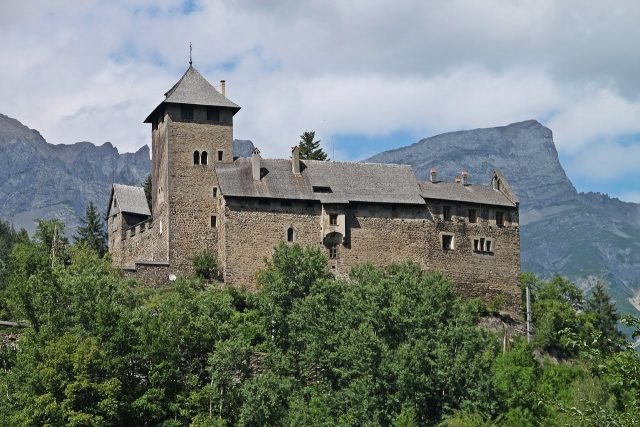
The castle was probably built in the second third of the 13th century. Apart from a Hugo von Wiesberg, who appears around 1271, the Lords of Wiesberg are barely documented. They and the subsequent Lords of Ramüs were vassals of the Bishops of Chur.
Around 1330, a Nanno von Ramüs is mentioned several times. On the occasion of a dispute with the Tyrolean sovereign, the judge of Landeck then besieged the castle and was finally able to capture it. Towards the end of the 14th century, the feudal suzerainty had already tacitly passed from the Diocese of Chur to the Counts of Tyrol. They granted Wiesberg to the Lords of Rottenburg. After his death, princely administrators were appointed.
In 1414, the administrator Moritz Hergassen had the castle equipped with modern firearms. The later administrators and pledge holders also ensured that the defensibility of the complex was not neglected. Among the latter were Hans von Stuben (1431), Cyriak von Haidenreich (1588), Johann Marx Georg Graf von Clary und Aldringen (1679) and Theodor Peregrin von Wolkenstein-Rodenegg (1777). Countess Therese von Wolkenstein-Rodenegg sold her pledged property in 1837 to Michael Fink. In 1852, Wiesberg passed to the Tyrolean provincial government. In 1859, the castle gained a peasant owner in Martin Siegele. However, the new owner cared as little about its preservation and maintenance as the former pledge lords before him.
When the Trisanna Bridge was built in 1885 as part of the Arlberg Railway, the state railways bought the already very dilapidated castle to avoid objections. After the completion of the bridge, they sold Wiesberg two years later to Georg Auer from Saalfelden. However, in an attempt to transform the castle into a luxury hotel, he ran into financial difficulties, so Wiesberg was auctioned off in 1889. The new owner was Hermann Landfried from Heidelberg, who initiated an elaborate general renovation in 1906, which involved a partial new construction. The remarkable interior design was completed by 1940. The Americans occupied the castle in 1945, but soon handed it over to the French occupation forces responsible for Tyrol. Since its return, the well-maintained complex has once again belonged to the Landfried family.
Take Mobile History with you
You are reading this text for free. Premium adds what matters on the road: descriptions read aloud, sites found through your camera, whole regions taken offline.
- Every description, including the ~17,700 Premium sites
- Audio guide: have descriptions read to you on location
- AR finder: see sites through your camera, with distance and bearing
- Unlimited saved sites
14 days free, then from €2.99 a month. Cancel anytime.
Source: Wikipedia · Licence: CC BY-SA 4.0 · Image: Norbert Kaiser
This description draws on the facts documented in the linked Wikipedia article; Wikipedia content is licensed under CC BY-SA 4.0. Wording and editing: Mobile History.
Location: 47.1169, 10.4927