Restaurant
Hotel
CastleWesterburg
Westerburg Castle
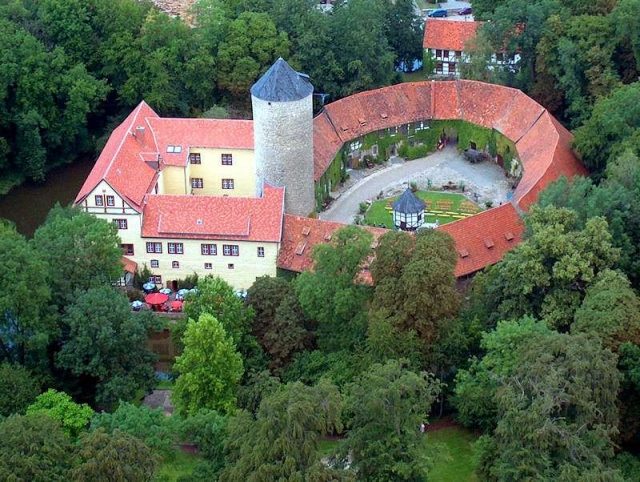
The history of the complex's origins is unknown. It is located on an early, fortified path through the marshy lowlands of the Große Bruch. The castle was probably built around 780 during the Saxon Wars. It may have been founded by Charlemagne as an advanced Frankish stronghold. In the 11th century, an oval round castle measuring 60 x 80 m with a round keep was inserted into the area of a 350 x 300 m ring wall with a moat.
The first documented mention of Westerburg occurred in 1052, when Emperor Henry III gifted the area to the Bishop of Halberstadt. In 1180, the Counts of Regenstein received the castle as a fief and expanded it into one of their strongest fortresses. Towards the end of the 13th century, it was converted into a residential complex, with the ring wall, up to 1.95 meters thick, simultaneously forming the outer wall of the houses.
On July 14, 1596, two women, and on May 12, 1597, three more women from Rohrsheim were burned at Westerburg for witchcraft, on behalf of Amtmann Peregrinus Hünerkopf.
After the death of the last Count of Regenstein, the castle reverted to Halberstadt administrative law. Over the following centuries, the owners of the old fortress changed constantly:
* 1599, after the extinction of the Regensteins, Westerburg fell back to the Bishop of Halberstadt, Duke Julius of Braunschweig; various enfeoffments and pledges
* 1630, Swedish troops occupied the castle during the Thirty Years' War, but no destruction occurred
* 1648, the Bishopric of Halberstadt, and thus Westerburg, passed to Brandenburg-Prussia;
* 1681, completion of the baroque castle chapel under Henning Adolph von Steinberg and Anna Catharina von Münchhausen
* 1701, after several changes of ownership, renovations and structural additions, Prussian princes (Frederick I, Frederick II, Heinrich Ludwig) became owners of the now Westerburg domain.
* 1770, lease of the castle to the Wahnschaffe family with the condition to cultivate the marshy "Große Bruch".
* 1802, it became a Prussian state domain
* 1952, it served the LPG Westerburg as an administrative seat with stables, apartments, and a small restaurant
* 1990, lease, maintenance, restaurant operation
* 1999, sale by TLG to private owners; extensive renovation and conversion into a hotel
* July 2, 2000, opening as a 4-star superior hotel with restaurant
Complex+
To this day, two surrounding moats with an intermediate rampart are preserved. The inner moat encloses the oldest castle, an oval complex with a diameter of about 70 m, in whose wall ring the 33 m high keep is integrated in the southwest. This has a circular floor plan and its access is at a height of 12 m. To the west follows a 34 m long castle-like annex with a small inner courtyard. Renovations in the castle area took place mainly in the Renaissance, which is particularly evident in the windows and portals. Also preserved is a wooden pulpit altar in the castle chapel from the end of the 17th century. Also worth seeing: the Count's office, Restaurant Prinzessin Marie Pauline, Knight's Cellar, Prince's and Mirror Hall, baroque castle chapel and the keep.
Take Mobile History with you
You are reading this text for free. Premium adds what matters on the road: descriptions read aloud, sites found through your camera, whole regions taken offline.
- Every description, including the ~17,700 Premium sites
- Audio guide: have descriptions read to you on location
- AR finder: see sites through your camera, with distance and bearing
- Unlimited saved sites
14 days free, then from €2.99 a month. Cancel anytime.
Source: Wikipedia · Licence: CC BY-SA 4.0
This description draws on the facts documented in the linked Wikipedia article; Wikipedia content is licensed under CC BY-SA 4.0. Wording and editing: Mobile History.
Location: 52.0142, 10.8661