To be privately owned
CastleWernstein am Inn
Wernstein Castle
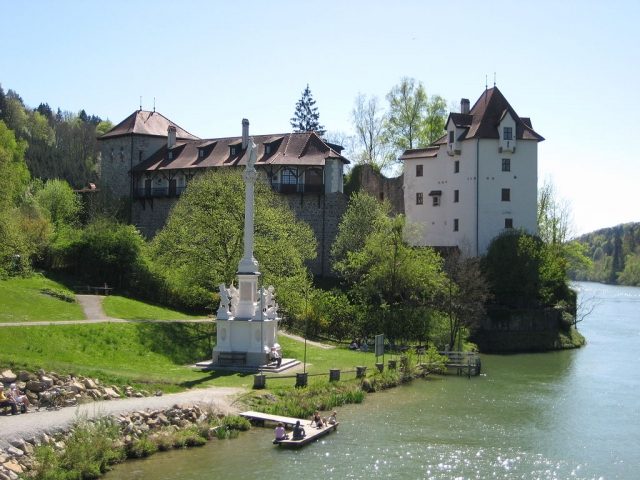
Wernstein Castle is a castle complex in the municipality of Wernstein am Inn in Upper Austria. The castle is located on a granite rock directly next to the Inn river; opposite, on the Bavarian bank, lies Neuburg am Inn Castle.
Wernstein is first mentioned in documents in the 12th century and was built by the Counts of Formbach around 1126 as an outpost of Neuburg. Wernstein was never home to an independent noble family; instead, the lordship was always administered by castle bailiffs from Neuburg. In 1200, an Ortlof de propugnaculo (Ortlof from the outpost), who also called himself Ortlof ob der wer, is mentioned. From the Formbachers, Neuburg, including Wernstein, passed to the Counts of Andechs-Meran. As a dowry of an Agnes from this family, it came to the last Babenberg, Frederick II, also known as Frederick the Quarrelsome. After the divorce from Agnes, he had to return the property to the Andechs family. Premysl Ottokar II, who considered himself the rightful successor of the Babenbergs, forcibly occupied Neuburg and Wernstein in 1257. Eberhard von Wallsee redeemed the Passau pledge on the castles around 1355. In 1379, Duke Albrecht III pledged Neuburg and Wernstein to Otto von Zelking. In 1518, Emperor Maximilian I sold the County of Neuburg to Nikolaus Graf Salm. In 1654, the property passed to Count Ludwig von Sinzendorff. Then followed a change of ownership in 1698 to the Hamilton family and in 1719 to Count Carl Josef vom Lamberg. Through an exchange, Neuburg then came to the Diocese of Passau in 1731; Bishop Dominik Graf Lamberg was the brother of the previous owner. Until 1803 (secularization of the Prince-Bishopric of Passau), Wernstein shared the ownership history of the County of Neuburg and then passed into private ownership.
The castle, which had fallen into ruin, was extensively renovated between 1991 and 1993. It is now in the private possession of the Ernst Dietrich family and is not publicly accessible.
Wernstein Castle today+
Wernstein is considered a so-called curtain wall castle, as there were no other buildings within the castle wall, but rather these were part of the castle wall. The area around the castle rock has been excavated, creating an artificial deep and wide moat. In front of the castle is a pond, which further secured the castle in earlier times. The buildings are concentrated around the access, which is secured by two outworks with an intermediate bailey. To the right behind the gatehouse stood a tower with an attached residential wing, which housed the castle garrison. Today, the tower is partially dismantled, and the covered long wing serves as a barn. To the left of the entrance is the current residential wing, which no longer looks very defensible due to alterations.
In front of the castle is a replica of the Marian column, which was created in 1646 based on a model by Johann Pock.
Take Mobile History with you
You are reading this text for free. Premium adds what matters on the road: descriptions read aloud, sites found through your camera, whole regions taken offline.
- Every description, including the ~17,700 Premium sites
- Audio guide: have descriptions read to you on location
- AR finder: see sites through your camera, with distance and bearing
- Unlimited saved sites
14 days free, then from €2.99 a month. Cancel anytime.
Source: Wikipedia · Licence: CC BY-SA 4.0 · Image: http://commons.wikimedia.org/wiki/File:070415_Burg_Wernstein.jpg
This description draws on the facts documented in the linked Wikipedia article; Wikipedia content is licensed under CC BY-SA 4.0. Wording and editing: Mobile History.
Location: 48.5050, 13.4543