Vineyard
CastleWachenheim
Wachenheim Castle
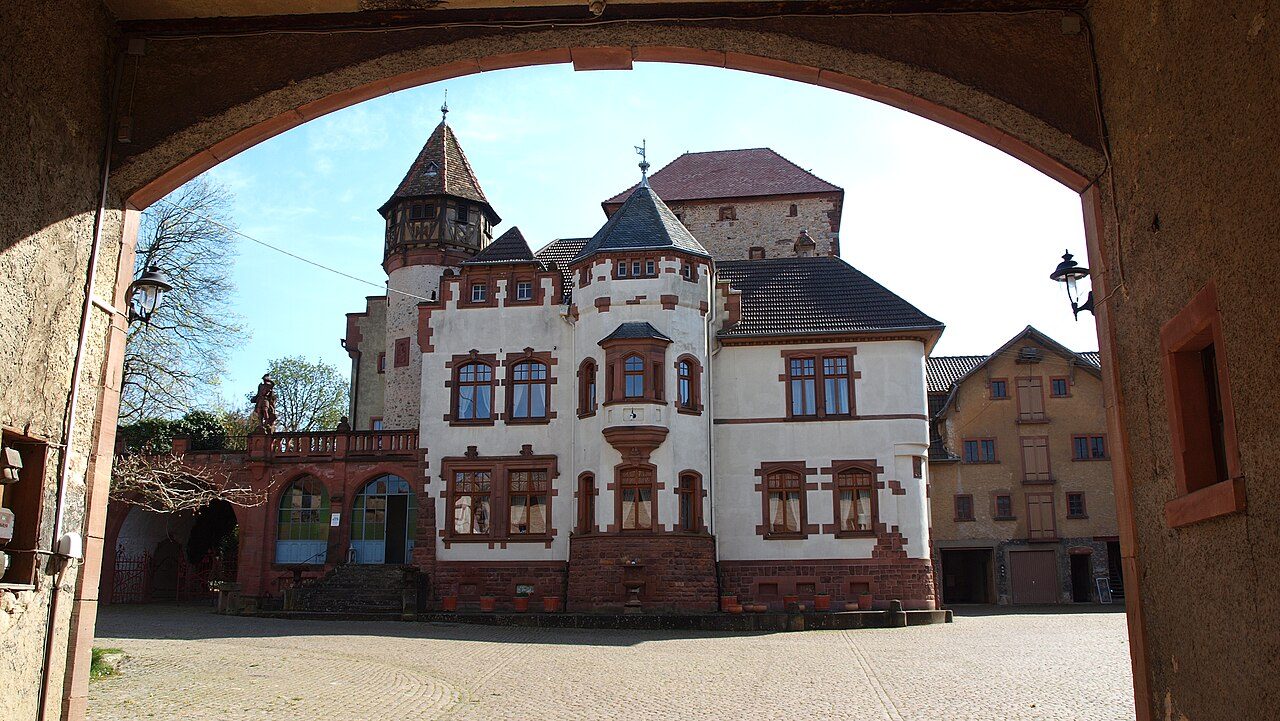
Wachenheim Castle, occasionally also called Oberburg Wachenheim, Wachenheim Castle (Pfrimm) or today Schlossgut Lüll, is a castle or palace complex with a medieval core in Wachenheim in southern Rheinhessen.
It is not to be confused with the Wachenburg, the occasionally mistakenly also called Wachtenburg, or with Schloss Wachenheim in the slightly more southerly town of Wachenheim an der Weinstraße and the sparkling wine cellar Schloss Wachenheim located there.
Location+
The complex is located in the center of the municipality of Wachenheim in the Zellertal (Verbandsgemeinde Monsheim) in the Rhineland-Palatinate district of Alzey-Worms. It stands at an altitude of about 160 m above sea level, a good 200 m south (right) of the Pfrimm. The address is: "Hauptstraße 41–45, 67591 Wachenheim". The associated park is bordered to the south by "Wormser Straße" (B 47). The Wachenheim-Mölsheim stop on the Zellertalbahn, which operates for tourist traffic on Sundays and public holidays during the summer months, is also located nearby.
The origin of the castle is unknown. According to Karl Würth, there were originally three castle complexes in Wachenheim. The oldest is said to have been located in the area of the Romberger Hof and to have been built by or owned by the Archbishopric of Trier. However, there is apparently no confirmed evidence of this from historical sources or archaeological finds.
It is historically confirmed that Count Palatine Ludwig the Strict appointed Emich IV from the Leiningen noble family as a castellan in Wachenheim in 1278, it being assumed that this refers to the town of the same name on the Pfrimm. The existence of a castle in Wachenheim since 1324 is documented, when a "Knight Dietz von Wachenheim" assigned the feudal rights of his share of the castle to Count Palatine Adolf. Already at that time, the then complex was apparently a ganerbe (joint inheritance) of the Lords of Wachenheim, as in 1336 another co-owner, "Gerhard von Wachenheim", bequeathed his share of the property as a fief to the Trier Archbishop Balduin of Luxembourg. In the following years, the castle, which was partly owned by the Wachenheim family or enfeoffed and then apparently at least partially re-transferred, was inhabited by members of the Wachenheim family. This older castle complex was the "Unterburg" or "Unterschloss", of which no structural relics remain today.
The castle still existing today, also called "Oberburg" or "Oberschloss", was built around 1471 or 1480 (possibly after a partial destruction of the Unterburg) in the immediate vicinity with the residential tower still existing today as the origin or core of the new castle. Initially still in the hands of the Lords of Wachenheim, the ownership, possession, feudal and dower rights to the castle changed several times in the following period. Among others, the noble families von der Leyen, Landschad von Steinach, Carben, and Leiningen-Westerburg are mentioned as co-owners, feudal lords and vassals. In the late 18th century, Wachenheim Castle became the property of the von Botzheim family.
The castle, which was neither destroyed in the Palatinate War of Succession nor by French revolutionary troops, was expanded and extended in the 19th and early 20th centuries and came into the ownership of the Lüll family in 1925, who still manage it as owners today.
Description+
The oldest preserved part of the castle is the Gothic keep (apparently) from around 1470/71. It clearly towers over the other castle buildings and the residential houses of the town and is a characteristic landmark in the silhouette of Wachenheim. The rectangular tower with a side length of 11 x 8 meters and a wall thickness of about 1.1 m is built of (today only partially plastered) quarry stones, with some corner stones made of Bunter sandstone. It served as a residential tower and, with its six full stories rising above the cellar vault and the undeveloped attic under the hip roof, is considered the highest of its kind in Rheinhessen. A semicircular stair tower is attached to the northern side, reaching up to the third floor. A side wing is dated to 1572.
The apparently oldest of the farm buildings surrounding the spacious inner courtyard dates from 1617. The gate system was built in 1892, and the other single-story farm wings and stables date from around the turn of the 19th to the 20th century.
The castle or defensive wall enclosing the extensive park with a baroque garden house is dated to the 14th to 16th centuries.
Probably the youngest listed building of the complex is the villa- or small castle-like residential building standing north of the residential tower, built in 1901 in Neo-Gothic style. The two-and-a-half to three-story building consists of plastered and light-painted masonry, while, among other things, the basement, a raised terrace with an attached archway, the corner pilasters, the frames of the doors and windows, and other decorative elements of the facade are executed in unplastered red Bunter sandstone. An octagonal turret of approximately the same height protrudes from the front facade of the residential building. On the west flank is a second, slightly higher round stone tower, whose upper floor, built in half-timbered construction, also has an octagonal shape.
Current Use+
The castle is currently inhabited by its owners and operated as a winery. Private celebrations or occasionally publicly accessible events take place in the castle's rooms and in the approximately 17,000 m² park, which was laid out around 1747 in the Late Baroque/Rococo style and partly serves as a sculpture garden. The inner courtyard, the park, and possibly individual buildings can be visited during these events.
Take Mobile History with you
You are reading this text for free. Premium adds what matters on the road: descriptions read aloud, sites found through your camera, whole regions taken offline.
- Every description, including the ~17,700 Premium sites
- Audio guide: have descriptions read to you on location
- AR finder: see sites through your camera, with distance and bearing
- Unlimited saved sites
14 days free, then from €2.99 a month. Cancel anytime.
Source: Wikipedia · Licence: CC BY-SA 4.0 · Image: Wolkenkratzer / CC BY-SA 4.0 via Wikimedia Commons
This description draws on the facts documented in the linked Wikipedia article; Wikipedia content is licensed under CC BY-SA 4.0. Wording and editing: Mobile History.
Location: 49.6371, 8.1677