To be privately owned
CastleEuskirchen - Wißkirchen
Veynau Castle
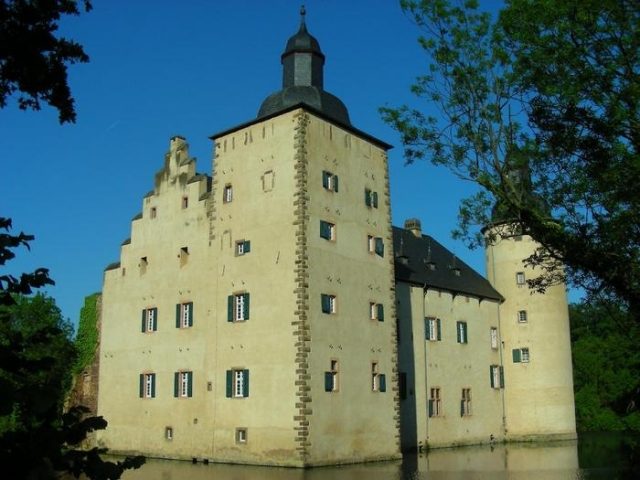
Veynau Castle is a medieval moated castle near the Euskirchen district of Wißkirchen and the largest castle complex in the Euskirchen district in North Rhine-Westphalia. It is one of the most impressive and significant castles in the Rhineland.
The castle is located directly on the Veybach next to the railway line of the Eifelstrecke and the Bundesautobahn 1, from where it is clearly visible when traveling south. It can be reached via the Wißkirchen exit, Bundesstraße 266 and L 11.
Complex+
Of the very extensive castle complex, the outer and inner bailey with two round shell towers and the core castle with palas and two corner towers are preserved. The historic moat, the curtain wall, and wall foundations of the vanished medieval wing buildings are still very clearly recognizable. The imposing manor house made of quarry stone stands on an island, surrounded by a moat, and is accessible through a gatehouse in the 16th-century curtain wall.
Veynau Castle has been a protected monument since 1985. It is privately owned and used as a residential and business premises. The exterior and parts of the interior are freely accessible.
Around 1340, the castle was founded and given by the Margrave of Jülich as a fief to the Truchsess Dietrich Schinnenmann von Aldenhoven, who developed it into the strongest fortress in the region. In 1351, the castle became a Cologne open house. In 1355, it was damaged but immediately rebuilt. In the same year, the castle passed into Jülich possession and became part of the Jülich castle belt around Euskirchen. In 1381, the castle then went as a fief to Balduin von Monyardin. In 1422, he failed to apply to the new sovereign Duke Adolf von Berg for a new enfeoffment with the castle, who then conquered the castle and confiscated the fief.
In 1447, Heinrich von Geisbusch first acquired one, and later the second half of the castle. He died in 1451, and his widow sold the castle to Dietrich I von Bourscheidt. Through a renovation, the castle received its current appearance.
In the Guelders War (1542–1543), the castle was successfully defended against the imperial troops. In the Thirty Years' War (1618–1648), the castle was heavily damaged and repaired from 1661 to 1664.
After the French General Lacroix had the castle burned down in 1708, it was restored, and the towers received their current spires. In 1722, the castle passed to the Palatine Field Marshal Maximilian Carl von Martial, who rebuilt the western part of the manor house. In 1743, Joseph Anton Freiherr Beissel von Gymnich inherited the castle.
In the 19th century, the castle lost its importance and deteriorated into a country estate. In 1843, Duke Prosper Ludwig von Arenberg acquired it. In the 20th century, it stood empty for a long time and fell into disrepair. A severe earthquake affected the castle in 1951. In 1973, the farmer Theodor Bamberg bought the castle from the Arenbergs.
In 1988, it came into the possession of Harald Freiherr von Elmendorff, who extensively restored it with the support of the state of North Rhine-Westphalia, and in whose possession it remains to this day.
Take Mobile History with you
You are reading this text for free. Premium adds what matters on the road: descriptions read aloud, sites found through your camera, whole regions taken offline.
- Every description, including the ~17,700 Premium sites
- Audio guide: have descriptions read to you on location
- AR finder: see sites through your camera, with distance and bearing
- Unlimited saved sites
14 days free, then from €2.99 a month. Cancel anytime.
Source: Wikipedia · Licence: CC BY-SA 4.0 · Image: http://www.wehrbauten.de/thread.php?threadid=568
This description draws on the facts documented in the linked Wikipedia article; Wikipedia content is licensed under CC BY-SA 4.0. Wording and editing: Mobile History.
Location: 50.6387, 6.7182