To be privately owned
CastleVellberg
Vellberg Castle
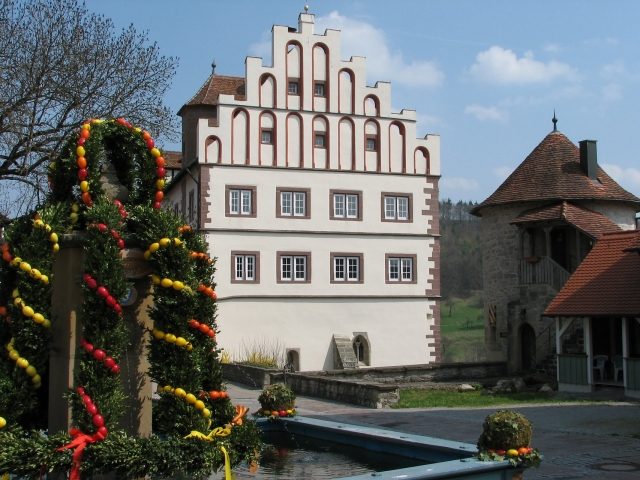
Vellberg Castle (Lower Castle) is a hilltop castle complex on the 360 m above sea level Feldberg, overlooking a loop of the Bühler river at the northeastern tip of the triangular town layout of Vellberg in the district of Schwäbisch Hall in Baden-Württemberg.
The castle was built around 1200 by the Lords of Vellberg. In the 15th century, the Knights of Vellberg expanded the castle and the hamlet in front of it into a fortress and a market, making it the center of their dominion.
Destruction in 1523
In the mid-16th century, the robber knight Hans Thomas von Absberg terrorized the imperial cities in Franconia and Swabia. He kidnapped merchants on their trade journeys and demanded a high ransom for their release. He sought allies who would support him in his raids, on whose castles he could flee in danger and where he could hide his hostages. Wilhelm von Vellberg also supported him in his feud, hoping to replenish his dwindling riches. In 1523, the Swabian League finally sent its troops to raze a total of 23 "robber nests" to the ground. The League's troops, allegedly consisting of 10,000 foot soldiers and 1,000 horsemen, carried 100 cannons and 30 arquebuses as armament, for which they had 900 hundredweight of gunpowder. On June 11, 1523, they reached Vellberg Castle and destroyed Wilhelm von Vellberg's share of the joint inheritance castle.
The woodcut made by Hans Wandereisen clearly depicts the castle's location on a rocky promontory. The houses visible in the foreground of the cut are probably meant to represent the buildings outside Vellberg's walls. However, like many of the topographical features, their location is also depicted rather doubtfully. The troops of the Swabian League are in the process of demolishing half of the castle, which was owned by Wilhelm von Vellberg. Vellberg is the only castle besides Berolzheim that was not or not completely destroyed. (Main article: Wandereisen Woodcuts of 1523)
Further History
The building was rebuilt between 1543 and 1546 by Wolf von Vellberg and his wife Anna Treusch von Buttlar. The builders had their coats of arms carved in sandstone above the entrance portal.
Around 1857, the city of Vellberg acquired the building from the Württemberg Chamber Office, which served as the seat of the city administration until 2004.
The two buildings, which stand on the foundations of the former castle complex, were restored in the 1960s. The entire building has been in private ownership since 2008.
Architecture+
The core castle, whose foundations were later built over with two buildings, is separated from the town by a preserved neck ditch. The property is accessible via the former outer bailey's zwinger and a stone bridge. The southeastern building, the former town hall, still shows remnants of the castle chapel from 1549. The defensive walls, sloping down behind the buildings, offer a view over the river valley to Stöckenburg in the northwest. Furthermore, the castle complex had two zwinger and two zwinger gates, gun towers, an old ditch, and a chancellery tower, which later served as a prison.
Zwinger and Outer Bailey
On the north side of the outer bailey, there is a second gate in the city wall. According to an inscription, this was walled up into a "secret gate" in 1707. To reach this gate, one first had to cross the zwinger, which sloped down to the north. Johann Friedrich Reik's watercolor shows the pointed-arch outer gate, built in 1499, in the right half of the picture. A small half-timbered house was later built on top of it. A large gun tower with an open platform protected the entrance to the zwinger.
Lower Castle and Chancellery Tower
The Lower Castle was erected in 1543/1546 on the foundations and walls of the old castle. The west side of the castle faces the outer bailey. The facade shows cornices that emphasize the division into three stories with regularly arranged windows. In addition, there is a stepped and perforated crenellated gable, which is placed in front of the pointed roof. To the right is the Chancellery Tower. Reik captured this view in a watercolor.
There is also a castle chapel from the 14th century with a fresco cycle from 1549 depicting the Passion story. The keystones of the ribbed cross vaults show the coats of arms of the Vellberg, Buttlar, and Crailsheim families. In addition, founders, knights, and noblewomen of the Vellberg noble family were also depicted. The Knight's Hall (Hook Hall) on the first floor showed hunting scenes of the Haller patricians as wall paintings.
Take Mobile History with you
You are reading this text for free. Premium adds what matters on the road: descriptions read aloud, sites found through your camera, whole regions taken offline.
- Every description, including the ~17,700 Premium sites
- Audio guide: have descriptions read to you on location
- AR finder: see sites through your camera, with distance and bearing
- Unlimited saved sites
14 days free, then from €2.99 a month. Cancel anytime.
Source: Wikipedia · Licence: CC BY-SA 4.0 · Image: Peter Schneider
This description draws on the facts documented in the linked Wikipedia article; Wikipedia content is licensed under CC BY-SA 4.0. Wording and editing: Mobile History.
Location: 49.0876, 9.8829