To be privately owned
CastleTierberg
Tierberg Castle
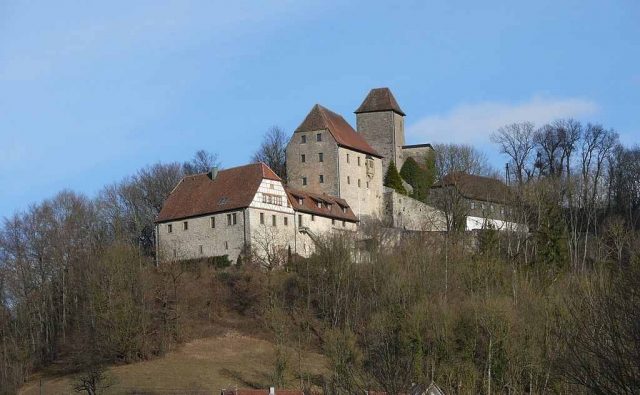
Tierberg Castle is a Staufer-era knight's castle in the Hohenlohe region, located in the district of Steinkirchen, part of the present-day municipality of Braunsbach in the Schwäbisch Hall district of Baden-Württemberg.
The hilltop castle stands on a west-southwest spur created by two converging stream valleys, on the nearly 7 km wide plateau between the Kocher River to the west and the Jagst River to the east. Half a kilometer southwest of the shield wall castle and about 130 m lower, the Hirschbach, flowing from the west through the Heerklinge, empties into the southwest-flowing Weilersbach, which in turn reaches the Kocher a kilometer further down the valley. 4.5 km north of Tierberg Castle stands Stetten Castle, also a shield wall castle, in a similar location directly on the eastern Kocher valley escarpment.
In 1220, the noble free lords of Langenburg had Tierberg Castle built by one of their ministeriales, the knight Arnold von Tierbach. The fortification served to secure or control two nearby long-distance trade routes. The builder of the castle named himself after the castle and was documented in 1226 as Arnold von Tierberg.
Between 1232 and 1235, the lordship of Langenburg came into the possession of the Hohenlohe family. As a result, the knights of Tierberg became Hohenlohe vassals. When they later migrated, a Feldner family from Hall became the owners of the castle in 1300. In 1374, the lordship of Tierberg, including the castle, passed into the direct possession of the Lords of Hohenlohe-Langenburg.
Due to financial difficulties, the reigning lord Ulrich von Hohenlohe sold the castle and its lordship in 1387 for a pittance to two lords of Stetten. This led to a family dispute within the House of Hohenlohe. Gottfried III von Hohenlohe, the brother of the head of the family, sued the Stetten family in 1398 for the return of the castle and payment of compensation for unauthorized use. The lawsuit ended in 1402 with a settlement; this included the conclusion of a new purchase agreement, which granted the Hohenlohe family a right of repurchase, as well as the payment of an additional purchase price. In the following period, the Stetten family expanded the satellite castle, strategically located near their ancestral castle, into a hunting lodge and enlarged the complex. 72 years after the purchase by the Stetten family, in 1474, the descendants of the sellers, the Lords of Hohenlohe-Langenburg, who had by then risen to the rank of counts, demanded the repurchase at the old price, citing the contractually agreed right of repurchase. The Stetten family resisted this request and demanded at least adequate compensation for the construction costs they had incurred. Thereupon, in 1475, armed troops of the Hohenlohe family forcibly expelled the Stetten family from the castle.
This led to a 20-year bloody feud between the two noble houses, culminating in 1488 with a siege and partial conquest of Stetten Castle by the Hohenlohe family. Both adversaries sought support from more powerful authorities. This dispute thus developed into a constitutional conflict between the Emperor and the Imperial Princes over power in the Empire. This so-called Tierberg Feud is considered a co-trigger of the Imperial Reform; it was only settled judicially in 1495.
After 1475, the castle remained in the possession of the later princely House of Hohenlohe-Langenburg for five hundred years. It continued to use the complex as a hunting lodge and expanded and rebuilt it for this purpose. Large hunts were occasionally held here.
In 1974, the Hohenlohe-Langenburg family sold the castle to civilian buyers due to financial difficulties.
Architectural Description+
The castle was built on a mountain spur that slopes steeply on three sides. On the mountain side, to the east, there is a very deep and wide neck ditch. Directly behind the neck ditch rises the fortification wall of the Outer Bailey, which was built later than the core castle and forms a curtain wall around the entire core castle. At the northeast corner, the bailey wall is secured by a round tower. At the other end of the bailey wall at the neck ditch, on the southeast side of the complex, there is a bastion.
Parallel to the outer bailey wall and the neck ditch is a second, inner bailey wall, which was built together with the core castle. This inner bailey is located in front of the shield wall, which forms the mountain-side end of the core castle. The almost square keep is integrated into the center of the 18-meter-high and 2-meter-thick shield wall. This also has a wall thickness of 2 meters, an edge length of 6.5 meters, and is 26 meters high.
The shield wall is now directly covered with a roof on the masonry.
However, two exits in the keep, which are above this end, show that there were battlements on the shield wall in earlier times.
The shield wall and keep are unusually high because the supporting spur at the castle's location has already significantly subsided compared to the adjacent high plateau to the east; despite the low elevation, this height allowed the adjacent terrain to be overlooked and the castle to be defended.
The original core castle is enclosed by two thick, almost parallel walls that form a small inner courtyard connecting the shield wall with the palas, and then continue into the outer walls of the palas.
On the north wall, along the entire length of the courtyard, there is an outbuilding of the core castle. Another, smaller outbuilding stands on the south wall in the courtyard, directly at the shield wall.
On the southeast side of the shield wall, outside the core castle, there is a later-built outbuilding, the so-called Jägerhaus (Hunter's House). It was built on parts of both the inner and outer bailey, extends to the neck ditch, and today forms the access to the castle.
At the tip of the mountain spur, two further outbuildings, also built later, are found on the wall of the outer bailey.
Trivia+
Tierberg Castle, or Tierberg Hunting Lodge, is one of the settings in Agnes Günther's novel "Die Heilige und ihr Narr" (The Saint and Her Fool) and is referred to in the novel as Schloss Schweigen (Silence Castle).
Take Mobile History with you
You are reading this text for free. Premium adds what matters on the road: descriptions read aloud, sites found through your camera, whole regions taken offline.
- Every description, including the ~17,700 Premium sites
- Audio guide: have descriptions read to you on location
- AR finder: see sites through your camera, with distance and bearing
- Unlimited saved sites
14 days free, then from €2.99 a month. Cancel anytime.
Source: Wikipedia · Licence: CC BY-SA 4.0
This description draws on the facts documented in the linked Wikipedia article; Wikipedia content is licensed under CC BY-SA 4.0. Wording and editing: Mobile History.
Location: 49.2521, 9.7865