The Castle can be visited
CastleAlken
Thurandt Castle
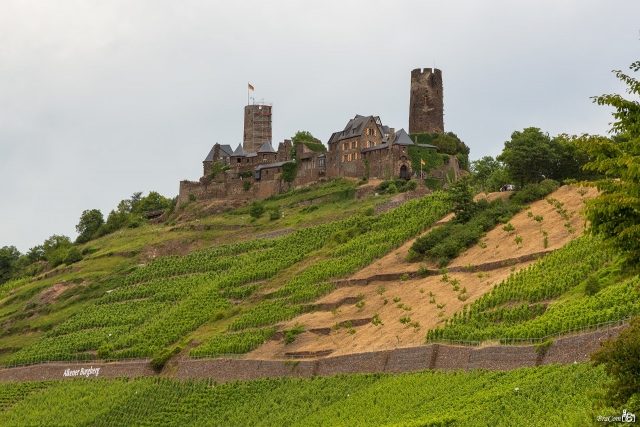
The ruin of Thurant Castle (also Thurandt) stands on a wide slate mountain spur high above the village of Alken on the Moselle. It is located in the Mayen-Koblenz district (Rhineland-Palatinate) and belongs to the type of spur castles. A special feature – in addition to its location on the steep valley shoulder – are the vineyards on the sunny side.
From the middle of the 13th century, the archdioceses of Cologne and Trier were joint owners of the complex and had their respective shares administered by burgraves. Each half therefore had its own keep, its own residential and economic buildings, and a separate entrance.
From the beginning of the 16th century, the double castle gradually fell into disrepair and was completely ruined by destruction during the War of the Palatine Succession. Robert Allmers acquired the complex at the beginning of the 20th century and had parts of it rebuilt. The castle is still in private ownership today, but can be visited all year round for a fee. According to the Monument Protection Act of Rhineland-Palatinate, it is a protected cultural monument and is listed in the state monument list. The entire complex is designated as a monument zone. Furthermore, Thurant Castle is a protected cultural property according to the Hague Convention and is marked with the blue and white protective emblem.
Ceramic finds suggest a Roman settlement of the mountain spur, but the first documented mention of a complex at this location dates only from 1209.
Presumably between 1198 and 1206, Count Palatine Heinrich I the Long from the noble house of the Welfs had a fortification built at the present site to secure the claims of his brother, Emperor Otto IV, in the Moselle region. According to tradition, he named the hilltop castle after Toron Castle near Tyre in present-day Lebanon, which he had unsuccessfully besieged with an army during the Battle of Barbarossa in the Third Crusade. After Count Palatine Heinrich II the Younger died without male offspring in 1214, Emperor Frederick II granted the castle and the town of Alken as an imperial fief together with the Palatinate to the Wittelsbachs, who were loyal to the Staufer.
Due to its location in the Trier region, Thurant Castle was also claimed by the Archbishops of Cologne and Trier. In 1216, Engelbert I of Cologne succeeded in taking the complex by force. Although Pope Honorius III protested against this action, Engelbert maintained his conquest until his death in November 1225, before the castle returned to the possession of the Counts Palatine of the Rhine. Otto II of Bavaria then appointed the knight Berlewin, called Zurn, as burgrave. However, since Berlewin acted as a robber knight and raided the Trier region from his castle, Arnold II of Isenburg and Konrad von Hochstaden joined forces and besieged the castle from 1246 in the so-called Great Feud. In 1248, the complex was taken by them and on November 17 of that year, a peace treaty was signed, which is still preserved today and thus represents one of the oldest German documents. In the document, the Electoral Palatinate renounces Thurant Castle and the associated town of Alken in favor of the two archdioceses.
The archbishops divided the complex into a Trier and a Cologne half, which were separated by a wall and each administered by its own burgrave. Each half had a separate entrance, its own residential and economic buildings, and a keep, today called Trier Tower and Cologne Tower. In the 14th and 15th centuries, both parts of the castle served not only as sub-fiefs but also as collateral. Among the noble families who ruled Thurant from the beginning of the 14th century were the families of Schöneck, Winningen, Eltz, and von der Reck. From 1495, the Lords of Wiltberg were one of the feudal tenants. They used the castle, already described as dilapidated in 1542, as a quarry to build the Wiltberg Castle, also called Wiltburg, in Alken.
During the War of the Palatine Succession in 1689, further destruction by French troops occurred, finally turning the complex into a ruin. Only the two keeps and a 16th-century residential building remained largely intact.
Privy Councillor Robert Allmers acquired the complex in 1911 and had some of its parts rebuilt in 1915/16. Since 1973, it has been the joint private property of the Allmers and Wulf families.
Description+
The majority of the original building fabric still preserved today dates from the period after 1248. The gatehouse was only built during a partial reconstruction of the castle at the beginning of the 20th century, while a residential building, the so-called manor house, was rebuilt between 1960 and 1962 after its destruction in the Second World War.
The entire complex is surrounded by a curtain wall and protected by a neck ditch on its south side.
Trier Castle
The Trier part of the castle complex is accessible via a gatehouse, to which a wooden bridge spanning the neck ditch leads. It is followed by a large inner courtyard, which was transformed into a rock garden by Robert Allmers in the 20th century. From there, the 20-meter-high Trier Tower is accessible, which stands on an elevated plateau to the north. With its three-meter-thick walls at the base, it now serves as a water reservoir and cannot be visited.
On the west side of the inner courtyard, facing the Moselle, is the manor house, a residential building still in use today, which was rebuilt on old foundations between 1960 and 1962, as it had been destroyed during the Second World War by American artillery fire and a subsequent fire. At the northwest corner of the building, a battlement begins on the western curtain wall, facing the Moselle, which continues into the Cologne part of the castle.
A second, smaller gate leads from the inner courtyard into the northwest-lying courtyard of honor, where the only preserved of formerly three existing cisterns of the castle is located. Its shaft is about 20 meters deep. The courtyard of honor was formerly enclosed on its northwest side by a thick wall, of which today only a section remains in full height and strength.
In the northern corner of the courtyard of honor stands a three-story building, the uppermost floor of which was built in half-timbered style and today serves as a holiday apartment together with the first floor. On the ground floor is the castle chapel with old wall and ceiling frescoes, whose furnishings include a Baroque altar from 1779 and a baptismal font from 1515. Northeast of the building is the still preserved ground floor of the Trier Palas.
Cologne Castle
Formerly, the Cologne half of the castle was only accessible via a narrow wooden bridge and the adjoining Palatine Gate at the northwest corner of the complex. The gate is followed by an inner courtyard, at the southeastern end of which stand two round towers, connected by an intervening, covered battlement. Inside the southern tower, wall paintings are preserved, showing the coats of arms of all owners and feudal lords of the castle.
Via the former border wall to the Trier half of the castle, the southern round tower is connected to the ruin of the Cologne Palas from the 16th century on the east side of the complex. Formerly housing the knight's hall, the building was destroyed by Napoleonic troops in 1812/13, so that today, in addition to the cellar, only the ground floor is completely preserved. Of the higher floors, in addition to the gable walls with fireplace cutouts, parts of the northeastern outer wall are also preserved. It has window openings in the Late Romanesque style, which, however, do not belong to the original building fabric but were added only at the beginning of the 20th century.
At the northern end of the castle stands the so-called hunting lodge with two turrets, which, like the manor house, has been rebuilt on old foundations. Its ground floor is occupied by a single room with dark wood paneling and a beamed ceiling, which serves as an exhibition space for hunting trophies, armor, old weapons, and finds from excavations. The building is connected by a covered battlement to the Cologne Tower, whose first floor formerly served as a dungeon. Today, torture instruments can be seen there.
Take Mobile History with you
You are reading this text for free. Premium adds what matters on the road: descriptions read aloud, sites found through your camera, whole regions taken offline.
- Every description, including the ~17,700 Premium sites
- Audio guide: have descriptions read to you on location
- AR finder: see sites through your camera, with distance and bearing
- Unlimited saved sites
14 days free, then from €2.99 a month. Cancel anytime.
Source: Wikipedia · Licence: CC BY-SA 4.0 · Image: © BraCom (Bram)
This description draws on the facts documented in the linked Wikipedia article; Wikipedia content is licensed under CC BY-SA 4.0. Wording and editing: Mobile History.
Location: 50.2482, 7.4529