Cultural Events
CastleExtertal - Asmissen
Sternberg Castle
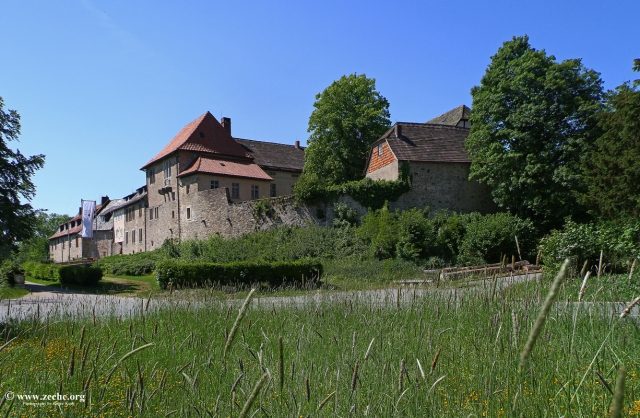
Sternberg Castle is located in the Lippe district of North Rhine-Westphalia, on the western border of the municipality of Extertal with the municipality of Dörentrup. The owner of the hilltop castle is the Landesverband Lippe. The castle is situated at an altitude of 315 meters on a spur of the Dörenberg, offering views over the Lipperland as far as the Teutoburg Forest.
The ruins of "Alt-Sternberg" castle, located about 1.5 kilometers northwest and already in use in the 12th century, are considered a precursor to Sternberg Castle.
From Construction to the Thirty Years' War
The oldest foundations of Sternberg Castle's ring wall can be dated to around 1100 through ceramic finds. This enclosing wall was significantly improved and expanded in the mid-12th century, with rammed earth floors and post constructions detectable on the inside of the wall during this period.
The construction of a stone residential tower at the northwestern corner of the castle hill occurred around 1240 by Count Heinrich I of Sternberg, who is documented as the first bearer of the name "von Sternberg" since 1243, having previously been known as Heinrich III of Schwalenberg. Rich tithe and lease revenues from the surrounding lands, but above all significant income from salt production in Bad Salzuflen, enabled the construction of Sternberg Castle. The ownership of the castle by Heinrich Count of Sternberg is documented for the year 1245, the first documentary seal with the Sternberg coat of arms dates from 1252, and the first documentary mention of Sternberg refers to the year 1266.
The Sternberg counts soon ran into financial difficulties; in 1317, Count Simon I zur Lippe referred to himself as "Tutor" (guardian) of the Lords of Sternberg. The castle itself continued to bear this name even after the death of the last Sternberg count in 1399.
From 1369, the castle and county of Sternberg were pledged to Count Otto von Holstein and Schaumburg and sold to the Schaumburg counts in 1377. Johann I, the last Sternberg count, renounced his reserved right of repurchase in 1391. Thereafter, Count Otto von Holstein and Schaumburg successively pledged parts of the county of Sternberg, Barntrup Castle and town, and Salzuflen village to the noble Lords zur Lippe.
In 1405, Sternberg Castle and County were pledged to the noble Lords Bernhard VI zur Lippe and Count Hermann zu Everstein, who subsequently had considerable disputes over the Sternberg pledge (Everstein Feud). Hermann zu Everstein withdrew from the contract, and in the following period, the noble Lords zur Lippe continued to pledge the castle. Pledges were held by the noble families of Zerssen, Quernheim, Münchhausen, Wend, Molenbeck, de Went, Westphal, and Kerssenbrock.
From the first half of the 15th century, the noble Lords zur Lippe carried out extensive extensions, building the south tower, the steward's house, and expanding the lower castle gate. This was urgently needed, as the dispute between the noble Lords zur Lippe and the Schaumburg counts, known as the "Sternberg War," culminated in 1424 with the devastation of the towns of Barntrup and Bösingfeld, as well as Alverdissen Castle. It is not known to what extent Sternberg Castle was affected. However, the historian Franz Carl Theodor Piderit reports that Sternberg Castle [...] burned down in 1430 but was soon rebuilt thereafter. The castle also suffered greatly in the Soest Feud. In 1444, documents report that "de Sternberg gebroken was" (Sternberg was broken). The damage was promptly repaired, as in 1447, the pledge holder Johann von Molenbeck successfully defended the castle against an attack by an army of 15,000 men led by Archbishop Dietrich of Cologne.
From 1471, tensions arose again between Schaumburg and Lippe over the Sternberg pledge, with Sternberg Castle and office held by Bernhard VII zur Lippe. It was among the duties of the church lords of Bösingfeld, since 1492, to read a monthly requiem mass for Bernhard in the chapel at Sternberg.
From 1521, the castle and office of Sternberg were administered by a bailiff residing in the castle. In 1564 and 1583, Sternberg was occupied by mercenaries of the Counts zur Lippe during renewed disputes over the Schaumburg share in Sternberg. Another impending conflict over Sternberg was settled by the marriage of Count Simon VI zur Lippe to the widowed Elisabeth von Schaumburg in 1585. In 1588, the baptism of their first child took place at Sternberg Castle.
Simon VI commissioned master builder Hermann Wulff to convert the north tower into a palas, now the Knights' Hall. He also commissioned the stonemason Master Peter Steinbohm for the door frames on the ground floor of the north tower and the fireplace in the Knights' Hall, whose mantelpiece displays the coats of arms commemorating the marriage of the houses zur Lippe and von Schaumburg.
From the Thirty Years' War to 1945
During the Thirty Years' War, in 1632, the renowned General von Pappenheim took up quarters at the castle. In 1636, Sternberg was shelled by artillery, and in 1665, "zwo neue gemauerte Rundelen" (two new brick rondels) and "zwo halbe Mauern" (two half walls) were constructed at the fortress.
In the 18th century, Sternberg became quiet; around 1723, the steward's house was rebuilt. Due to financial difficulties, Count Simon Henrich Adolph von Lippe pledged Sternberg Castle in 1733 to the House of Hanover, then owned by King George II of Great Britain. For a payment of 410,000 silver thalers, delivered in an ox cart, the British king secured all rights to the Sternberg office. Only Count Simon August ended the English rule over Sternberg in 1781 by repurchasing it. The 19th century saw numerous extensions. Under Princess Pauline zur Lippe, a new superstructure was added to the outer castle gate in 1803, and the gatehouse with the official prison was rebuilt in 1805. In 1844, the old bell house was demolished and replaced by a new building; in 1859, the annex to the southern residential tower was demolished and rebuilt; in 1877, the inner gatehouse was extended and remodeled. Thus, Sternberg Castle essentially acquired its present form.
Until 1919, Sternberg Castle was used as a Princely Head Forestry Office, also for numerous hunting parties hosted by the Princes zur Lippe. With the expropriation of the nobility in 1919, Sternberg Castle fell to the State of Lippe. In 1921, a small youth hostel was established in the office (lower castle), and in 1929, the Sternberg Head Forestry Office was moved to Brake Castle. From 1931 to about 1935, innkeeper Krüger operated the youth hostel along with an attached catering service.
From 1935, Sternberg was used as an SS training center, where the wives of higher-ranking officers were taught ballroom etiquette for receptions and similar official occasions (popularly known as the SS Brides' School). In 1943, the musical instrument maker Peter Harlan, brother of director Veit Harlan, took command of the castle as an air force officer. Contrary to his orders, he did not destroy it during the Allied invasion in 1945 but handed it over to the Allies.
1949 to Today
After the war, Peter Harlan established a musical instrument collection in the castle, transferring his personal collection from his original home in Saxony to the castle. Harlan continuously expanded the collection and resumed instrument making. In addition to building recorders, to whose renaissance he contributed significantly, he primarily developed instruments that were easy to build oneself, such as a newly developed form of the fiddle, and dedicated himself to establishing a music meeting place to promote amateur music. After Peter Harlan's death, his sons Till and Klaus continued the work, ultimately leading to the "Klingendes Museum" (Sounding Museum) now located in the castle.
In 1949, the newly founded Landesverband Lippe became the owner of Sternberg Castle. On the initiative of the first association chairman Heinrich Drake, the then district of Lemgo established a district youth home, incorporating the entire lower castle, which was completed in 1952 and initially had a capacity of 40 beds. Due to high demand, it was expanded and extended to 120 overnight places by 1962, including a swimming pool. This facility existed until the merger of the districts of Detmold and Lemgo in 1974 to form the present district of Lippe, and was affiliated with the German Youth Hostel Association. Subsequently, no further expansion or renovation work was carried out; the lower castle and the steward's house were used by the district of Lippe as social housing and a transitional shelter until 1998.
In 1996, the Landesverband Lippe conducted a symposium on the future cultural use of Sternberg Castle, whose concept formed the basis for applying to the state ministries for subsidies for the planned construction projects. In the same year, the Sternberg castle complex was entered into the monument list of the municipality of Extertal as an archaeological monument. The Landesverband Lippe, the district of Lippe, and the municipality of Extertal received positive decisions from the Düsseldorf ministries, so that nothing stood in the way of the structural and cultural renewal of Sternberg Castle.
The Landesverband Lippe carried out extensive construction and renovation work on Sternberg Castle between 1998 and 2003, with monument protection playing a prominent role. Both during the gutting of the buildings and in the use of materials for the interior design, the results of building research and archaeological excavations were taken into account, and historical models were followed.
The result of the work is the concept, still valid today, of the castle's multifunctional use both as a cultural event venue with a focus on music, and as a setting for seminars, workshops, and private celebrations. After the completion of the first construction phase in 2001, the Institute for Lippe Regional Studies, on behalf of the Landesverband Lippe, organizes its own concert series with a focus on early music and classical music. High-caliber artists, such as the Bremer Kaffeehausorchester or historical ensembles under the direction of Jürgen Grüner, were engaged for this purpose. Since the end of the renovation work in April 2003, the Institute for Lippe Regional Studies has maintained a branch office at Sternberg Castle.
In September 2002, the castle was named Monument of the Month in Westphalia-Lippe.
Take Mobile History with you
You are reading this text for free. Premium adds what matters on the road: descriptions read aloud, sites found through your camera, whole regions taken offline.
- Every description, including the ~17,700 Premium sites
- Audio guide: have descriptions read to you on location
- AR finder: see sites through your camera, with distance and bearing
- Unlimited saved sites
14 days free, then from €2.99 a month. Cancel anytime.
Location: 52.0534, 9.0489