Leisure home of the Protestant community in Pforzheim
CastleNeuhausen-Steinegg
Steinegg Castle
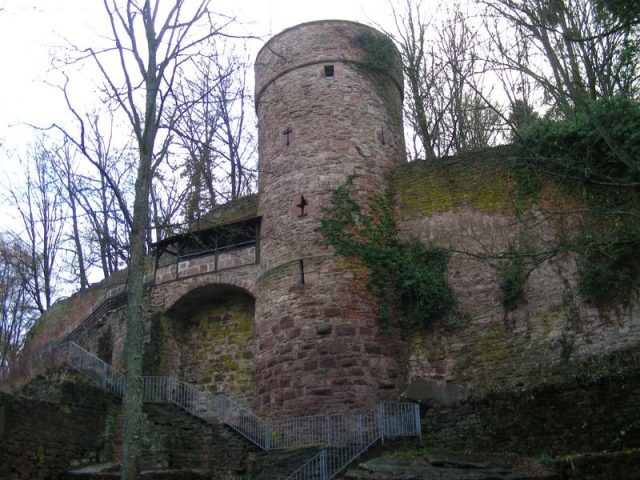
Steinegg Castle is a late medieval castle in the eponymous Steinegg, a district of the municipality of Neuhausen, in the Enzkreis in Baden-Württemberg, Germany. The castle now serves as a recreational home for the Protestant parish in Pforzheim.
On the terraced hilltop behind the current Steinegg Castle, the high medieval Steinegg Hill Castle was located. Its builder is considered to be Adalbert von Steinegg, a ministerialis of the Counts of Calw. The hill castle, along with its associated lordship, came into the possession of Wolf I vom Stain in 1324. Following the suppression of the Schleglerbund, the lordship and the castle were sold to Dieter von Gemmingen, who moved into the Schlegler Castle. His namesake son built a new castle below the old hill castle, of which only foundations remain today, and received the villages of Steinegg, Tiefenbronn, Mühlhausen, Hamberg, Schellbronn, Hohenwart, Lehningen, and Neuhausen, as well as forest in Hagenschieß, as a fief.
The castle then remained the seat of the Lords of Gemmingen-Steinegg for centuries and was expanded from an initially fortified castle into a representative palace. In 1520, a castle chapel was built, followed in the first half of the 18th century by the Hamberg Forest Chapel, erected on a rock in the forest near the castle. The last inhabitant of the castle was Julius von Gemmingen-Steinegg (1774–1842), who, in the entourage of Alois Henhöfer, converted from Catholicism to the Protestant church in 1823, handed over the property in Steinegg to his sons Eduard and Gustav in 1835, and moved to Stuttgart. The sons sold the castle to the state of Baden in 1839. The state intended to establish a brewery or spinning mill on the premises. However, this displeased Eduard von Gemmingen-Steinegg so much that he reacquired the castle in 1840. At his command, the roofs of the castle were then removed, whereupon the complex fell into ruin.
From 1931, Baroness St. Clair von Gemmingen, a granddaughter of Julius von Gemmingen, campaigned for the preservation of the ruin and soon also for the reconstruction of the buildings. After her death in 1951, Irmgard von Bistram, great-granddaughter of Julius von Gemmingen, continued the reconstruction. Through a hereditary building right contract, the Protestant parish of Pforzheim came into possession of the complex in 1958. With its own funds, state subsidies, and donations from the von Gemmingen family, the castle was finally largely rebuilt and converted into a recreational home.
Take Mobile History with you
You are reading this text for free. Premium adds what matters on the road: descriptions read aloud, sites found through your camera, whole regions taken offline.
- Every description, including the ~17,700 Premium sites
- Audio guide: have descriptions read to you on location
- AR finder: see sites through your camera, with distance and bearing
- Unlimited saved sites
14 days free, then from €2.99 a month. Cancel anytime.
Source: Wikipedia · Licence: CC BY-SA 4.0 · Image: http://www.wehrbauten.de/thread.php?threadid=1586
This description draws on the facts documented in the linked Wikipedia article; Wikipedia content is licensed under CC BY-SA 4.0. Wording and editing: Mobile History.
Location: 48.8150, 8.7871