Restaurant
CastleHahnstätten-Burgschwalbach
Schwalbach Castle
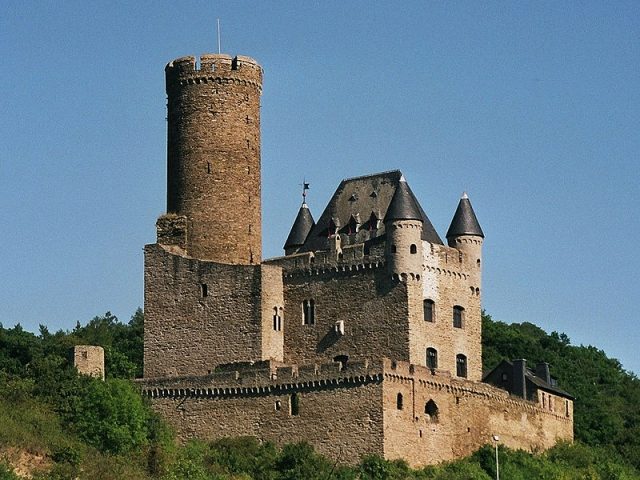
Schwalbach Castle is a late medieval hilltop castle in the town of Burgschwalbach in the Rhein-Lahn district in Rhineland-Palatinate.
The castle was built starting in 1368 by Count Eberhard V of Katzenelnbogen to secure the northeastern border of his territory. However, the reported completion date of 1371 is considered unlikely due to the seemingly much too short construction period. The surrounding settlement must have existed before the castle, because also in 1368, Emperor Charles IV granted it town rights, which was associated with permission to build fortifications and to hold a weekly market on a service day. Nevertheless, the settlement did not develop into a city and was referred to as a "Flecken" (small town) until the 18th century.
In 1536, the castle fell to the House of Nassau. After an inheritance division, Count Wilhelm of Nassau-Weilburg received Burgschwalbach in 1594, as well as the administrative district managed from there. He made the castle his residence. His widow Erika used the castle as her dower house until 1628 and had parts of the complex repaired. Until 1720, the building housed a Nassau-Weilburg office.
By 1737, repairs would have been necessary again. Given the high costs, the administration of Nassau-Usingen, to which Burgschwalbach now belonged, decided to let the castle fall into disrepair. Inventory, wooden components, and the roof were therefore auctioned off and removed.
In 1817, master carpenter Georg Philipp Schnabel bought the gatehouse. His family opened a restaurant in the castle in 1858. A restaurant still exists there today.
After battlements broke out of the curtain wall in 2006, the structure was initially scaffolded to allow for safety measures and investigations. The castle has been undergoing renovation since 2010.
Complex+
The castle was built from slate rubble stone. The entire complex has a pentagonal floor plan. The round keep is about 40 meters high. Other components of the complex include a round courtyard, a hall building, and a three-story palas. The outer wall ring is equipped with two towers. The keep is additionally secured by a neck ditch. Early on, the castle had a water pipeline (from the Präbachtal over the Eichelberg to the castle). From 1545 it was no longer usable and was replaced in 1598 by a pipeline of clay pipes, the remains of which were found in 1962.
Chapel
The castle chapel, which had already fallen into disrepair by the end of the 16th century, was restored under Countess Erika. Services are documented there again from 1603. The painted winged altar from 1517 is in the magazine of the Wiesbaden State Museum. The wings of the altarpiece on the left and right show four female saints on a patterned gold background. The outer cover of the left wing is painted with a depiction of a bishop's consecration. The right wing cover shows the Annunciation. On the back of the altar's central part, Saint Christopher is depicted.
Take Mobile History with you
You are reading this text for free. Premium adds what matters on the road: descriptions read aloud, sites found through your camera, whole regions taken offline.
- Every description, including the ~17,700 Premium sites
- Audio guide: have descriptions read to you on location
- AR finder: see sites through your camera, with distance and bearing
- Unlimited saved sites
14 days free, then from €2.99 a month. Cancel anytime.
Source: Wikipedia · Licence: CC BY-SA 4.0 · Image: http://de.wikipedia.org/wiki/Datei:Burg_Schwalbach-F-27-B-2-2004-09-08.jpg
This description draws on the facts documented in the linked Wikipedia article; Wikipedia content is licensed under CC BY-SA 4.0. Wording and editing: Mobile History.
Location: 50.2846, 8.0806