To be privately owned
CastleLa Neuveville
Schlossberg Castle (La Neuveville)
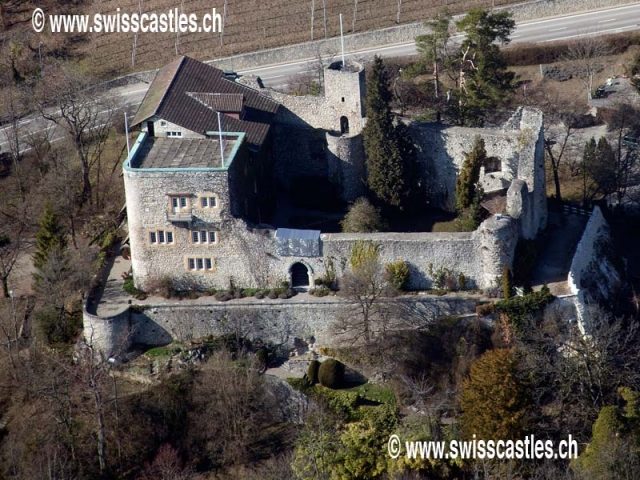
In the Bernese Jura, the southern part of the former Prince-Bishopric of Basel, very few remains of medieval castles have been preserved. The ruins of Erguel near St-Imier are among the most important, but above all, in the area of the upper Lake Biel, the complex on the Schlossberg above La Neuveville (Neuenstadt). It no longer resembles the proud fortress, topped by pointed towers, seen in 18th-century views. After a period of decay in the 19th century, it has become habitable again thanks to two restorations.
The builder towards the end of the 13th century was the energetic Basel Bishop Heinrich von Isny. He sought to secure his dominion in the Jura against that of the Counts of Neuchâtel. The castle on the Schlossberg, right on the border of his territory, was a means to this end. The rivalry between the various secular and spiritual powers produced peculiar results. Thus, within a few decades, several fortified places emerged in a very small area: after the Schlossberg complex (1283/88), the long-vanished town of Nugerol on Neuchâtel soil (1309), then La Neuveville, a foundation of Bishop Gerhard von Vuippens (1312), finally Le Landeron, again by the Neuchâtelers (1325). Not only that: the Schlossberg was supplemented to the south by an outer bailey called La Baille, which was to accommodate servants. It became largely superfluous after the city at the foot of the mountain was founded, but some of its buildings existed until the 17th century.
The castle was affected by acts of war in early winter 1367. The Bernese, who were advancing against the bishop at the time, besieged it, but came up short and had to retreat. In the mid-15th and 16th centuries, the Schlossberg was expanded into a residence. A main building erected transversely to the slope and, to the east of it, the courtyard fortified by several round and semi-circular towers, against whose walls outbuildings leaned, henceforth gave it the appearance it bore until the demise of the Prince-Bishopric. However, the castle was hardly used after the Reformation had taken hold in the southern Jura, which was allied with Bern. Little would have been missing, and it would today only exist as a ruin. The two restorations, first in a romantic sense after 1880, and later according to the sensibilities of 1930, saved the structure.
Today it belongs partly to the city of La Neuveville, partly to the Canton of Bern, and is privately rented.
Take Mobile History with you
You are reading this text for free. Premium adds what matters on the road: descriptions read aloud, sites found through your camera, whole regions taken offline.
- Every description, including the ~17,700 Premium sites
- Audio guide: have descriptions read to you on location
- AR finder: see sites through your camera, with distance and bearing
- Unlimited saved sites
14 days free, then from €2.99 a month. Cancel anytime.
Source: Wikipedia · Licence: CC BY-SA 4.0
This description draws on the facts documented in the linked Wikipedia article; Wikipedia content is licensed under CC BY-SA 4.0. Wording and editing: Mobile History.
Location: 47.0663, 7.0844