Hotel
CastleHohen Demzin
Schlitz Manor
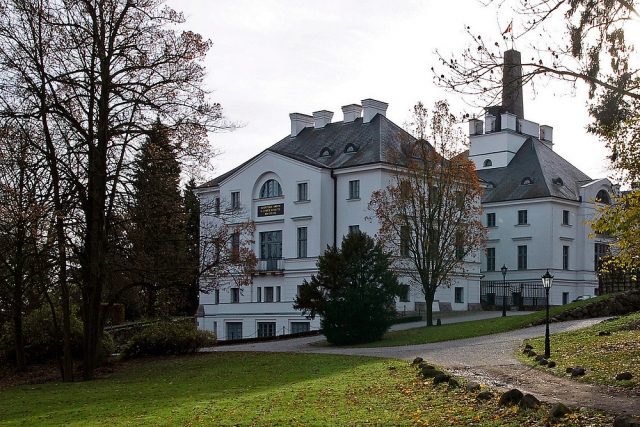
Burg Schlitz is a district of Hohen Demzin in the center of Mecklenburg Switzerland. Burg Schlitz is located west of Lake Malchin on Federal Highway 108 between Teterow and Waren and stands out due to its magnificent manor house amidst a park with valuable trees.
The name of the estate refers to the Hessian noble family of the Imperial Counts of Schlitz genannt Görtz. Hans von Labes (1763–1831), originally from Großwoltersdorf-Zernikow, lord of the manor of Karstorf, was adopted by his future father-in-law Johann Eustach von Schlitz (1737–1821) and elevated to the rank of count by the king to be able to marry Louise Caroline von Schlitz (1774–1832), thus becoming Count von Schlitz genannt Goertz. In 1798, he was a co-initiator and the first director of the Mecklenburg Agricultural Society.
In 1806, Hans von Schlitz had the predecessor building (a dilapidated castle) demolished and, according to plans by Otto Hirt and under the direction of Friedrich Adam Leiblin, built the three-winged Neoclassical manor house on the Buchenberg. The three wings of the building are arranged in parallel and executed as plastered structures. The two-story central wing is slightly set back and features a semicircular columned portico with a grand staircase as its main entrance, as well as a superimposed observation tower; the two three-story side wings each conclude with a gabled risalit. The building is considered the largest Neoclassical complex in Mecklenburg and was completed in 1824, after an interruption due to war, along with the surrounding park and Karolinenkapelle. The builder, von Schlitz, was significantly involved in the planning; he designed the extensive park himself. In 1831, Heinrich Graf von Bassewitz-Schlitz (1799–1861), who was married to the count's daughter, took over the estate.
In 1931, after bankruptcy, the estate came into the possession of the Mecklenburg Agricultural Society, which sold it in 1932 to Emil Georg von Stauss, then general director of Deutsche Bank. He made the castle available to the Nazis very early on as a meeting place and retreat. In 1945, it was expropriated, and the manor house was used as refugee accommodation and a school, and from 1955 as a retirement home. In the 1990s, the manor house was renovated and converted into a hotel.
Sights+
The Knights' Hall in the castle is designed in the Neo-Gothic style. In the so-called Schinkel Hall of the castle, there are wallpaper paintings with floral and animal motifs, as well as two tiled stoves designed by Karl Friedrich Schinkel. Neoclassical wall paintings are preserved in other rooms (entrance hall, staircase, garden hall, galleries).
In the 60-hectare landscape park with its associated park forest, there is the Neo-Gothic Karolinenkapelle, which Hans Graf von Schlitz dedicated in 1822 to his mother-in-law, Imperial Countess Caroline von Schlitz-Goertz. The park also contains a burial site with an entrance gate and Alexander Cross ("FAITH LOVE HOPE 1824"): "Here rests in God" Friedrich Graf von Bassewitz (* April 17, 1855; † November 23, 1923), lord of Burg-Schlitz, his wife Magdalene von Bassewitz, née Freiin von Maltzahn († June 22, 1945; without tombstone) and their son Rudolph Graf von Bassewitz (* January 14, 1885; † July 27, 1922). The park also contains the grave of Karstorf mayor Hermann Schubert (* August 28, 1901: † May 2, 1945).
The Nymph Fountain in the park was designed in 1903 by Walter Schott in Art Nouveau style for the fountain courtyard of the Wertheim department store in Berlin and presumably brought to Burg Schlitz by Emil Georg von Stauss in 1934. The fountain shows three approximately life-sized bronze nymphs dancing around the water feature on a sandstone trough. Two of several other, slightly smaller examples of the fountain are located in Berlin (Pacielliallee 14/16) and in New York's Central Park (the so-called "Untermeyer-Fountain").
More than 60 monuments are preserved in the castle park, which particularly impressively document the patriotic-national spirit of optimism of the early 19th century, including the double obelisk for Karl Theodor von Dalberg and Maximilian I of Bavaria, the Luise-von-Graeffe-Stone at Luisensee (inscribed on the truncated pyramid "TO LUISE, THE GRACIOUS LIFE COMPANION, THIS COMPLEX IS DEDICATED / NAMED LUISEN SEE / 1828"), the triangular Schiller Stone, inscribed "PLUTARCH ROUSSEAU MONTESQUIEU SCHILLER" and resting on two cuboids with "LIGHT" and "POWER" and between them "TO YOU I OWE THEM 1824"; furthermore, the Confederation of the Rhine Cross (inscribed "LOVE YOUR ENEMIES 22 3 1808", the date being that of the Duchy of Mecklenburg-Schwerin's accession to the Confederation of the Rhine) and other monuments, including for Blücher and Wellington, as well as stone settings. The entrance to the castle park is marked by a welcoming obelisk with stone benches.
Near the former stables, an older castle ruin is still preserved. Near the castle are also the Old Forge from 1832, a fieldstone building with a projecting columned gallery and a spirally bricked chimney, as well as the historic inn "Zum Goldenen Frieden" from 1819 at the entrance to the castle park.
Take Mobile History with you
You are reading this text for free. Premium adds what matters on the road: descriptions read aloud, sites found through your camera, whole regions taken offline.
- Every description, including the ~17,700 Premium sites
- Audio guide: have descriptions read to you on location
- AR finder: see sites through your camera, with distance and bearing
- Unlimited saved sites
14 days free, then from €2.99 a month. Cancel anytime.
Source: Wikipedia · Licence: CC BY-SA 4.0 · Image: http://www.werner-conrad.de/burg-schlitz.html
This description draws on the facts documented in the linked Wikipedia article; Wikipedia content is licensed under CC BY-SA 4.0. Wording and editing: Mobile History.
Location: 53.7012, 12.5425