To be privately owned
CastleSchladen-Werla
Schladen Castle
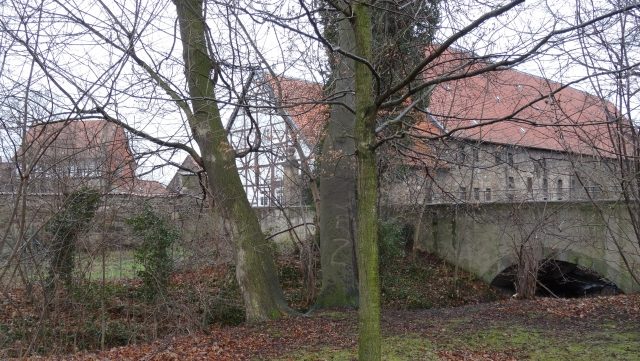
Schladen was first mentioned in a document in 1154 as "Schladheim" (settlement in the swamp). The old village center was protected by a double moat, and the Wedde formed the eastern border.
The history of Schladen is closely linked to the Ottonian royal palace of Werla, the remains of which can be found about 2 km north of the village. Schladen was home to its supply farm, the predecessor of today's domain. Just as the palace fell into disrepair around 1200, so did this complex. Only Bishop Udo of Hildesheim expanded it into a castle and appointed a Vogt for it. This was Eiko von Dorstadt, who took the name "von Schladen". The castle remained in the possession of the Counts of Schladen until 1353, was acquired by Bishop Heinrich III for the Prince-Bishopric of Hildesheim, came into the possession of the Dukes of Wolfenbüttel together with the village after the Hildesheim Diocesan Feud in 1523, and fell back to it in 1643 with the restitution of the Great Diocese. After the great fire of 1699, the Catholic church was built on the site in 1728. In the late 18th century, the domain received a park, gardens, and a sheep farm.
In 1803, Schladen, together with the Prince-Bishopric of Hildesheim, fell to Prussia through the Reichsdeputationshauptschluss, but in 1815 to Hanover, with whose annexation it became Prussian again in 1866. In 1885, it became part of the district of Goslar, with which it was reclassified from Prussia to Braunschweig in 1941.
The large sheepfold of the domain, built in 1750, today houses the municipal administration, the village community center, and the shooting club house. In the local history museum "Alte Mühle", visitors can find excavation finds from the palace, including its "hot air stones", predecessors of a central heating system.
In the "Bocla", the old court (today's "Buchladen"), the most famous resident of Schladen, Leo von Klenze, was born in 1784. He later rose to become the court architect of King Ludwig I of Bavaria, was ennobled, and was one of the most important architects of Classicism (Glyptothek, Propylaea, Alte Pinakothek, Walhalla, design for the New Hermitage in Saint Petersburg). Extensive information about his work can be found on the upper floor of the local history museum "Alte Mühle".
Take Mobile History with you
You are reading this text for free. Premium adds what matters on the road: descriptions read aloud, sites found through your camera, whole regions taken offline.
- Every description, including the ~17,700 Premium sites
- Audio guide: have descriptions read to you on location
- AR finder: see sites through your camera, with distance and bearing
- Unlimited saved sites
14 days free, then from €2.99 a month. Cancel anytime.
Location: 52.0237, 10.5403