The Castle can be visited
CastleLeinefelde-Worbis - Beuren
Scharfenstein Castle
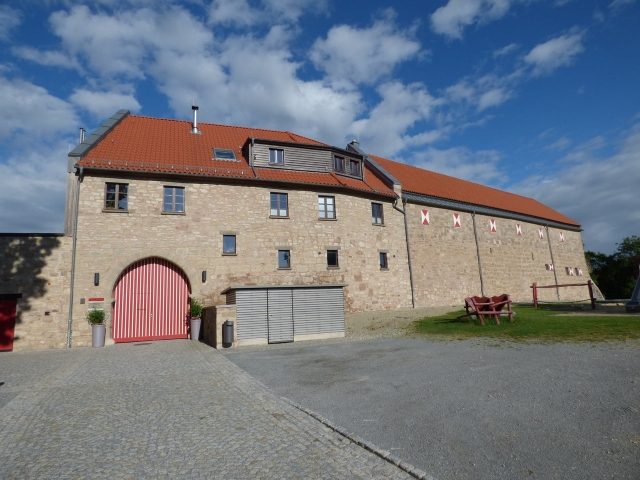
Scharfenstein Castle is a high medieval castle in the Eichsfeld region, first documented in 1209.
The spur castle is located southwest of the town of Leinefelde, on the edge of the Eichsfeld-Hainich Nature Park and above the village of Beuren. It is situated on a small spur protruding to the east, the Schloßberg (480 m) on the northern edge of the Dün in the Eichsfeld district in Thuringia.
The castle can be reached by road between Beuren and Kreuzebra. Various hiking trails over the Dün and from the Beuren stop of the Halle–Hann. Münden railway line lead to the castle.
The First Centuries
It is assumed that Scharfenstein Castle must have been built in the second half of the 12th century. The first documentary mention of the castle took place in 1209, but a Godehard von Scharfenstein was already mentioned in 1161. At the beginning of the 13th century, the castle was expanded. It was owned by the Counts of Gleichenstein, who were probably the builders of the castle. The Thuringian Landgraves asserted feudal claims, so Landgrave Ludwig IV of Thuringia, who was in a feud with the Mainz Archbishop Siegfried II of Eppstein, had the castle conquered and destroyed in 1219. By the middle of the 13th century, Scharfenstein Castle was rebuilt by the noble family of Gleichen with a new, extended curtain wall. In 1287, the castle was called "Castrum Scharphenstein" in a document when the castle property was leased to Archbishop Heinrich II by the Thuringian Landgrave. In 1294, due to high debts, it was sold by Count Heinrich von Gleichenstein, along with the castles of Birkenstein (near Birkungen) and Gleichenstein (near Wachstedt), to the Mainz Archbishop Gerhard II of Eppstein. This sale of castles was accompanied by the sale of Eichsfeld, which remained in Mainz possession until 1802. In the 14th century, Scharfenstein Castle was expanded into a pledge office, which included 14 villages, two monasteries, and several mills. In the 15th and 16th centuries, the pledge office belonged to the Lords of Wintzingerode. Struck by lightning, the castle burned down almost completely in 1431. But the Lords of Wintzingerode rebuilt it.
Since the Time of the Peasants' War
The former Reifenstein Cistercian monk Heinrich Pfeiffer fled to Scharfenstein in 1521, where he preached the Lutheran doctrine in the surrounding villages, on Scharfenstein, and under the "Burglinde" until 1523. Pfeiffer had to leave the castle and then went to Mühlhausen, where he met Thomas Müntzer. In May 1525, the Mühlhausen and Eichsfeld peasant groups united. Under the leadership of Pfeiffer and Müntzer, they marched through Eichsfeld and plundered the castles and monasteries in the area, including Reifenstein Monastery and, on Pfeiffer's command, Scharfenstein Castle. Just seven years later, the castle was rebuilt by Friedrich von Wintzingerode. During the so-called Counter-Reformation, the pledge of the Scharfenstein office was redeemed by Elector Daniel Brendel von Homburg. Under the Lutheran Lords of Wintzingerode, the Reformation had taken hold in the Scharfenstein office. Following the redemption of the pledge, the Counter-Reformation emanating from the Heiligenstadt Jesuit College took place. The year 1587 and the Mainz wheels on the castle gate still bear witness to this. Subsequently, the castle served as a prison, gradually lost importance, and was only used for administrative purposes. In 1802, Eichsfeld, and thus also Scharfenstein Castle, became Prussian. From 1814, it was an outwork of the Reifenstein domain. The dilapidated keep was demolished in 1864. In 1909, the castle burned out due to another lightning strike. After the Second World War, the castle became public property and was used as a training center and children's holiday camp from 1960.
After the GDR Era
Since 1990, Scharfenstein Castle has been managed by the Treuhand and has been owned by the city of Leinefelde-Worbis since 2002. Since 2006, the castle has been undergoing restoration. Scharfenstein was considered as a possible location for the Pope's visit to Eichsfeld in September 2011. In the course of this, extensive renovation work took place on the core castle from 2008. However, the Pope's visit was held at the pilgrimage site of Etzelsbach. Since 2011, a cafe and an outdoor terrace have been located on the former barn site of the castle, from which, in good visibility, one can see as far as the Harz mountains and the Brocken. On July 5, 2012, the city of Leinefelde-Worbis was awarded the Thuringian Heritage Protection Prize for the renovation of Scharfenstein Castle. In 2014, the lowest two meters of the keep, which was demolished after 1525 and dated to around 1200, were discovered and partially excavated in the cellar of the west wing of the core castle.
In front of the castle gate stands an approximately 550-year-old lime tree with a circumference of 7.90 m.
View+
From Scharfenstein Castle, there is a wide view to the north and east into the upper Leine Valley, the Eichsfeld Basin, the Ohm Mountains, and the eastern Dün, as well as, in good visibility, from the Upper Harz with the Brocken to the Lower Harz behind the Eichsfeld Gate.
Take Mobile History with you
You are reading this text for free. Premium adds what matters on the road: descriptions read aloud, sites found through your camera, whole regions taken offline.
- Every description, including the ~17,700 Premium sites
- Audio guide: have descriptions read to you on location
- AR finder: see sites through your camera, with distance and bearing
- Unlimited saved sites
14 days free, then from €2.99 a month. Cancel anytime.
Source: Wikipedia · Licence: CC BY-SA 4.0 · Image: http://www.wehrbauten.de/thread.php?threadid=2036
This description draws on the facts documented in the linked Wikipedia article; Wikipedia content is licensed under CC BY-SA 4.0. Wording and editing: Mobile History.
Location: 51.3633, 10.2689