Cultural Events
CastleMechernich - Satzvey
Satzvey Castle
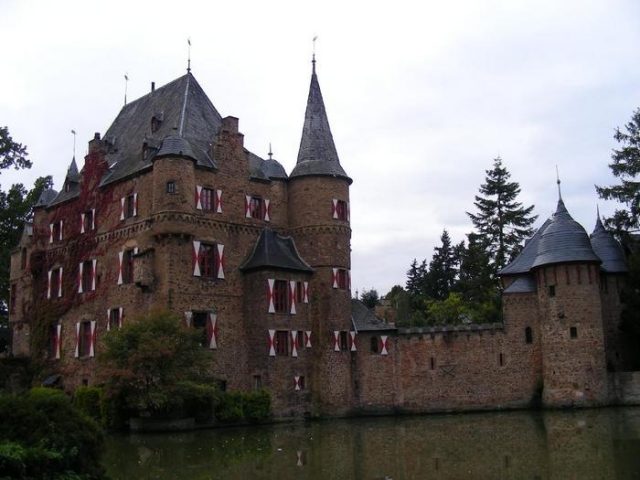
Satzvey Castle is a medieval moated castle, originally from the 12th century, located on the northeastern edge of the Eifel in Mechernich (Satzvey district) in the Euskirchen district, North Rhine-Westphalia (Germany).
Among experts, it is considered the best-preserved moated castle in the Rhineland in its original structure, a jewel of Rhenish castle construction and a monument to aristocratic culture and way of life.
Castle Type+
Satzvey Castle is a typical moated castle, such as those built by the ministerial nobility of the 14th and 15th centuries in the lowlands, while the high nobility built hard-to-conquer hilltop castles. The lack of a mountain as a natural obstacle for attackers had to be replaced by difficult-to-overcome moats. For this reason, moated castles were usually built on two islands and were almost always located near a stream that supplied the moats with water. The more heavily fortified main castle was thus additionally protected by the outer bailey on the second island.
The Satzvey complex also originally stood on two islands. This lightly fortified farmstead (Fronhof) from the 12th century, surrounded by moats, was the seat of a family of Vey, who managed the extensive ecclesiastical estates of the eponymous district (named after the Veybach stream flowing through the area) for the Benedictine convent of Dietkirchen (former monastery in the northern part of Bonn) as bailiffs. Archbishop Engelbert III of the Mark of Cologne granted Satzvey as a fief to Otto von Vey, who was first mentioned in a document in 1368 as the first bailiff of that name. His granddaughter, after the extinction of the male line, brought the bailiwick and castle in 1391 to her husband Heinrich von Krauthausen, who in 1396 built the first, originally freestanding, two-story castle house, attributable to the Gothic architectural style, as the new administrative seat.
Still in the 15th century, the defensibility of the complex was increased. The gatehouse with the twin towers was built, a Zwinger (outer ward) was laid out, and the outer bailey was more heavily fortified. In the second half of the 15th century, the castle belonged to a family von Meller, was after 1512 in the possession of various noble families, until it came into the possession of Wilhelm Spies von Büllesheim in 1561 through usurpation. To maintain peace in the land, the Archbishop of Cologne supported the appropriation. In 1578, Duke Wilhelm V the Rich of Jülich occupied the castle. This resulted in the castellan Spies von Büllesheim having to swear allegiance to both the sovereign of Jülich and the sovereign of Cologne, Archbishop Gebhard I von Waldburg, three years later.
At the end of the 16th century, the bailiwick became an immediate imperial seat of power. In 1747, the castle came into the possession of the Rhenish noble family von und zu Gymnich through the sale by Johann Spies von Büllesheim to Karl Otto von Gymnich. However, in 1794, the sub-lordship of Satzvey was lost and thereafter only had the status of a knight's estate eligible for the Landtag. In 1882, the moated castle came to Count Dietrich Wolff-Metternich zur Gracht due to the extinction of the main Gymnich line.
Until that time, there had been no significant structural changes at Satzvey Castle since the 16th century. It was only Dietrich Wolff Metternich zur Gracht who, at the end of the 19th century, transformed the hitherto largely medieval and heavily dilapidated castle into a representative stately home through extensive renovation and expansion. Moats were drained, the castle house was extended with additions and annexes, and new towers were erected. Buildings in the style of English stables were built on the former outer bailey, and a manor house with farm buildings was constructed. The core and model for these construction measures was the existing original building fabric from the early 15th century.
The castle was largely spared from wartime destruction for centuries. However, it was severely damaged in World War II. In 1942, Countess Adeline Wolff Metternich zur Gracht (1919-2010) inherited the estate in place of her brother Dietrich, who had fallen in the war. In 1944, she married Franz Josef Graf Beissel von Gymnich zu Frens (1916-2008), a younger branch of the von und zu Gymnich family, whereby Satzvey Castle fell to the Counts Beissel von Gymnich. The young couple moved into the castle and in the following years initially restored the most important structural parts. Their four sons were born here.
The Castle Today+
In 1977, the parents transferred the property to their eldest son Franz Josef Graf Beissel von Gymnich. To preserve the castle and to maintain the history and traditions of past eras, he decided to make the complex accessible to the public and, together with his wife Jeannette, organizes historical knight festivals there.
Today, Satzvey Castle is considered the best-preserved moated castle in the Rhineland in its original structure. The original castle house, the twin-towered gatehouse, the north wall, and the north tower are the oldest parts of the building. They have survived 600 years and, together with the construction measures of the late 19th century, form a monument to a typical German moated castle.
Take Mobile History with you
You are reading this text for free. Premium adds what matters on the road: descriptions read aloud, sites found through your camera, whole regions taken offline.
- Every description, including the ~17,700 Premium sites
- Audio guide: have descriptions read to you on location
- AR finder: see sites through your camera, with distance and bearing
- Unlimited saved sites
14 days free, then from €2.99 a month. Cancel anytime.
Source: Wikipedia · Licence: CC BY-SA 4.0 · Image: http://www.wehrbauten.de/thread.php?threadid=568
This description draws on the facts documented in the linked Wikipedia article; Wikipedia content is licensed under CC BY-SA 4.0. Wording and editing: Mobile History.
Location: 50.6199, 6.7068