The Castle can be visited
Museum
CastleRunkel
Runkel Castle
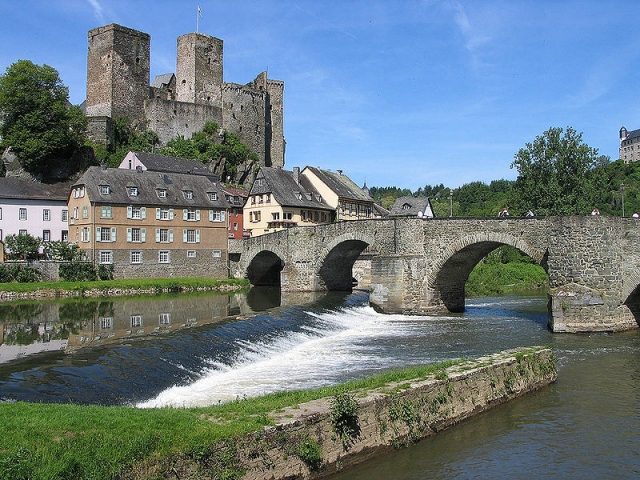
Runkel Castle is a High Medieval castle ruin in the town of Runkel in the Limburg-Weilburg district in Hesse, Germany.
The town and the castle are located approximately six kilometers east of Limburg an der Lahn, 30 kilometers southwest of Wetzlar, and almost 60 kilometers northwest of Frankfurt am Main, in the Lahn valley. The hilltop castle is situated at about 150 m above sea level and rises approximately 35 to 40 meters above the Lahn valley.
The castle was first mentioned in 1159 but is likely older. It was built by the Lords of Runkel to secure the Lahn bridge and was in the possession of Siegfried (I) of Runkel in 1159.
During a family dispute over property and inheritance claims that arose around 1250, Siegfried (V) expelled his cousin Heinrich († 1288) from the castle in 1276. Heinrich subsequently had Schadeck Castle built as a rival fortress on the opposite heights of the Lahn from 1288. In the same year, the previously united lordships of Runkel and Westerburg were separated. Dietrich III of Runkel expanded his lordship in 1376 to include the tithes of Schupbach and Aumenau and had a more modern castle built next to the existing one. Dietrich IV of Runkel († after 1462), Lord of Runkel, also came into possession of the County of Wied through marriage to Anastasia of Isenburg-Wied, after which his descendants were henceforth named. In 1543, Runkel Castle hosted Melanchthon as a guest of Count Johann IV of Wied-Runkel († 1581).
In 1595, the County of Wied was divided; Wilhelm IV of Wied-Runkel received the "Upper County of Wied" (around Runkel and Dierdorf), and his nephew Johann Wilhelm of Wied-Runkel received the "Lower County of Wied" (around Wied, Braunsberg, and Isenburg). Runkel thus became the center of the Upper County of Wied.
During the Thirty Years' War, on October 15, 1634, the castle and the town were destroyed by imperial troops (Croats) under Count Isolani. After that, the main or core castle was not rebuilt; however, the buildings of the lower castle and some farm buildings were restored or further expanded in the following years.
In 1692, Friedrich of Wied-Runkel ceded the Upper County of Wied to his grandson Maximilian Heinrich of Wied-Runkel, notably augmented by Isenburg, which until then belonged to the Lower County of Wied. The county was henceforth called Wied-Runkel and was elevated to a principality in 1791.
As part of the Confederation of the Rhine Act, the principality was mediatized in 1806 and incorporated into the newly created Duchy of Nassau, with the part on the right bank of the Lahn incorporated into the Grand Duchy of Cleves and Berg (to Prussia in 1813). Karl Ludwig Friedrich Alexander, Prince of Wied, became, among other things, administrator of the newly created Nassau office of Runkel as a sovereign lord.
When Karl Ludwig Friedrich Alexander, Prince of Wied, died childless in March 1824, and his brother Friedrich Ludwig, Prince of Wied, died childless in April 1824, the Wied-Runkel line became extinct. Their sovereign rights to the town and castle of Runkel fell to Wilhelm Hermann Karl, Prince of Wied, from the collateral line of Wied-Neuwied (formerly the Lower County).
List of the Lords of Runkel (House of Runkel)
Lordship of Runkel
- around 1159: Siegfried I of Runkel, Lord of Runkel
- around 1181: Siegfried II of Runkel, his son, Lord of Runkel
- around 1191–around 1221: Siegfried III of Runkel-Westerburg, his son, Lord of Runkel and Westerburg
- after 1221–around 1250: Siegfried IV of Runkel-Westerburg († 1266), his son, Co-Lord of Runkel, Lord of Westerburg
- after 1221–around 1226: Dietrich I of Runkel, his brother, Co-Lord of Runkel
- after 1250–1277: Heinrich I of Runkel-Westerburg, son of Siegfried IV, Co-Lord of Runkel, Lord of Westerburg
- around 1270–1288: Siegfried V of Runkel, son of Dietrich I, Co-Lord of Runkel, 1277 Sole Lord of Runkel
- 1288(?)–1352: Dietrich II of Runkel († after 1352), his son (or grandson?), Lord of Runkel
- 1352–1402: Dietrich III of Runkel († 1402), his son, Lord of Runkel
- 1402–1417: Friedrich III of Runkel († before 1417), his son, Lord of Runkel
- 1417–around 1427: Siegfried VIII of Runkel, his brother, Lord of Runkel
- around 1427–1462: Dietrich IV of Runkel († 1462), his brother, Lord of Runkel
- 1462–1487: Friedrich IV of Wied-Runkel († 1487), his son, Lord of Runkel, 1454 Count of Wied
- 1487–1505: Wilhelm III of Wied-Runkel († 1526), his son, Lord of Runkel, Count of Wied and Moers
- 1505–1533: Johann III of Wied-Runkel († 1533), his brother, Count of Wied
- 1533–1535: Philipp of Wied-Runkel († 1535), his son, Lord of Runkel, Count of Wied
- 1535–1581: Johann IV of Wied-Runkel († 1581), his brother, Lord of Runkel, Count of Wied
- 1581–1591: Hermann I of Wied-Runkel († 1591), his son, Lord of Runkel, Count of Wied (jointly with Wilhelm IV)
- 1591–1595: Johann Wilhelm of Wied-Runkel († 1633), his son, Lord of Runkel, Count of Wied (jointly with Wilhelm IV)
- 1581–1595: Wilhelm IV of Wied-Runkel († 1612), brother of Hermann I, Lord of Runkel, Count of Wied (with Hermann I or Johann Wilhelm)
Upper County of Wied
- 1595–1612: Wilhelm IV of Wied-Runkel († 1612), Count of Wied (Upper County)
- 1613–1631: Hermann II of Wied-Runkel († 1631), brother of Johann Wilhelm, Count of Wied (Upper County)
- 1631–1640: Friedrich of Wied-Runkel († 1698), his son, Count of Wied (Upper County, also 1691–1692), 1638–1698 Count of Wied (Lower County)
- 1640–1653: Moritz Christian of Wied-Runkel († 1653), his brother, Count of Wied (Upper County)
- 1653–1664: Johann Ernst of Wied-Runkel († 1664), his brother, Count of Wied (Upper County)
- 1664–1691: Ludwig Friedrich († 1709), his son, Count of Wied (Upper County)
- 1691–1692: Friedrich of Wied-Runkel († 1698), his uncle, Count of Wied (Upper County, also 1631–1640), 1638–1698 Count of Wied (Lower County)
County and Principality of Wied-Runkel
- 1692–1706: Maximilian Heinrich of Wied-Runkel († 1706), his grandson, Count of Wied-Runkel
- 1706–1762: Johann Ludwig of Wied-Runkel († 1762), his son, Count of Wied-Runkel
- 1762–1791: Christian Ludwig of Wied-Runkel († 1791), his son, Count of Wied-Runkel, 1791 Prince of Wied-Runkel
- 1791–1806: Karl Ludwig Friedrich Alexander, Prince of Wied († 1824), his son, Prince of Wied-Runkel, from 1806 mediatized sovereign lord
Sovereign Lords of Runkel
- 1806–1824: Karl Ludwig Friedrich Alexander of Wied († 1824), Prince of Wied, Lord of Runkel
- 1824: Friedrich Ludwig of Wied († 1824), his brother, Prince of Wied, Lord of Runkel
- 1824–1836: Johann August Karl of Wied († 1836), his 4th degree uncle, Prince of Wied, Count of Isenburg, Lord of Runkel and Neuerburg (House of Wied-Neuwied)
- 1836–1848: Wilhelm Hermann Karl of Wied († 1869), his son, Prince of Wied, Count of Isenburg, Lord of Runkel and Neuerburg, abdicated in 1848, Lordship of Runkel dissolved
Structure of the Castle+
The castle consists of an upper or core castle and a lower castle.
The upper castle has been a ruin since its destruction, but it is accessible. On the highest point of the rock opposite the current Lahn bridge, built between 1440 and 1448, stands the climbable keep. Surrounding it are the mighty ruins of the palas and other former residential buildings, which on the Lahn side almost resemble a shield wall. At both ends of the approximately 40-meter-long building complex, there is a mighty defensive tower, hardly inferior to the keep in height and wall thickness. Therefore, Runkel Castle can be described as one of the very rare castle types that possesses three keeps.
The lower castle was rebuilt and expanded in the 17th and 18th centuries after its destruction in the Thirty Years' War. It consists of two- to three-story buildings that connect to the south of the upper castle in a U-shape, forming an enclosed inner courtyard. Further former farm buildings are located within an outer courtyard, which is surrounded by a curtain wall. The buildings of the lower castle, which are still well preserved in contrast to the upper castle, are still predominantly in use today.
Today+
Today, the lower castle houses a museum, a chapel, an archive, and the princely Wied administration. The castle is occasionally inhabited by Metfried Prince of Wied and his family. Other parts of the building are also inhabited or serve, among other things, as storage space for agricultural vehicles. The unrestored buildings of the upper castle can also be visited. Climbing the main tower is possible. From its viewing platform, there is a beautiful view of the town of Runkel, the medieval Lahn bridge, and the still well-preserved Schadeck Castle on the opposite side of the Lahn. In addition to its status as a protected monument, the castle has received protection status in case of war under the Hague Convention.
Take Mobile History with you
You are reading this text for free. Premium adds what matters on the road: descriptions read aloud, sites found through your camera, whole regions taken offline.
- Every description, including the ~17,700 Premium sites
- Audio guide: have descriptions read to you on location
- AR finder: see sites through your camera, with distance and bearing
- Unlimited saved sites
14 days free, then from €2.99 a month. Cancel anytime.
Source: Wikipedia · Licence: CC BY-SA 4.0
This description draws on the facts documented in the linked Wikipedia article; Wikipedia content is licensed under CC BY-SA 4.0. Wording and editing: Mobile History.
Location: 50.4057, 8.1564