To be privately owned
CastleBad Breisig-Rheineck
Rheineck Castle
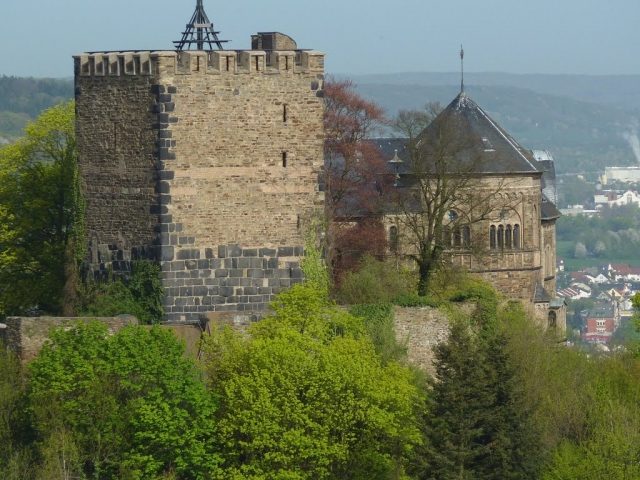
Rheineck Castle is a hilltop castle near Bad Breisig in the Rhineland-Palatinate district of Ahrweiler. Its roots lie in a medieval complex from the 11th century. The castle was the center of the Rheineck Burgraviate.
The castle stands on the left bank of the Rhine in the Middle Rhine Valley, in the immediate vicinity of the Vinxtbach stream. In Roman times, it separated the Roman provinces of Upper and Lower Germania and the Moselle and Ripuarian Franks. In the Middle Ages, the territories of Trier and Cologne bordered each other there.
The Rhenish Palatine Counts built the castle in the 11th century. Count Otto von Salm was the first to call himself "Comes de Rinegke" (Count of Rheineck) in the 12th century. After the castle's destruction in 1151 by King Conrad III, the Archbishop of Cologne and simultaneous Imperial Chancellor Rainald von Dassel considered Rheineck, alongside the Cologne possessions of Andernach and Rhense, an important pillar of his dominion and wanted to have the castle rebuilt as a Cologne possession. To preempt the power claims and territorial expansion plans of the then Palatine Count Konrad von Hohenstaufen, Rainald ordered the swift occupation of the mountain and the reconstruction of the castle in 1166.
He was thus able to prevent a civil war, as his deputy and later successor Philipp I von Heinsberg, following his instructions, gathered the then immense number of 125,000 men for an expected battle against the Palatine Count's troops. On May 18, 1164, the opposing soldiers faced each other near the city of Andernach, a few kilometers south of Rheineck Castle. The contemporary Cologne Royal Chronicle notes on this date: In this year, when Palatine Count Konrad, the emperor's brother, desired to invade and plunder the Cologne diocese and intended to occupy the mountain called Rheineck, the Cologne Elect Reinold, who was with the emperor in Italy, ordered the faithful of the Cologne church through trusted messengers to occupy the mountain beforehand. When the Palatine Count realized that he had been preempted, he announced a war against the people of Cologne, for May 18 on the plain near Andernach. By mobilizing the Cologne prelates, cavalry squadrons and infantry, as well as ships, gathered to support the army. There were about 125,000 warriors. Therefore, neither the Palatine Count nor anyone dared to approach, as they waited for his arrival for 12 days. Three weeks after the prevented and unheld battle, Emperor Frederick Barbarossa gifted his Imperial Chancellor Rainald von Dassel the village of Dairago in the province of Milan for immense and countless services. In addition, villas and castles, as well as the bones of the Three Holy Kings from conquered Milan, were given as gifts.
Around 1180, the knightly family of Ulmen was presumably enfeoffed with Rheineck Castle, soon adopting the name von Rheineck. With the extinction of the von Rheineck family in 1539, the Burgraviate (from 1576) passed to the Barons von Warsberg, who sold it in 1654 to the Austrian Counts von Sinzendorf, who died out in 1822.
The new construction of Rheineck Castle took place on the old footprint, using old building materials, in the 1830s. After several destructions, the Bonn university professor and later Prussian Minister of Culture, Moritz August von Bethmann-Hollweg, acquired the castle in 1832 and had it rebuilt by Johann Claudius von Lassaulx. The newly erected chapel, which in its floor plan and exterior design connects to the original gate chapel of the 12th century, was painted by Edward von Steinle in 1838. Parts of the curtain walls, the massive keep with its square floor plan, and the gate above the access road are still preserved from the Middle Ages.
The castle was acquired in 2000 by the current owner Kai Krause. He had it fundamentally restored.
Visiting the Castle+
A visit to the castle is not possible; only the access road on the hillside up to the gate is accessible. This is also part of a designated hiking trail. However, the castle cannot be seen from there due to many tall trees.
Take Mobile History with you
You are reading this text for free. Premium adds what matters on the road: descriptions read aloud, sites found through your camera, whole regions taken offline.
- Every description, including the ~17,700 Premium sites
- Audio guide: have descriptions read to you on location
- AR finder: see sites through your camera, with distance and bearing
- Unlimited saved sites
14 days free, then from €2.99 a month. Cancel anytime.
Source: Wikipedia · Licence: CC BY-SA 4.0 · Image: Joachim Schneeleopard
This description draws on the facts documented in the linked Wikipedia article; Wikipedia content is licensed under CC BY-SA 4.0. Wording and editing: Mobile History.
Location: 50.4959, 7.3130