The Castle can be visited
CastleBorgholzhausen
Ravensberg Castle
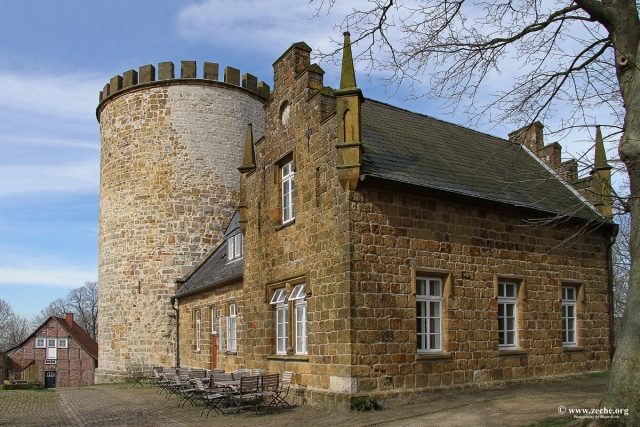
Ravensberg Castle is a partially preserved hilltop castle complex in northeastern North Rhine-Westphalia and the namesake of the County of Ravensberg; through this, it is indirectly also the namesake of the cultural landscape of Ravensberger Land and the natural region of Ravensberger Hügelland. The castle is located on a hill about 2.5 km south of Borgholzhausen (Gütersloh district) in the Teutoburg Forest. Geographically, it lies in the natural sub-unit of Haller Osning, which is part of the Osning Ridge sub-unit, which in turn belongs to the main unit of Bielefelder Osning; it is thus not located in the Ravensberger Hügelland, which is indirectly named after it.
The castle was built around 1080 by Hermann (II) von Calvelage and was the ancestral seat of the Counts of Ravensberg until 1346. Surrounded by a ring wall and a dry moat, the castle was divided into an outer bailey and a main castle. Access was via a gatehouse with a drawbridge and an adjoining Zwinger. Both parts of the castle contained utility buildings, with the main castle additionally housing the palas, the keep, the castle well, and the castle chapel of Sancta Magdalena.
After the death of the last native Count of Ravensberg in 1346, the castle passed as an inheritance to the later House of Jülich-Kleve-Berg and later to the Hohenzollerns. During the Thirty Years' War, the castle changed hands several times. During this time, in 1646, the keep was renovated. In 1662, the last castle garrison was withdrawn.
In 1673, troops of the Prince-Bishop of Münster, Christoph Bernhard von Galen, attacked the castle and largely destroyed it. In 1695, the Drostei (bailiwick) housed there was relocated from the dilapidated buildings of the castle. Subsequently, the castle increasingly fell into disrepair. Frederick William I of Prussia had all buildings demolished in 1733 to use the stones to build new houses. Only the keep has remained standing to this day.
Around 1830, the further decay of the castle was sustainably halted. The commitment of the High President of the Province of Westphalia, Ludwig von Vincke, not only led to the preservation of the castle but also to the construction of a viewing platform on the tower. In 1868, a forester's house was built in the castle courtyard to increase its attractiveness as an excursion destination and thus contribute to its preservation.
In 2003, the castle became the property of the Stiftung Burg Ravensberg (Ravensberg Castle Foundation), which was specifically founded for its preservation.
In 2006, the keep was extensively renovated. At the same time, students from the University of Bamberg conducted archaeological excavations in the outer bailey for several weeks. The keep can still be climbed.
The foundation offers experiential learning for school classes and other educational programs. In the entertainment area, playful historical events and cultural offerings take place.
Take Mobile History with you
You are reading this text for free. Premium adds what matters on the road: descriptions read aloud, sites found through your camera, whole regions taken offline.
- Every description, including the ~17,700 Premium sites
- Audio guide: have descriptions read to you on location
- AR finder: see sites through your camera, with distance and bearing
- Unlimited saved sites
14 days free, then from €2.99 a month. Cancel anytime.
Source: Wikipedia · Licence: CC BY-SA 4.0 · Image: http://www.zeche.org/
This description draws on the facts documented in the linked Wikipedia article; Wikipedia content is licensed under CC BY-SA 4.0. Wording and editing: Mobile History.
Location: 52.0829, 8.2974