Museum
CastleRanis
Ranis Castle
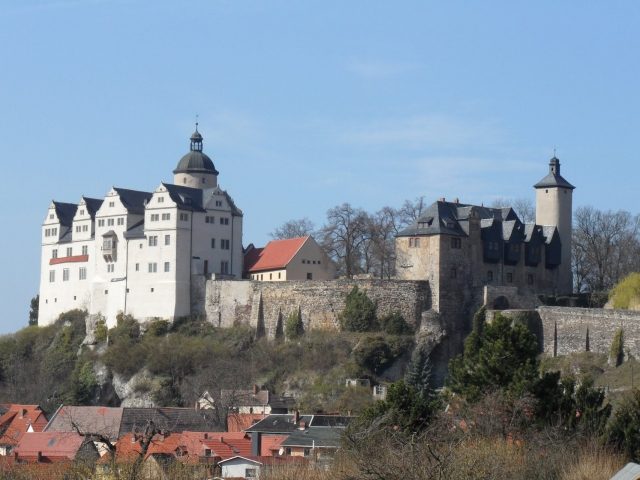
Ranis Castle is located on a ridge near the Thuringian town of Ranis, not far from Pößneck.
The hilltop castle consists of a small main castle in the west, which encloses the small castle courtyard, a round keep, the characteristic south wing today, and two spacious outer baileys. The preserved outer bailey building separates the large castle courtyard, which adjoins the main castle to the east, and the outer bailey area. This formerly housed the economic buildings and offers an arched tunnel down into the old town. The outer bailey building, as well as the wall serving as a fortification to the east, were each protected by a Zwinger (outer ward) with a moat and drawbridge. The castle complex dates back to the 12th century. The basic features still recognizable today date from the 13th and 14th centuries, but its appearance is shaped by the extensions from the beginning of the 17th century. At that time, the castle was converted into a representative palace by the construction of the south wing with its characteristic gable dormers.
Owners of the Castle+
Since the 11th century, there has been a fortification on the castle hill. In 1084, Emperor Henry IV enfeoffed Wiprecht von Groitzsch, later Margrave of Meissen and Lusatia, with the Castrum Ranis - the first documented mention. In 1199, the castle is named as the seat of imperial ministerials, who were directly subordinate to the king. As imperial property, the castle held an important position in the Saale region as a border fortress against the Slavs. Emperor Otto IV pledged Ranis Castle and the dominion around Saalfeld to the Counts of Schwarzburg. In 1220, Emperor Frederick II enfeoffed the Schwarzburgs with the castle. In the 13th and 14th centuries, Ranis remained in the possession of the Counts of Kevernburg and Schwarzburg.
In 1389, the Schwarzburgs sold the castle to the Wettins. In 1463, Wilhelm III bequeathed the castle to her brother Heinrich von Brandenstein in honor of his wife Katharina von Brandenstein. Due to over-indebtedness, the Lords of Brandenstein sold the castle in 1571 to the Lords of Breitenbauch. Under them, the town of Ranis and the district of Ziegenrück became Prussian in 1815. In 1902, they changed their name to Breitenbuch. In 1942, the von Breitenbuch family sold the castle to the German Red Cross. It now belongs to the Thuringian Castles and Gardens Foundation.
Facilities at the Castle+
The Castle Museum was founded in 1926 by the then owner of the castle, Dietrich von Breitenbuch, and re-established as a local history museum by the city of Ranis in 1956 after the Second World War. Beyond the history of the castle and the region, it provides information about the Ilsenhöhle cave located directly below the castle, as well as about the geology, seismology, and the prehistory and early history of the region. In April 2014, the museum was included in the Red List of Culture of the German Cultural Council and classified in category 1 (threatened with closure). The city council cut funding and decided to close it from November 1, 2014, if no other operator could be found. In May 2014, it was announced that the Saale-Orla district would receive up to 50,000 Euros annually from the state of Thuringia from 2015-2017 to ensure the operation of the museum. In addition, a sustainable financing concept is to be developed, and the exhibition modernized.
In 1928, the Breitenbuchs established a restaurant at the castle, which is no longer in operation today. The restaurant and museum were attempts to raise part of the maintenance costs for the operation of the complex.
Further Information+
Around 1940, there was a bear enclosure at the castle. From 1995 to 2010, the castle was restored at a cost of 8 million Euros. In July 2010, filming for Löwenzahn - Das Kinoabenteuer took place at the castle.
Take Mobile History with you
You are reading this text for free. Premium adds what matters on the road: descriptions read aloud, sites found through your camera, whole regions taken offline.
- Every description, including the ~17,700 Premium sites
- Audio guide: have descriptions read to you on location
- AR finder: see sites through your camera, with distance and bearing
- Unlimited saved sites
14 days free, then from €2.99 a month. Cancel anytime.
Source: Wikipedia · Licence: CC BY-SA 4.0 · Image: Uwe Klimpke
This description draws on the facts documented in the linked Wikipedia article; Wikipedia content is licensed under CC BY-SA 4.0. Wording and editing: Mobile History.
Location: 50.6625, 11.5638