Hotel
CastleAhorntal
Rabenstein Castle
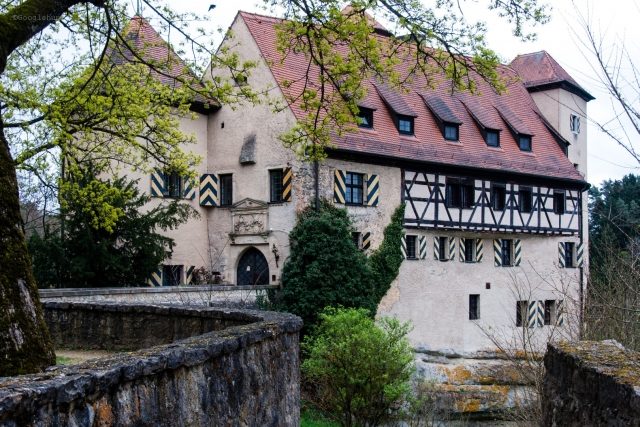
Rabenstein Castle is a former high medieval noble castle in the municipality of Ahorntal in the Upper Franconian district of Bayreuth in Bavaria (Germany).
The spur castle can be visited for an entrance fee.
The hilltop castle is located in the Franconian Switzerland-Veldenstein Forest Nature Park on a rocky mountain spur at an altitude of about 420 meters above the Ailsbach valley in Franconian Switzerland, 6.5 kilometers northwest of Pottenstein. Within walking distance of the castle is the Sophienhöhle, a touristically attractive stalactite cave.
Near Rabenstein Castle, there were several other castles; on the opposite side of the valley lies the presumed castle site of Brunn- or Rabenloch, a little further up the Ailsbach valley was the former Ahorn Castle, today's isolated settlement of Klausstein, opposite it is the presumed castle site of Hohenloch above the Ludwigshöhle, downstream along the Ailsbach lies the castle site of Alte Veste, and also in the village of Oberailsfeld stood a small castle, Ailsfeld Castle on a rock in the valley. To the west, above the Wiesent valley, stands Rabeneck Castle, probably also a foundation of the Rabenstein family.
The oldest parts of the castle were built in the first quarter of the 12th century as a noble residence in the lordship of Waischenfeld. At the same time, the ministerial family Rabenstein, who are considered the builders of the castle and bore the raven in their coat of arms, are documented in the service of the nobles of Waischenfeld. In the early 13th century, the outer bailey was expanded. Over the next centuries, owners and inhabitants of the castle changed, including the family of Schlüsselberg and the Burgraves of Nuremberg. In 1450, the castle was destroyed in the First Margrave War and rebuilt from 1489 by Konz von Wirsberg.
In 1557, the castle passed to the "von Rabenstein" family, who were rising to nobility, thus regaining their ancestral seat. Daniel von Rabenstein rebuilt the castle again in 1570, merging the former outer bailey with the main castle.
During the Thirty Years' War, the castle was completely destroyed again by imperial troops, as the lord of the castle, Hans Christoph von Rabenstein, sided with the Swedes. After the war, between 1648 and 1728, only smaller buildings were restored next to the farmstead.
In 1742, the von Rabenstein family died out, and the castle passed to the Counts of Schönborn-Wiesentheid, who redesigned the castle ruins in 1829/30 for a royal visit by Ludwig I.
Current Use+
In the recent past, the castle has been developed into a hotel for events and conferences. Next to the castle are a falconry, also active in research and teaching, with over 80 species of birds of prey, and a manor tavern with a beer garden.
Miscellaneous+
The castle is one of the main settings for the interactive PC game Gabriel Knight: The Beast Within.
Take Mobile History with you
You are reading this text for free. Premium adds what matters on the road: descriptions read aloud, sites found through your camera, whole regions taken offline.
- Every description, including the ~17,700 Premium sites
- Audio guide: have descriptions read to you on location
- AR finder: see sites through your camera, with distance and bearing
- Unlimited saved sites
14 days free, then from €2.99 a month. Cancel anytime.
Source: Wikipedia · Licence: CC BY-SA 4.0 · Image: Google Hupf
This description draws on the facts documented in the linked Wikipedia article; Wikipedia content is licensed under CC BY-SA 4.0. Wording and editing: Mobile History.
Location: 49.8222, 11.3707