The Castle can be visited
CastleRabeneck
Rabeneck Castle
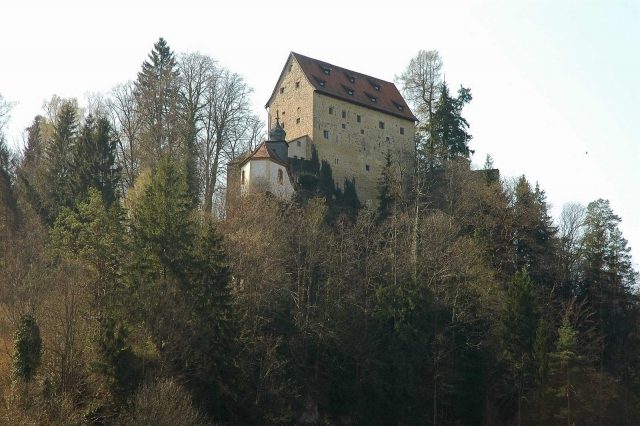
Rabeneck Castle is a former high medieval noble castle, high above the Wiesent valley in the Upper Franconian district of Bayreuth in Bavaria. The castle can be visited for an entrance fee.
The hilltop castle is located in the Franconian Switzerland-Veldenstein Forest Nature Park on a rocky mountain spur at an altitude of about 415 meters above the Wiesent valley in Franconian Switzerland, about three kilometers south-southwest of Waischenfeld.
Nearby is the castle ruin of Waischenfeld and to the east Rabenstein Castle, which was probably the ancestral castle of the Rabeneckers, who belonged to the lineage of the ministerial family of Rabenstein.
Up the Wiesent valley, above the Pulvermühle on the Galgenberg, stood Schlüsselberg Castle, the ancestral castle of the Lords of Schlüsselberg.
The Founding of Rabeneck Castle
The name of Rabeneck Castle first appeared with the documentary witnesses Siboto de Rabeneck and Chunrad de Rabenekke, mentioned in 1257.
A Nentwich von Rabenekke, presumably of clerical status, also appeared in a document in 1261 and 1296, and a Heinrich von Rabenec in 1276. The ministerial family of Rabeneck probably originated from the noble family of Rabenstein, as indicated by the determining word "Rabe" (raven) in Rabenstein and Rabeneck, and also by the spatial proximity of the two castles.
The name component "Eck" (corner) also suggests a later foundation than for castles ending with "Stein" (stone) in their name. A branch of the Rabensteiners probably built Rabeneck Castle as a free-owned castle around or shortly before the year 1250 and named themselves after it. In contrast to Rabenstein Castle, Rabeneck Castle did not belong to the lordship of Waischenfeld, which the noble lords of Schlüsselberg held at that time; nevertheless, the Schlüsselbergers had shares of ownership in the castle. How they acquired these shares is not known.
After Konrad von Schlüsselberg fell at Neideck Castle in 1347, Konrad's son-in-law, Count Günter von Schwarzburg, his wife Reichza, and her sister Agnes, the wife of Heinrich von Plauen, sold their share "what he rightfully had in the castle of Rabeneck" to the Diocese of Bamberg in 1348. This contract was confirmed again in 1376 by Count Johann von Schwarzburg and his son Günther. In 1360, Countess Sophia von Zollern, née von Schlüsselberg, unsuccessfully sued for the return of the share in Rabeneck.
Rabeneck Castle under Changing Owners
In 1353, the castle was entirely in the possession of the Rabensteiners; they had probably bought the share of the Bamberg Diocese, which had presumably fallen into financial difficulties due to the purchase of the remaining Schlüsselberg possessions. From 1360 onwards, Rabeneck was no longer mentioned as being in Bamberg possession. In 1353, the Rabensteiners granted the Burgraves of Nuremberg the right of access to their free-owned castle for twelve years.
In 1388, Rabeneck Castle was in the free-owned possession of the Lords of Stiebar, after Konrad Stiebar, Hofmeister of the Bishop of Bamberg, had presumably acquired it.
They also granted the Burgraves the right of access for 700 guilders. In the same year, Rabeneck was captured by the Bambergers Ulrich von Aufseß and Hans Stiebar in the Cities' War, the reason being probably the right of access for the Nuremberg residents. Cathedral Dean Friedrich Stiebar founded the castle chaplaincy in 1415, which Bishop Albrecht confirmed.
During the Peasants' War in 1525, the castle fell victim to the rebellious peasants, who captured and burned it down. Alexander Stiebar zu Rabeneck received 485 guilders and Christoph Stiebar, who owned the other half of the castle, 554 guilders as compensation. The reconstruction lasted until 1535.
Until 1530, Rabeneck remained in the possession of the Stiebar family. On January 28, 1530, Alexander Stiebar enfeoffed his half of the castle to the Prince-Bishopric of Bamberg. 29 years later, Christoph Stiebar's share of the castle also became a fief of the Bambergers, who now held the entire castle as a fief. After the death of the heavily indebted Christoph, his share went to his son Endres, a bailiff in Pottenstein, who died as early as 1572 and, via Wilhelm von Künsberg, who called himself "zu Rabeneck" as early as 1570, to Daniel Rabenstein. The latter was enfeoffed with the purchased half in 1577. The second half of Rabeneck remained longer in the possession of the Stiebar family. After Daniel Stiebar, the last member of the Rabeneck line, who was by then in holy orders, his half went to the Stiebar lines of Buttenheim and Ermreuth.
In 1603, the Stiebar family sold their half to their brother-in-law Georg Werner von Rabenstein. Rabenstein Castle was already described as dilapidated at that time.
The Rabensteiners sold the castle in 1620 after Georg's death for 36,000 guilders to the Diocese of Bamberg. Due to renewed financial difficulties of the Diocese, Bishop Johann Gottfried von Aschhausen
had to advance the money; the castle remained in his and his heirs' possession as collateral until the Diocese could repay the sum. Rabeneck was still in the possession of the von Aschhausen family in 1682.
The guilders the Rabensteiners received were of low value, so Hans Dietrich and Hans Christoph von Rabenstein initiated a lawsuit against the Diocese in the second quarter of the 17th century, as they were "subsequently paid in bad money."
Only on March 2, 1716, was a settlement reached between Bishop Lothar Franz von Schönborn and the Rabensteiners, by which the Rabensteiners retroactively regained possession of the castle on February 22. From Bishop Lothar, they also received a loan of 12,000 Reichstalers in 1717, which was increased to 20,000 guilders in 1719, to restore the ruinous castle. They probably only renewed the main castle; the outer bailey remained desolate.
Rabeneck in the Possession of the Lords of Schönborn
With the death of Peter Johann Albrecht von Rabenstein on May 19, 1742, the last Rabensteiner at Rabeneck, the family died out and the knightly estate of Rabeneck reverted to the Diocese of Bamberg.
On December 10, 1742, Count Franz Rudolph Erwein von Schönborn, the brother of Bishop Friedrich Karl von Schönborn, received Rabeneck Castle as a fief.
However, after the death of Bishop Friedrich on July 26, 1746, the cathedral chapter did not recognize the enfeoffment of the Schönborns, leading to a lengthy and costly lawsuit before the Imperial Aulic Council. The Imperial Aulic Council ruled in favor of the Counts of Schönborn, so on October 1, 1778, Bishop Adam Friedrich von Seinsheim had to reinstate the Counts in their possession.
Current Use
In 1975, the castle was sold to its current owner, Norman Schiller. The castle can currently be visited. Overnight stays are also possible. Upon request, celebrations are also organized.
Take Mobile History with you
You are reading this text for free. Premium adds what matters on the road: descriptions read aloud, sites found through your camera, whole regions taken offline.
- Every description, including the ~17,700 Premium sites
- Audio guide: have descriptions read to you on location
- AR finder: see sites through your camera, with distance and bearing
- Unlimited saved sites
14 days free, then from €2.99 a month. Cancel anytime.
Source: Wikipedia · Licence: CC BY-SA 4.0
This description draws on the facts documented in the linked Wikipedia article; Wikipedia content is licensed under CC BY-SA 4.0. Wording and editing: Mobile History.
Location: 49.8226, 11.3270