To be privately owned
CastleNeufelden-Pürnstein
Pürnstein Castle
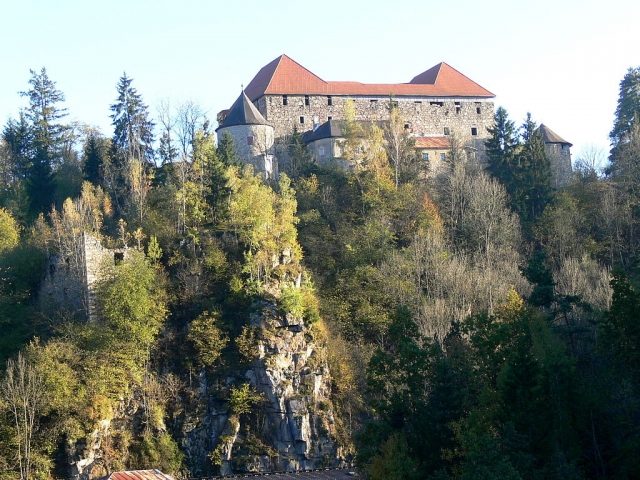
Pürnstein Castle is one of the best-preserved fortifications in Upper Austria. It is located in the Mühlviertel near Neufelden high above the Große Mühl river.
In 1010, a fortification was first mentioned as a bishop's castle of Passau at this location. The first documented owner was Alram de Birchenstaine in 1170, a ministerialis of the Blankenbergers. In the 13th century, the castle passed from the Rosenbergers in 1213 to the ownership of the Prince-Bishopric of Passau. The bishops had the castle administered by burgraves, but often had to pledge it due to lack of money.
From 1309 to 1311, Jakob de Strachner was named as a feoffee. In 1337, Hans von Kapellen sold the castle to Dietrich von Harrach. In 1344, the castle went to Ulrich III von Tannberg. Around 1402, the castle was a fief of Passau, and between 1437 and 1451, the Passau administrator Erhard Marschalk resided there.
By 1455 at the latest, the Starhembergers acquired the castle complex and expanded it into what is still known today as the Upper or New Castle. A large part of the old castle complex was demolished, and a completely new, unified fortress was built, the last castle or the first palace. On July 20, 1449, the castle chapel was consecrated. Parts of the ruins of the original fortification have also been preserved to this day. In 1493, the Passau canon Balthasar von Starhemberg bequeathed Pürnstein Castle and lordship to his cousin Gregor von Starhemberg. In 1526, Pürnstein was a refuge from the Turks, before it was sold to Lienhard von Harrach in 1572. In 1611, Karl Jörger bought the castle; in 1621, Emperor Ferdinand II, after the expropriation of the Jörgers, gifted a part of the castle to Count Leonhard von Harrach. However, the Bishop of Passau Leopold Wilhelm of Austria demanded the castle back, as it was a Passau fief. In 1660, the castle was pledged to the general secretary of the Bishop of Passau. In 1681, the castle was redeemed by Johann Maximilian Steiner von Plainfelden. In 1774, an extension was built under Cardinal Firmian of Passau, and the castle gate was renewed.
In 1782, Pürnstein came to Austria through a treaty; at the end of 1802, the Diocese of Passau lost its secular possessions, including Pürnstein. In the 19th century, ownership changed several times; from 1813, the castle was owned by Michael Planck von Planckburg, from 1818 by his brother Franz, from 1828 by Johann Freiherr von Bartenstein, and thereafter by the industrialist Carl Christian Müller. A fire on September 7, 1866, destroyed the entire interior with all wooden parts and the roof structure of the inner castle complex; only the chapel was spared. Arson is stated as the cause. However, parts of the later added buildings, largely from the 17th and 18th centuries, are still habitable today.
In 1883, Carl Müller gifted the castle to his daughter Ida. Between 1880 and 1958, Pürnstein was owned by Margarete Reichner, after which Karl Reichner (great-grandson of Gustav Müller) was the owner. The castle was threatened by decay; in 1958, a thorough restoration began. The current owner and the Association for the Preservation of Pürnstein Castle are dedicated to the preservation and renovation of the castle complex.
Structure+
The castle is situated on terrain that slopes steeply to the north and west. The spacious complex has five semi-circular towers. Through the main gate, one enters the outer bailey. The main castle is reached through the upper castle gate. The main castle is a large, hexagonal residential castle. The castle courtyard measures 17 x 13.5 meters.
In the central palas are the knight's hall, living quarters, kitchen, chapel, and the inner castle courtyard. The palas is surrounded by a defensive wall with five towers. The thickness of the walls is up to six meters.
In Steinbruch, a district of Neufelden, the epitaphs of several castle owners of Pürnstein (Marga Reichner, Gustav Adolf Müller, Weissbach family) are located on the outer wall of the subsidiary church of St. Anna.
Take Mobile History with you
You are reading this text for free. Premium adds what matters on the road: descriptions read aloud, sites found through your camera, whole regions taken offline.
- Every description, including the ~17,700 Premium sites
- Audio guide: have descriptions read to you on location
- AR finder: see sites through your camera, with distance and bearing
- Unlimited saved sites
14 days free, then from €2.99 a month. Cancel anytime.
Source: Wikipedia · Licence: CC BY-SA 4.0 · Image: http://commons.wikimedia.org/wiki/File:P%C3%BCrnstein_1_Gesamt.jpg
This description draws on the facts documented in the linked Wikipedia article; Wikipedia content is licensed under CC BY-SA 4.0. Wording and editing: Mobile History.
Location: 48.5019, 14.0125