The Castle can be visited
CastlePottenstein
Pottenstein Castle
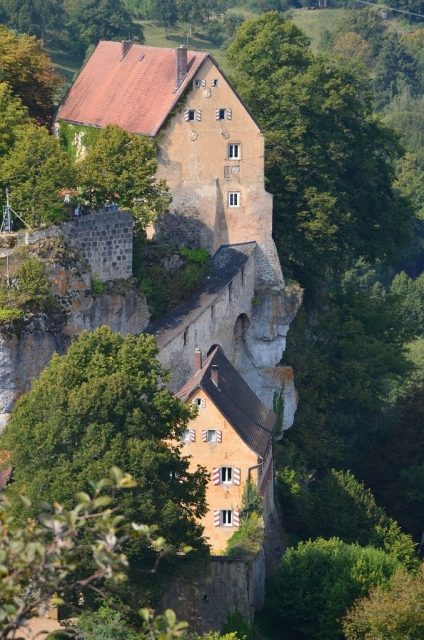
Pottenstein Castle is one of the oldest castles in Franconian Switzerland and houses a castle museum. It rises on a rock above the town of Pottenstein in the district of Bayreuth in Upper Franconia, Bavaria.
The castle and the castle museum can be visited for an entrance fee.
The spur castle is located in the Franconian Switzerland-Veldenstein Forest Nature Park at an approximate height of 410 meters on a mountain spur projecting to the west between the valleys of the Püttlach and the Weihersbach, immediately southeast above the town of Pottenstein, about 22 kilometers southwest of Bayreuth.
Several other castles are located nearby: to the west, Gößweinstein Castle, Kohlstein Castle, and the two castle ruins in Tüchersfeld; to the east, Hollenberg Castle Ruin and the castle sites of Wartberg and Böheimstein.
The Founding of Pottenstein Castle
Around the year 1050, the town of Pottenstein was owned by Margrave Otto von Schweinfurt and, after his death in 1057, passed to his third daughter Judith. Judith was married in her first marriage to Duke Kuno of Bavaria. After Kuno died in 1055, Judith married Count Palatine Botho of Carinthia around 1057. Botho came from the noble family of the Aribonen; in 1070, he called himself comes de Potensteine, i.e., Count of Pottenstein.
The founding of Pottenstein Castle, which bears his name (Botho's Stone), must therefore have taken place between 1057 and 1070 by Botho. The castle probably originally served to secure the area between the Upper Main and Pegnitz to the southeast.
There is no clear documentary evidence for the castle's founding by King Conrad I as early as around 918.
The Episcopal-Bamberg Official Castle
Botho died in 1104 without direct heirs and was buried in Theres Monastery. Judith had already died in 1066.
From the fact that the castle was not among the acquisitions of Otto I, the Holy, who held the title of bishop from 1102 to 1139, it can be concluded that Botho sold the castle to the Diocese of Bamberg during his lifetime, before or in the year 1102. The castle was the residence of Bishop Otto I around 1118 and 1121.
In the following centuries, Pottenstein Castle was managed by an episcopal-Bamberg ministerial family, who also named themselves after the castle. The oldest known member of the family was a Wezelo von Pottenstein around 1121; in 1169 there was a Rapoto von Pottenstein. He was followed by Erchenbert or Erchenbrecht von Pottenstein from 1185 to 1221; from about 1207, he was also an episcopal-Bamberg seneschal. His brother Heinrich also called himself von Pottenstein. Further members of the family followed, including a Konrad von Pottenstein between 1240 and 1248; from 1242, he was a cathedral canon.
Pottenstein Castle temporarily served as a residence for Saint Elisabeth, Landgravine of Thuringia, from 1227 to 1228.
Between 1323/1327 and 1348, the castle became the seat of a Bamberg office. In 1348, a Gebhard Storo was the bailiff in Pottenstein. Pottenstein was the center of an extensive high court district. The Pottenstein administrative area expanded through the incorporation of smaller episcopal offices: in 1492, the office of Tüchersfeld; in 1594, the office of Leienfels; and between 1628 and 1636, the office of Gößweinstein.
From the beginning of the 14th century, the castle was administered by a Vogt (bailiff), who resided in the Vogteihaus (bailiff's house) in the lower castle. This Vogteihaus was referred to as the old Vogtei in 1728 and 1743; the Vogt probably moved into a building in the town in 1728, and by 1748 at the latest, he occupied the Vogthaus, which had been purchased in 1745 and rebuilt in 1748/1749. The reason given was the arduous ascent to the mountain castle. The only known noble Vogt was Walter von Streitberg in 1332; the later Vogts, who appeared at the end of the 16th century, were of bourgeois status.
From 1500, the officials called themselves Pfleger (caretakers); they resided in the so-called Kemenate (stone house) in the upper castle. In 1750, the Pfleger also moved from the castle to the Vogthaus in the town. The castle was abandoned as an official residence and served as a grain storage facility.
Warlike Events
During the bitter struggles in 1125 between King Lothar III and the Staufer anti-king Conrad III, the town of Pottenstein fell victim to flames. The castle remained unscathed.
During the Peasants' War in 1525, it was occupied and plundered by the peasants, but not burned down, out of fear that falling and burning debris could also damage houses in the town below. Furthermore, the peasants would have been left without protection against the troops of the Palatine and Margraves, as well as those of the city of Nuremberg.
Severe destruction was brought by the Second Margrave War, in which Albrecht Alcibiades, Margrave of Brandenburg-Kulmbach and Bayreuth, undertook numerous raids and plunderings, leading to the destruction of many places and castles in the Empire, especially in Franconia. Pottenstein Castle was shelled and captured by margravial troops on May 18, 1553. Among other things, the chapel in the upper castle was destroyed and was no longer mentioned after 1553. The damage sum of 20,000 Gulden shows that not only the outer bailey was conquered.
During the Thirty Years' War, an attack on the castle by the Swedish Colonel Cratz failed in 1634. A trumpeter, claiming to have been sent by the imperial troops, appeared before the castle. He was allowed over the drawbridge, but when it was noticed that enemies were waiting outside, the drawbridge was quickly raised. The captured trumpeter was executed after his conversion to the Catholic faith.
During the War of the Spanish Succession, a garrison was stationed in the castle in 1703/1704; it was still occupied by soldiers in 1708 and 1712. In 1703, an oven for the garrison was installed in the already dilapidated keep. No further warlike events around Pottenstein Castle have been reported from later times.
Sale of the Castle to Private Ownership
After the diocese passed to the Bavarian state in 1803 during secularization, the castle fell into disrepair. In 1878, the castle came into the possession of the Nuremberg pharmacist Dr. Heinrich Kleemann, to whom the preservation of the then ruinous and demolition-threatened castle is owed. After his death in 1890, his widow sold the castle in 1900.
In 1918, Pottenstein Castle was acquired by the father of the castle lord Winzelo Freiherr von Wintzingerode, who died in 2006 and whose ancestral seat was Bodenstein Castle in Thuringia. His life's work was the establishment of the museum and the ongoing renovation of the castle complex. The castle remains in the family's possession to this day.
Today, the castle is a privately run and inhabited museum, showcasing prehistoric and early historical objects, a weapon collection, books, autographs, and three exhibition rooms furnished as an ensemble.
The Elisabeth Room, furnished as a memorial room in the former residential tower, the western part of the palas, commemorates the stay of Saint Elisabeth in 1227–1228.
Accessible are the upper main building (Knight's Hall, Red Salon, Elisabeth Room), remnants of the former keep, the well house (porcelain, glass, ceramics, and ethnographic objects), and the tithe barn (with an exhibition on the tithe system, an exhibition on the castle's recent history, and changing special exhibitions). In addition to the impression of a well-preserved 16th-century castle complex with medieval substance, visitors to the castle garden enjoy a magnificent view over the town and landscape.
The Murder at the Castle
On April 2, 1866, Max Söhnlein, recently released from Bayreuth prison, killed the castle warden's wife with a broad axe in the presence of her infant. Max Söhnlein was the son of a former castle warden and committed the robbery-murder to cover up a crime. He wanted to steal clothes and money when he realized that his parents no longer lived in the castle. He was arrested shortly thereafter in Pegnitz and sentenced to life imprisonment by the jury court in Bayreuth on May 7, 1866. Due to his youth – he was only 20 years old – the otherwise customary death penalty could not be imposed.
Take Mobile History with you
You are reading this text for free. Premium adds what matters on the road: descriptions read aloud, sites found through your camera, whole regions taken offline.
- Every description, including the ~17,700 Premium sites
- Audio guide: have descriptions read to you on location
- AR finder: see sites through your camera, with distance and bearing
- Unlimited saved sites
14 days free, then from €2.99 a month. Cancel anytime.
Source: Wikipedia · Licence: CC BY-SA 4.0 · Image: Peter Schneider
This description draws on the facts documented in the linked Wikipedia article; Wikipedia content is licensed under CC BY-SA 4.0. Wording and editing: Mobile History.
Location: 49.7698, 11.4084