Hotel
CastleTexingtal-Plankenstein
Plankenstein Castle
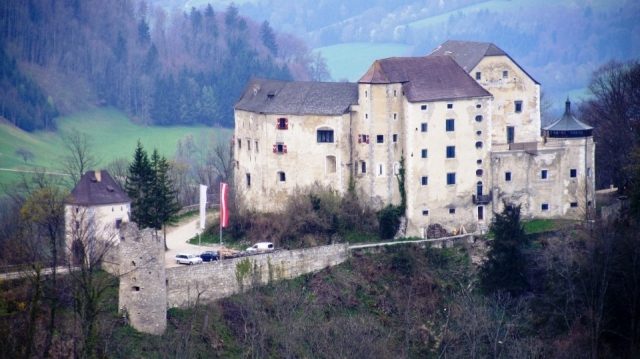
Plankenstein Castle is located in the village of Plankenstein, about 4 kilometers southwest of Texing in Lower Austria. The castle was first mentioned in a document in 1186 and was built by the Plankensteiners, vassals of the Counts of Peilstein. The family name is derived from the word blanc (= white) and roughly means "from the white stone".
The Plankensteiners acquired significant possessions in the 15th century. Pankraz von Plankenstein owned, among other things, Peilstein, Freienstein, and Sassendorf, was the pledge lord of Weitra and the administrator of Pöchlarn. In 1453, he had the castle renovated, but did not reside there. In the fraternal dispute between Emperor Frederick III and Duke Albrecht VI, Pankraz von Plankenstein sided with the Emperor, which brought him further power after the peace treaty.
After many years of changing ownership, the Tinti family acquired the castle in 1713. Bartholomäus von Tinti, who had acquired Schallaburg in 1763, died in 1799 at the age of 96 at Plankenstein.
Decay
Since his family already resided at Schallaburg, Plankenstein was abandoned and began to decay. A chronicle from 1800 reports: Plankenstein, at the beginning of the century still a well-preserved castle, was gradually stripped of its furnishings, and finally even its windows and doors. In the stately rooms, wind and weather played their game, the walls cracked, the roofs collapsed, and in a few decades the castle was a ruin. Plankenstein could no longer be restored, as the most necessary restoration would have caused disproportionately high costs. However, at least enough was done so that the church and school, the parsonage and the school teacher's residence found space in the castle ruins.
In 1939, the Tinti family sold their heavily indebted property, including Plankenstein and Schallaburg, to the noble family Nagel-Doornick from Westphalia, who still own castles and palaces in Germany today, including Vornholz Castle. Their possessions were expropriated as German property by the Russian occupation forces after the Second World War. While Schallaburg, as a former USIA enterprise, fell to the Republic of Austria in 1955 with the State Treaty due to unresolved ownership issues, which then resold it to the state of Lower Austria, Plankenstein Castle was restituted to the Nagel family.
Reconstruction
After the castle increasingly decayed and partially collapsed, the Nagel family decided in 1975 to sell it to the architect Hans-Peter Trimbacher. With a dedicated team, Trimbacher managed to close and roof the main roof by October, thus protecting the fragile limestone walls from further collapses just in time before winter. Trimbacher invested at least 15 million Schilling in the renovation and reconstruction. In 2008, the castle, which was open for tours and featured 40 guest rooms in addition to various event spaces, was for sale for 1.45 million euros.
Hotel Operation
In 2010, Viennese entrepreneur Erich Podstatny bought Plankenstein Castle to fulfill a childhood dream. The guest rooms were equipped with modern sanitary facilities and antique pieces from his private collection. Today, one can stay affordably in the individually designed guest rooms and feel like a knight in the idyllic castle courtyard, the arcaded courtyard, the former castle chapel, or one of the other event rooms.
Take Mobile History with you
You are reading this text for free. Premium adds what matters on the road: descriptions read aloud, sites found through your camera, whole regions taken offline.
- Every description, including the ~17,700 Premium sites
- Audio guide: have descriptions read to you on location
- AR finder: see sites through your camera, with distance and bearing
- Unlimited saved sites
14 days free, then from €2.99 a month. Cancel anytime.
Source: Wikipedia · Licence: CC BY-SA 4.0 · Image: http://www.wehrbauten.at/noe/niederoesterreich.html
This description draws on the facts documented in the linked Wikipedia article; Wikipedia content is licensed under CC BY-SA 4.0. Wording and editing: Mobile History.
Location: 48.0253, 15.2788