To be privately owned
CastlePitten
Pitten Castle
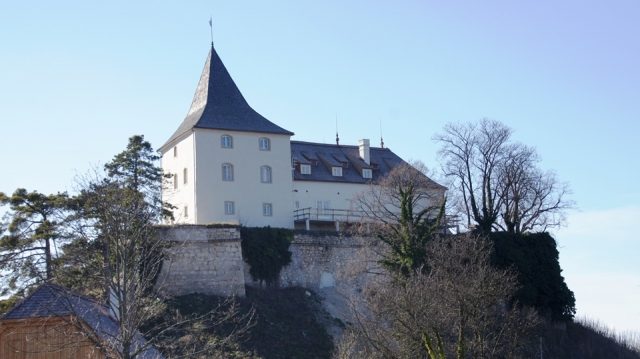
The name Pitten first appears in the year 869. Even then, there was a fortified earthwork secured by ditches and palisades. In 907, the area belonging to the Lords of Ebersberg was conquered by the Hungarians. In 1042, they retreated after a lost battle. The existence of a castle is documented from 1094.
A branch of the Formbacher counts, who ruled here in the 12th century, named themselves after Pitten. Eckbert III, the last of his family, fell in 1158 in the Battle of Milan. His widow bequeathed Pitten to Margrave Otakar III of Styria, who was related to her husband. Due to the Georgenberg inheritance treaty of 1186, the lordship came to the Babenbergs and thus became princely.
The family enfeoffed with the castle also named themselves after it. Its members belonged to the ministeriales of the Babenbergs. When Offo von Pitten died in 1265 without male descendants, his widow married Heinrich von Stubenberg. After his death, the castle was confiscated by the sovereign and was always pledged or given as a fief until the 15th century. However, the owners did not live here and had the lordship administered by burgraves. From 1426, these were always princely. In 1463, the mercenary leader Georg von Vöttau plundered the town of Pitten and besieged the castle. From 1482 to 1485, Wolfgang Teufel was the administrator of Pitten. He defended the castle for four years against King Matthias Corvinus of Hungary and could only be overcome after final starvation. Corvinus withdrew after the destruction of the castle. It was rebuilt soon after. In 1529, under castellan Matthäus Teufel, Wolfgang's son, the Turkish siege was withstood.
From 1550, the lordship was held in pledge by the Frohnsdorf line of the Barons von Teufel. In 1605, Hans Christoph von Teufel succeeded in converting this into free ownership. The expansion of the castle into a modern fortress was carried out on his behalf. His heir, Christoph Adolf von Teufel, ran into financial difficulties and had to hand over the property to his brother-in-law Hans Balthasar Hoyos in 1662. A siege by the troops of Stephan Bocskai in 1605 was successfully endured. From the 17th century, Pitten was part of the Frohsdorf lordship and had the same rulers. Around 1820, the partly dilapidated castle passed to Countess Lipona. In 1842, a renovation took place, and since then Pitten was habitable again. In 1890, the ownership right was registered for the still underage Prince Don Jaime of Bourbon.
In the 19th century, the castle, which had long lost its fortress character, served primarily as a base for aristocratic hunting parties. After the death of the Count of Chambord in 1883, Pitten came to the House of Parma or Habsburg and passed into private ownership in the 20th century.
Take Mobile History with you
You are reading this text for free. Premium adds what matters on the road: descriptions read aloud, sites found through your camera, whole regions taken offline.
- Every description, including the ~17,700 Premium sites
- Audio guide: have descriptions read to you on location
- AR finder: see sites through your camera, with distance and bearing
- Unlimited saved sites
14 days free, then from €2.99 a month. Cancel anytime.
Source: Wikipedia · Licence: CC BY-SA 4.0 · Image: http://www.wehrbauten.at/noe/niederoesterreich.html
This description draws on the facts documented in the linked Wikipedia article; Wikipedia content is licensed under CC BY-SA 4.0. Wording and editing: Mobile History.
Location: 47.7165, 16.1906