The remains of the Castle can be visited
CastleOschersleben
Oschersleben Castle
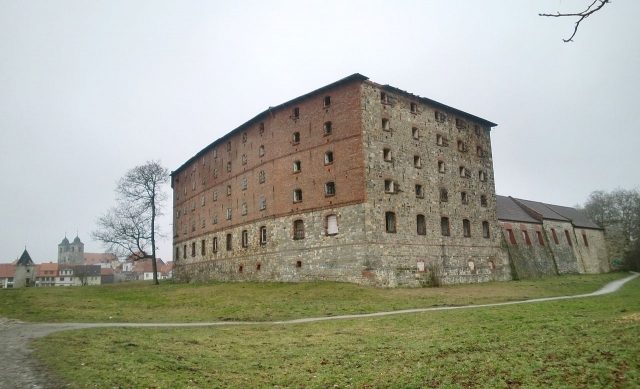
Oschersleben Castle, also partly referred to as Oschersleben Palace, is a medieval castle complex in Oschersleben, Börde district, Saxony-Anhalt, which, however, only survives in a few remnants.
The castle was built as a lowland castle in the immediate vicinity of the Bode river. It was equipped with ramparts and moats. The earliest documentary mention dates back to 1205, although the castle is likely older. In addition to a main castle, there was a bailey to the north, which was later used as an economic courtyard.
Strategically, the castle served to secure a crossing over the Großer Bruch, a 50-kilometer long and up to two-kilometer wide swamp area that no longer exists in this form today. The complex was owned by the Bishops of Halberstadt, who, however, repeatedly pledged it, for example, to the Archdiocese of Magdeburg and also to the Counts of Regenstein. In 1545, Cardinal Albrecht had an episcopal office established and the castle renovated and extended northwards towards the town. A four-story residential building in the Renaissance style, known as the palace, was built. With the transfer to Brandenburg in 1648, the castle became a domain. In 1691/92, a two-story, plastered official residence was built, which delimited the economic courtyard to the southwest. In the second half of the 19th century, the domain passed into private hands. In 1896, the palace was demolished, except for a stair tower that still exists today, and rebuilt as a granary. The material from the previous building was reused.
Current Appearance+
The former castle complex has largely disappeared. This particularly affects the bailey. In many parts, only an empty, open space remains. The palace, converted into a granary, is preserved but largely empty and in need of renovation. Portals designed as one pointed arch and two round arches still bear witness to its original function as a palace. Some rectangular windows with tracery frames and a stone coat of arms plaque with the coats of arms of the Archbishops of Magdeburg and Mainz and the Bishop of Halberstadt are also preserved. A spiral staircase from the second half of the 16th century is also still present. In the area of the old main castle, remnants of the historic fortifications have also been preserved.
Take Mobile History with you
You are reading this text for free. Premium adds what matters on the road: descriptions read aloud, sites found through your camera, whole regions taken offline.
- Every description, including the ~17,700 Premium sites
- Audio guide: have descriptions read to you on location
- AR finder: see sites through your camera, with distance and bearing
- Unlimited saved sites
14 days free, then from €2.99 a month. Cancel anytime.
Source: Wikipedia · Licence: CC BY-SA 4.0 · Image: http://commons.wikimedia.org/wiki/File:Oschersleben_Burg_Speicher.JPG
This description draws on the facts documented in the linked Wikipedia article; Wikipedia content is licensed under CC BY-SA 4.0. Wording and editing: Mobile History.
Location: 52.0242, 11.2250