District Court
CastleObernberg am Inn
Obernberg Castle
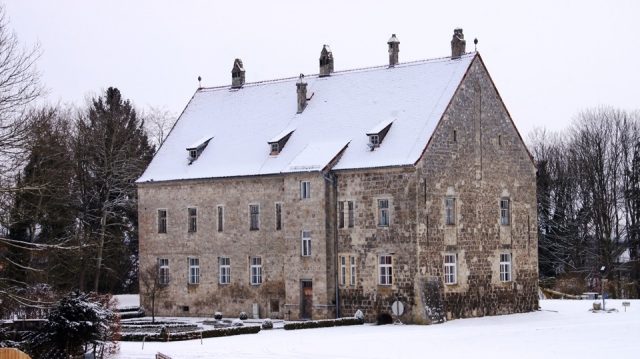
The first castle complex was built by the Counts of Formbach in the 10th century (Upper Castle). They had the castle administered by a burgrave. A Meginhart de Obernberge is attested from the year 1160. Obernberg was ceded by the Counts of Formbach and their successors, the Counts of Andechs, to the Diocese of Passau in 1191.
Bishop Wolfker had Obernberg expanded into an almost impregnable fortress from 1199 to 1202. In 1241, the Muhringer of Eberschwang attacked the fortress and market of Obernberg. Duke Friedrich II of Austria was able to capture the castle in 1243 after a siege through an act of betrayal. The castle guard was transferred to Counts Ulrich and Wernhart of Schaunberg. They were able to withstand a six-week siege by Bishop Rüdiger of Passau in 1245. In 1246, Duke Friedrich returned the castle to the Diocese of Passau, which was then occupied by Duke Otto. When Otto von Lonsdorf was elected as the new Bishop of Passau, the castle reverted to Passau and remained with the diocese until secularization in 1803. Obernberg was pledged to Bavaria in 1368, in 1372 it was pledged to the Archdiocese of Salzburg for four years after an attack by Reichker von Riedenberg and Zacharias Haderer, in 1388 it came into the possession of Duke Albrecht III for some time, and in 1411 it was pledged to the Count of Ortenburg.
A Kuchler, who administered Obernberg around 1427, introduced a toll in 1466. In 1550, Bishop Count Wolfgang von Salm had a new building erected here as a residential and official building for the respective administrator. During the War of the Spanish Succession, Obernberg was occupied by Bavarian troops in 1701. In 1782, Obernberg came to Austria, but the Diocese of Passau remained the landlord. After Obernberg, along with the other Passau possessions in the Innviertel, fell to Austria in 1803, the Imperial and Royal District and Administrative Court was housed in one of the castle buildings. In 1807, all buildings that were no longer in use were demolished. In 1809, the Napoleonic occupiers also had the tall tower and the remaining defensive structures razed. The castle area now belongs to the state of Upper Austria. One building housed the district court until 2005. The Kunsthaus Obernberg is located in the second. A falconry is also located in the castle area.
Take Mobile History with you
You are reading this text for free. Premium adds what matters on the road: descriptions read aloud, sites found through your camera, whole regions taken offline.
- Every description, including the ~17,700 Premium sites
- Audio guide: have descriptions read to you on location
- AR finder: see sites through your camera, with distance and bearing
- Unlimited saved sites
14 days free, then from €2.99 a month. Cancel anytime.
Source: Wikipedia · Licence: CC BY-SA 4.0 · Image: http://www.wehrbauten.at/ooe/oberoesterreich.html
This description draws on the facts documented in the linked Wikipedia article; Wikipedia content is licensed under CC BY-SA 4.0. Wording and editing: Mobile History.
Location: 48.3230, 13.3334