To be privately owned
CastleNordenbeck
Nordenbeck Castle
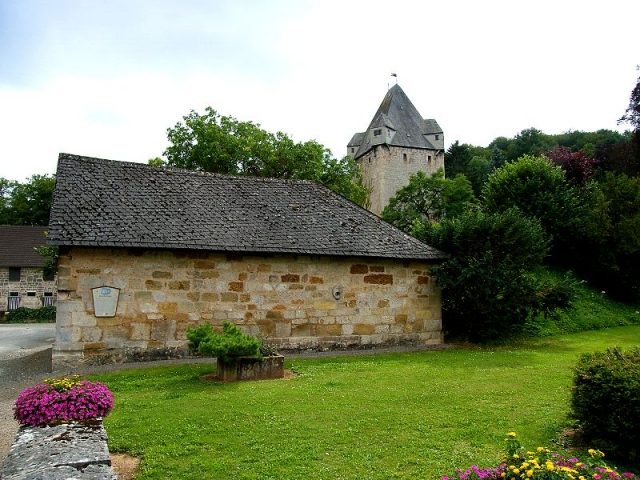
Nordenbeck Castle is a former moated castle in Nordenbeck, a district of Korbach in the Waldeck-Frankenberg district in Hesse.
In a document from 1036, Nordenbeck was first mentioned as an outwork of the Paderborn manorial estate in Korbach. The Lords of Nordenbeck, first documented in 1306 as vassals of the Counts of Itter, probably built the castle complex surrounded by moats in the 13th century.
In 1346, Kurt I (also Konrad) von Viermünden, then lord of Hallenberg Castle, acquired the castle and made it the ancestral seat of his noble family in 1368. In 1380, the "old" Lords of Nordenbeck died out. In 1412, Brosecke von Viermünden built a six-story tower as a residential tower. Between 1443 and 1453, a residential building (also referred to as a palace) was erected next to the tower; from then on, the tower was only accessible via a drawbridge on the second floor of this residential building. In 1563, with Hermann von Viermünden, the Nordenbeck line of the Viermünden family died out in the male line, whereby Nordenbeck, after a long legal dispute, fell to Hermann's daughter Anna von Viermund and her husband.
Subsequently, the ownership of the castle changed frequently, while the Lower Rhenish collateral line of the noble family Viermünden in Neersen, as well as the Westphalian collateral line in Bladenhorst, repeatedly and ultimately unsuccessfully tried to regain the castle. Since Johann von Viermünden zu Neersen temporarily occupied the castle during the Thirty Years' War, the coat of arms of the Lordship of Nordenbeck adorns the escutcheon of his family coat of arms and today also the coat of arms of Neersen. Remains of the former castle complex and the residential tower are still preserved.
Since 1790, the castle complex has been owned by the Canisius family. (A visit to the privately owned complex is not possible.)
Between 1851 and 1854, the residential building was demolished, while the tower remains well preserved to this day. The six floors are partly equipped with fireplaces, and it also contains a chapel with a bronze bell from the 13th century. A defensive floor is equipped with cannons. Some wall paintings are still preserved. It was accessible via a drawbridge on the second floor.
Take Mobile History with you
You are reading this text for free. Premium adds what matters on the road: descriptions read aloud, sites found through your camera, whole regions taken offline.
- Every description, including the ~17,700 Premium sites
- Audio guide: have descriptions read to you on location
- AR finder: see sites through your camera, with distance and bearing
- Unlimited saved sites
14 days free, then from €2.99 a month. Cancel anytime.
Source: Wikipedia · Licence: CC BY-SA 4.0
This description draws on the facts documented in the linked Wikipedia article; Wikipedia content is licensed under CC BY-SA 4.0. Wording and editing: Mobile History.
Location: 51.2404, 8.8397