School
CastleNordeck
Nordeck Castle
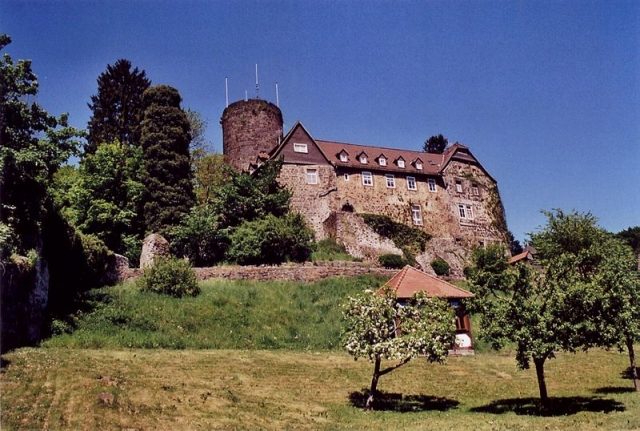
Nordeck Castle is located in Nordeck, a district of Allendorf an der Lumda in the Gießen district. The castle, whose origins are documented in the 12th century, still shapes the image of Nordeck today. It frequently changed owners, is now owned by the Counts of Schwerin zu Friedelhausen, and has housed the Nordeck Castle Country Boarding School since 1925. The keep can be visited by prior arrangement.
The actual age of the castle can be deduced from the dimensions of its chapel, as there are no documents about its construction phase: the "Roman foot," which underlies its dimensions, was used until the 11th century. During this time, the chapel was built with the main complex of the castle from basalt and Lungstein.
The first documented reference to a lord of the castle dates from a later period and names an Adolf von Nordeck in 1222. However, Nordeck an der Lumda is mentioned as a settlement as early as 1093. But the village presupposes the castle, so its construction before 1100 can be considered certain. Initially established as the ancestral seat of the von Nordecks, the castle was owned by the Landgraves of Hesse from the 13th century. It once served as an important barrier on the road from Mainz to Amöneburg.
In 1328, Hermann the Elder (* after 1305; † between 1368 and 1370), the youngest son of Landgrave Otto I, received Nordeck Castle as a paragium after his eldest brother Heinrich II (* before 1302; † 1376) took over the rule in the Landgraviate of Hesse.
Castle Chapel+
The castle chapel is located in the outer bailey, whose walls enclosed part of the village situated on the slope. It stands near the inner fortress wall and belonged to the former outer bailey. Its floor plan was once a rectangle consisting of two almost square parts, one as a choir with an altar, the other only slightly larger, for visitors.
The Romanesque groin vault above the choir is supported by "corner projections." During renovations in the early 1950s, an original fresco of unknown age was discovered on one of these corner projections. It shows a reddish-brown devil's head staring into the altar area. The painting was later whitewashed at the request of the community because the image disturbed some visitors.
It is not certain whether the large arch separating the two old parts of the room was once round and only later pointed. The building underwent a major intervention in 1708. The roof and ceiling were renewed, as were the portal and windows. A gallery was installed and a roof turret with a bell tower was added. Three round wooden supports bear this construction. In addition, the community room was extended to the north by a higher area.
The Lords of Nordeck presumably intended to redesign their chapel for permanent use for Sunday services. Before that, only services for the castle residents, but hardly any community services, had taken place there. Following a complaint from the patron family, the Marburg Church Consistory ordered a regular rotation for Winnen and Nordeck in 1733 and 1780. However, already in the first half of the 19th century, the chapel had fallen into disrepair again and was not used for about 40 years. In the meantime, a renovation was rejected by the church leadership on the grounds that the chapel was private property. It was only restored in 1842, but even after that, no regular services took place. The pastor at the time rejected them on the grounds that the Winnen parish would be split into two communities.
Nevertheless, the chapel was extensively renovated in 1933/34 with the help of volunteers. It had again not been used for 30 years and served as a lumber room. Weddings and baptisms were to be held there; however, this use only became established in 1952.
During this renovation, the cobblestones in the altar area were replaced with sandstone slabs. The current altar and the patron's pews in the gallery were created. The coats of arms of the von Schwerin, Eulenburg, and Nordeck families can be seen on the pews and parapet.
The calligrapher Rudolf Koch, who was a guest at the castle at the time, was allowed to place the inscriptions still visible today on the east wall of the choir. Without a preliminary drawing and in 20 minutes, he wrote in Gothic letters a verse from Psalm 103:13 (As a father has compassion on his children, so the Lord has compassion on those who fear him) and Isaiah 40:31 (Those who wait for the Lord will renew their strength; they will mount up with wings like eagles). The baptismal font and the altar vessels were also made according to Koch's designs in the local art forge Schönwandt. The altar cross, in particular, was highlighted: it consists of a wooden core with a shiny brass overlay, also designed by Rudolf Koch. At its four ends, the cross bears the names of the four evangelists Matthew, Mark, Luke, and John. The edges are decorated with round rivet heads. The base forms a stepped pyramid. Wavy stripes like flowing water are engraved over the middle of the steps. Below them are the names of the rivers flowing from Paradise (Gen 2:10-14): Pishon, Gihon, Tigris, Euphrates. In the middle of the pyramid, the cross is enthroned as a symbol of Christ.
Complex+
The small but well-preserved complex is a hillside castle with a neck ditch, a shield wall, and a round keep (12th/13th century) on the attack side. Buildings from the 14th to 17th centuries surround a narrow castle courtyard with an old well on three sides. It also includes a castle chapel.
Take Mobile History with you
You are reading this text for free. Premium adds what matters on the road: descriptions read aloud, sites found through your camera, whole regions taken offline.
- Every description, including the ~17,700 Premium sites
- Audio guide: have descriptions read to you on location
- AR finder: see sites through your camera, with distance and bearing
- Unlimited saved sites
14 days free, then from €2.99 a month. Cancel anytime.
Source: Wikipedia · Licence: CC BY-SA 4.0
This description draws on the facts documented in the linked Wikipedia article; Wikipedia content is licensed under CC BY-SA 4.0. Wording and editing: Mobile History.
Location: 50.6926, 8.8428