Cultural center
CastleIlmtal-Weinstraße - Niederroßla
Niederroßla Castle
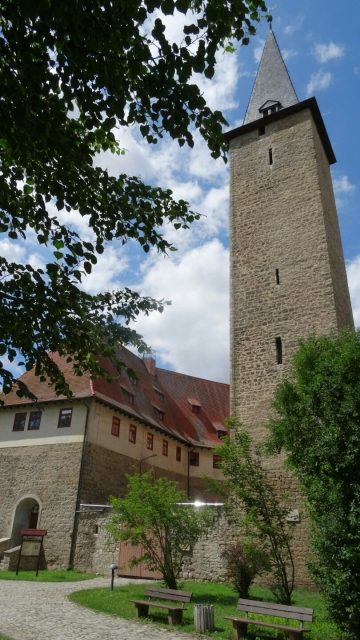
Niederroßla Castle stands on the right bank of the Ilm river in the Niederroßla district (Schlosshof 8) of the rural municipality of Ilmtal-Weinstraße in the Weimarer Land district in Thuringia.
Nieder- and Oberroßla were formerly one district. The division only took place in the 12th century. It was probably during this time that the moated castle was built in Niederroßla. A nobleman, Dietmar von Roßla, was first mentioned in a document in 1119. He is certainly also the builder of the moated castle.
After the extinction of this family, the castle passed into the possession of the von Vitzthum family in 1371. The Vitzthums lost the castle during the Saxon Fratricidal War in 1447 because they were responsible for feuds. Subsequently, Duke Wilhelm III of Saxony owned the castle and established an accounting and judicial office (Amt Roßla) within it. Since he died childless in 1482, the property passed to his nephews Ernst and Albrecht. They carried out the Leipzig Partition in 1485, whereby Niederroßla Castle came to the Ernestines. It remained with them even after the Wittenberg Capitulation in 1547. Through the Erfurt Partition of the Ernestine Duchy of Saxony, Niederroßla Castle came to the Duchy of Saxe-Weimar in 1572 and to the Duchy of Saxe-Altenburg in 1603. After the extinction of the Saxe-Altenburg line in 1672, the castle returned to Saxe-Weimar during the subsequent division of the country.
From 1738 to 1739, the Weimar Duke Ernst August I had the baroque Niederroßla Palace built on the grounds of the outer bailey. This was demolished by the communists in 1947.
In 1945, the owners were expropriated and expelled by the communists. After the Second World War, the castle complex was left to decay. In 1956, the castle was placed under monument protection, and in 1966, the municipal council, together with the Institute for Monument Preservation, initiated steps to secure and renovate the building fabric within the scope of the possibilities at the time. Apartments and a gymnasium were created in the west wing. A school kitchen was housed in the knight's hall. In 1976, the tower was re-roofed.
From 1991, the outdoor area was redesigned and measures were taken to preserve the half-timbered remains. In 1995, structural securing of the east wing was possible. On April 1, 2008, the gable side of the east wing collapsed for unknown reasons. The foundation stone for the reconstruction was laid by the mayor on April 23, 2009. For this, 96,000 euros in donations and 200,000 euros in funding were provided. A plastic tube containing coins, a leaflet about the moated castle, the call for donations, a current newspaper, and a commemorative publication was embedded in the masonry.
Description+
The moated castle, a simple three-story building complex with its core castle on a pentagonal plan, was protected on its north and west sides by the Ilm river and on the other two sides by artificial moats. The moat had a width of 25 m and a depth of 5 m.
Above the old outer bailey in the south of the current castle complex, on a trapezoidal plan, are the palace complex and two round corner towers. Johann Wolfgang von Goethe stayed here several times between 1779 and 1789 to monitor the progress of work on his agricultural estate in Oberroßla.
The 57-meter-high square keep has a base area of 6.5 by 6.5 meters and a wall thickness of 2 meters.
Take Mobile History with you
You are reading this text for free. Premium adds what matters on the road: descriptions read aloud, sites found through your camera, whole regions taken offline.
- Every description, including the ~17,700 Premium sites
- Audio guide: have descriptions read to you on location
- AR finder: see sites through your camera, with distance and bearing
- Unlimited saved sites
14 days free, then from €2.99 a month. Cancel anytime.
Location: 51.0364, 11.4844