Cultural Events
Museum
CastleWolfsburg - Neuhaus
Neuhaus Castle
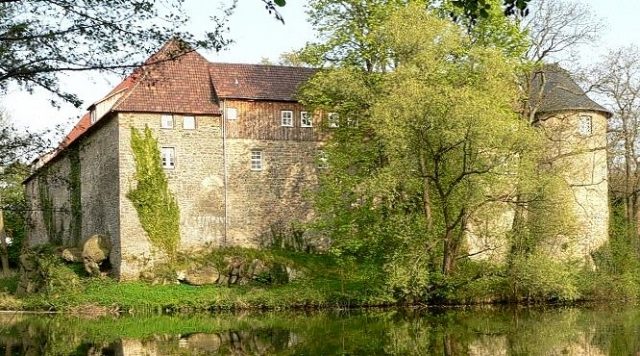
Neuhaus Castle is a well-preserved medieval moated castle in the Neuhaus district of Wolfsburg and, along with Fallersleben Castle and Wolfsburg Castle, is one of the city's most important historic buildings. First documented in 1371, the castle became the knight's seat of the Rothehof line of the von Bartensleben family from 1423. Until the mid-16th century, it served a military function. Afterwards, it served as a ducal Brunswick administrative building and became an agricultural domain. Since April 1, 1981, the castle has belonged to the city of Wolfsburg.
The castle was built on a rock massif of Keuper sandstone above the Aller lowlands. It became a moated castle by damming the Hehlinger Bach, which surrounded it as a moat. Today, only the castle pond remains.
The castle was formerly located at a favorable position to protect passing trade routes. These were the routes Lüneburg - Leipzig and Bremen - Magdeburg. The trade routes crossed the Aller glacial valley here at a relatively dry spot between the marshlands of the Barnbruch to the west and the Drömling to the east.
Construction+
Neuhaus Castle was completed in 1372 as "Neues Haus" (New House) after only two years of construction. The builder was Duke Magnus the Younger of Brunswick with the help of the city of Brunswick. It was intended to be a counter-castle to Wolfsburg Castle and the (now non-existent) fortification "Altes Haus" (Old House) in Vorsfelde, both of which were under the control of the von Bartensleben family. The reason for the Duke's rearmament was a breach of loyalty by the von Bartenslebens. Although bound by feudal ties, they had become disloyal by entering into a feudal contract with an eastern sovereign.
Neuhaus Castle is a closed complex with a protected inner courtyard. Characteristic of its military strength are the high walls and the approximately 20 m high, defiant keep next to the gate entrance. It had a large knight's hall. The complex was only accessible via a drawbridge. Today, the castle is one of the best-preserved medieval moated castles in northern Germany.
In Merian's description from 1654, it says about Neuhaus Castle:
This is a Princely Brunswick administrative house. This house is built very high on a stone rock and has strong masonry towers on both corners.
During the Lüneburg War of Succession (1370-1388), Duke Magnus the Younger of Brunswick declared war on the von Bartenslebens and sent a strong garrison to Neuhaus Castle. On June 24, 1372, an open field battle took place near Hesslingen between Brunswick troops and units from Wolfsburg (von Bartensleben), which ended in a draw. In 1374, a special peace treaty ended the hostilities in the region. In 1464, there were renewed acts of war against the castle when Duke Otto of Lüneburg undertook a revenge campaign against Duke Henry I of Brunswick, the Peaceful. Neuhaus Castle as well as Wolfsburg Castle withstood the attacks, while the Vorsfelde castle "Altes Haus" was completely destroyed.
Since 1423, Neuhaus Castle was the seat of the Rothehof line of the von Bartensleben family. They operated under the name Bartensleben zum Newenhauß. According to tradition, in 1473, Huner von Bartensleben resided in the castle when his cousins Jakob and Busso applied to the sovereign for the castle, should anything happen to their relative.
In 1552, units of Count Vollrad von Mansfeld from the Schmalkaldic League advanced on Neuhaus Castle. He had invaded the Duchy of Brunswick with around 5,400 landsknechts and 2,100 horsemen, plundering and had already devastated several cities in the Harz foreland. The troops shelled the castle with heavy artillery, including the large-caliber Fürnmörsers (mortars). This caused significant damage to the buildings, and the castle chapel was not rebuilt afterwards, but the conquest of the castle failed. Von Mansfeld carried out a similar cannon bombardment in the same year at Lichtenberg Castle in Salzgitter, which was thereby reduced to ruins. For Neuhaus Castle, its time as a knight's seat ended after the attack. It was converted into an administrative building for the Duchy of Brunswick. An agricultural domain was established in the castle's outbuildings. From 1585 to 1890, it housed a brewery and a distillery.
In 1934, the castle's function as an administrative seat and domain ended, and during the Third Reich, a Reichssportschule (Reich Sports School) was established there.
Today+
After World War II until 1980, the castle was a children's home. In 1981, the city of Wolfsburg acquired the complex with 65 rooms on 3200 m² and housed resettlers there for a few more years before opening it to citizens and associations of the Neuhaus district. Today, it is enlivened by a diverse range of users and offerings, such as:
- Freundeskreis Burg Neuhaus e.V. (Friends of Neuhaus Castle Association)
- Newcastle Renaissance Dance Group
- Castle Museum
- Citizen's Contact Point of the City of Wolfsburg
- Knight's Hall and Tower Room for events and family celebrations
- Kindergarten
- Gymnasium
- Neuhaus Play and Sports Club
- Artist and artisan studios (clay and metal sculptures, ceramics, textile design, painting)
Annually recurring events such as:
- Autumn Market of Artisans
- Castle Singing
- Castle Festival (on the last Saturday before the summer holidays)
- Cultural autumn event of the Freundeskreis Burg Neuhaus
- Cake Festival
Take Mobile History with you
You are reading this text for free. Premium adds what matters on the road: descriptions read aloud, sites found through your camera, whole regions taken offline.
- Every description, including the ~17,700 Premium sites
- Audio guide: have descriptions read to you on location
- AR finder: see sites through your camera, with distance and bearing
- Unlimited saved sites
14 days free, then from €2.99 a month. Cancel anytime.
Source: Wikipedia · Licence: CC BY-SA 4.0 · Image: https://de.wikipedia.org/wiki/Datei:Burg_Neuhaus_Fassade.jpg
This description draws on the facts documented in the linked Wikipedia article; Wikipedia content is licensed under CC BY-SA 4.0. Wording and editing: Mobile History.
Location: 52.4157, 10.8562