The Castle can be visited
CastlePausa-Mühltroff
Mühltroff Castle
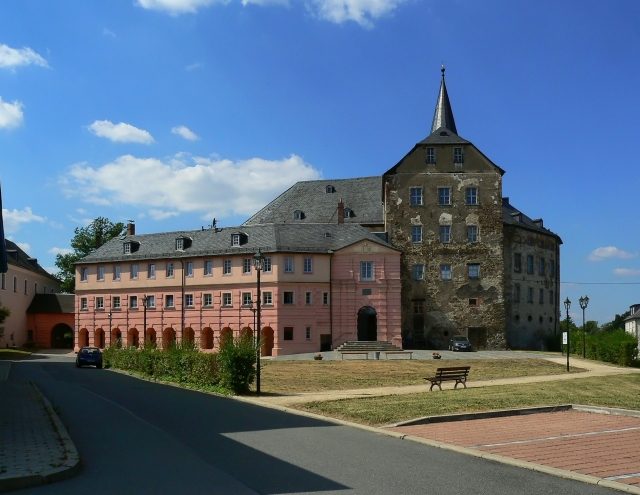
Mühltroff Castle is a former castle and later palace in Mühltroff (August-Bebel-Straße) in the Vogtland district of Saxony. Mühltroff Palace is the landmark of the town.
The castle was founded in the 10th to 11th century, presumably to consolidate the rule of German emperors, who enfeoffed knights with their fortifications for protection against attacks by the Sorbs.
Before 1274, the lordship of Mühltroff was owned by the Lords of Lobdeburg. In 1349, the castle, called "castrum", is mentioned as a Meissen fief in the feoffment book of Frederick the Strict and is the seat of the Vogt of Plauen, Lord of "Muldorf".
In 1357, the Plauen Vogts had to cede the castle to the Wettin margrave brothers Balthasar and Wilhelm, who then enfeoffed various vassal families with it. In 1380, the castle was burned down in the Guttenberg Feud.
From 1436 to 1591, the castle and the lordship were owned by the Nobles of Sack and then passed to the families of Schönberg and Lindemann until the family of Mandelsloh took over the castle in 1601.
From 1604, the family of Bodenhausen owned the castle and the lordship until their extinction in Mühlhausen in 1775, and it then passed to the Thuringian family of Kospoth. From 1790, Imperial Count Otto Carl Erdmann von Kospoth took over the castle and manor. Further changes of ownership took place until the great fire in 1817, then in 1822 the Counts of Hohenthal-Püchau took over the castle with its land.
From 1923 to 1939, the castle served as a recreation home for the Higher Girls' School in Plauen until it came into the possession of the town of Mühltroff as a donation in 1940 and was then temporarily used as a camp for child evacuation.
From 1949 to 1989, the castle, transferred to the public ownership of the GDR, was used as a residential building until it came back into the possession of Mühltroff after the fall of the Berlin Wall.
Current Use+
The manor house was privately sold in 1999 as the only part of the castle and contains modern apartments.
As a cultural center of the town, the castle, which can be visited during guided tours, offers premises for various club and exhibition activities as well as a wide range of events, with the "Black Kitchen" being particularly noteworthy.
Description+
The castle was founded as a lowland castle on a greenstone rock as a round defensive and watchtower surrounded by moats, around which residential and commercial buildings as well as a manor were built over the centuries.
The main building of the palace dates from the 16th and 17th centuries, a period of extensive construction. Further alterations took place after the fire in 1817, and between 1820 and 1837, as well as in 1856, the castle tower was redesigned.
Take Mobile History with you
You are reading this text for free. Premium adds what matters on the road: descriptions read aloud, sites found through your camera, whole regions taken offline.
- Every description, including the ~17,700 Premium sites
- Audio guide: have descriptions read to you on location
- AR finder: see sites through your camera, with distance and bearing
- Unlimited saved sites
14 days free, then from €2.99 a month. Cancel anytime.
Source: Wikipedia · Licence: CC BY-SA 4.0 · Image: Thomas Eichler
This description draws on the facts documented in the linked Wikipedia article; Wikipedia content is licensed under CC BY-SA 4.0. Wording and editing: Mobile History.
Location: 50.5404, 11.9302