Local Authorities
CastleMeiningen
Meiningen Castle
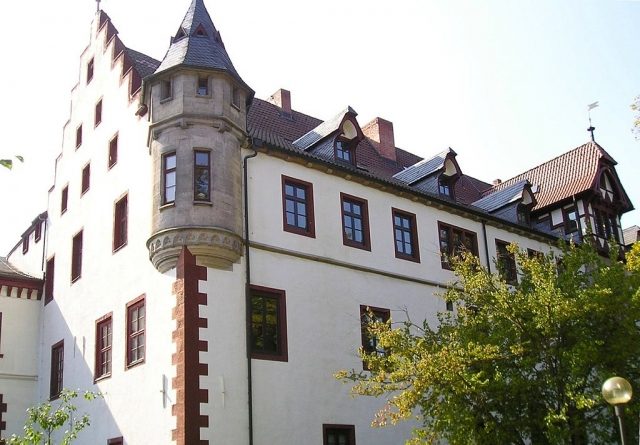
Meiningen Castle was a town castle in the present-day district town of Meiningen and existed until 1682. Today, the baroque Elisabethenburg Palace stands on the same site. The castle was a moated castle on the northwestern edge of the historic old town of Meiningen on the right bank of the Werra at a ford.
Description+
Meiningen Castle was a town and moated castle and was integrated into the northwestern part of the town's fortifications. The moat was fed by the Werra. It consisted of a main house, the Centhaus, outbuildings, a tower, and a castle wall. Access was from the south and was secured by a drawbridge.
The exact start date of the castle's construction is not known, but due to its protective function for the Meiningen March and the royal estate of Meiningen, as well as a Werra ford, it is assumed to be before 1000. Meiningen, like the nearby Landwehrberg, Vachdorf, Belrieth, and other places in the East Franconian Grabfeldgau, was probably provided with a simple fortification during the Hungarian invasions of 899–955.
As compensation for territorial losses due to the new foundation of the Diocese of Bamberg in 1007, Henry II handed over, among other things, the royal estate of Meiningen to the Prince-Bishopric of Würzburg in 1008. To protect this exclave, the Würzburg bishops had the existing fortification expanded into a moated castle. As castellan, the bishops appointed ministerial feudal lords from the lower nobility, who were often also responsible for the Landeswehre Castle, also belonging to Würzburg. Among the first documented castellans were Gumbert von Meiningen (1168), Berthold von M. (1206), and Otto von M. (1240).
In 1406, the Junkers von der Tann took the castle as a fief. The Junkers' increasingly hostile attitude towards the Diocese of Würzburg prompted Bishop Johann II von Brunn in 1418 to have the castle stormed by force, the Junkers captured and deposed. During a citizens' uprising on August 10, 1432, the people of Meiningen destroyed the castle and expelled the castellans, as their attacks on the population had incurred the wrath of the citizens. From 1509 to 1511, Bishop Lorenz von Bibra had the castle rebuilt in the Renaissance style.
In 1542, the castle and town of Meiningen came under the County of Henneberg. After the extinction of the Counts of Henneberg in 1583, the county and thus Meiningen Castle fell, according to the treaty, to the Ernestine line of the Saxon ruling house of Wettin. Since they could not agree on a division of the county with other ruling houses that also claimed the Henneberg inheritance, a joint Henneberg government was initially formed. Meiningen was chosen as the administrative seat, and the government took up residence in Meiningen Castle. In 1615/16, the castle was expanded with a freestanding tower, gardens, and an extended castle wall. The castle survived the Thirty Years' War unscathed. Only in 1660 did the final division of the County of Henneberg and thus the dissolution of the Henneberg government take place.
In 1680, the Duchy of Saxe-Meiningen was founded through an inheritance division, and the castle came into its possession. Duke Bernhard I decided in 1682 to build a new residential palace in place of Meiningen Castle. Except for the main building as a temporary residence, the castle was razed, and construction of the palace began on the cleared areas. For financial reasons, the ideal plan of Elisabethenburg Palace could not be realized, and the remaining main building of the castle was integrated as the north wing into the three-wing complex and henceforth called "Altes Schloss" (Old Palace). From 1859 to 1861, the palace wing, now called "Bibrasbau," was rebuilt by the architect and building official Otto Hoppe, during which it received its present appearance.
Status+
The remaining main building is today a cultural monument. It houses the Meiningen City Archives, the Thuringian State Archives Meiningen, and the "Max Reger" Music School.
Take Mobile History with you
You are reading this text for free. Premium adds what matters on the road: descriptions read aloud, sites found through your camera, whole regions taken offline.
- Every description, including the ~17,700 Premium sites
- Audio guide: have descriptions read to you on location
- AR finder: see sites through your camera, with distance and bearing
- Unlimited saved sites
14 days free, then from €2.99 a month. Cancel anytime.
Source: Wikipedia · Licence: CC BY-SA 4.0 · Image: http://commons.wikimedia.org/wiki/File:Meiningen-Schloss01.jpg
This description draws on the facts documented in the linked Wikipedia article; Wikipedia content is licensed under CC BY-SA 4.0. Wording and editing: Mobile History.
Location: 50.5708, 10.4131