The Castle can be visited
CastleWüstenrot-Maienfels
Maienfels Castle
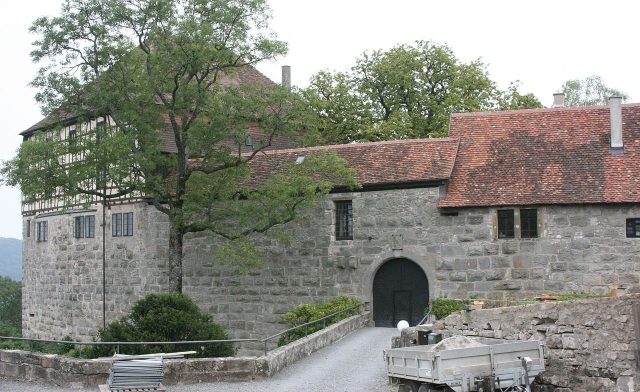
Maienfels Castle is located on a mountain spur above the Brettach Valley in the eponymous district of Maienfels, part of the municipality of Wüstenrot in the Heilbronn district of Baden-Württemberg.
Findings from building components suggest that the construction of Maienfels Castle began between 1230 and 1250. The high-altitude castle complex first appears in 1302 as the seat of a collateral line of the Lords of Neudeck, who later called themselves von Maienfels. Members of this ministerial family served the Hohenlohe and maintained close ties with the Staufer. At the end of the 14th century, the Neudeck sold the castle to the Hohenlohe.
With the castle peace treaty negotiated in 1426, the castle became a joint inheritance (Ganerbenbesitz) and distaff fief (Kunkellehen) of the Lords of Urbach, von Venningen, von Sickingen, and von Weiler. The castle owners were considered opponents of the surrounding imperial cities, and conflicts with them repeatedly arose. The imperial cities, united under the leadership of Hall, therefore besieged the castle for over three months in 1441 and razed a considerable part of the complex. After Weinsberg came under Palatine rule, the new families of Schott von Schottenstein, Rauch von Winnenden, von Gültlingen, von Remchingen, von Freyberg, and von Vellberg, some of whom had acquired joint inheritance through the female lines of the previous castle owners, rebuilt the castle. In 1464, they pledged the castle as a fief to the Count Palatine to be protected by him against the imperial cities. All six families lived in the castle, making extensions within the castle walls necessary. This feudal lordship passed to Württemberg in 1504 after the conquest of Weinsberg by Ulrich of Württemberg.
The Lords of Gemmingen acquired two-thirds of the castle through marriage in the 15th and 16th centuries, and in the 18th century, they were also able to acquire the remaining third. However, the Gemmingen-Maienfels line died out as early as 1799, and the castle passed to the Gemmingen-Hornberg line, who no longer used the castle for residential purposes. Only after a renovation in 1930 was the castle inhabited again.
Complex+
Maienfels Castle is considered a section castle, where only one side needs to be protected, the other sides being secured by steep drops. A main building, the fortifications, and a tower of the castle are preserved. From the original substance of the High Middle Ages, the battlement and a machicolation on the curtain wall above the gate to the church are preserved.
The castle remains in the family possession of the Lords of Gemmingen, who founded the non-profit Maienfels Castle Foundation in 1997 for the maintenance of the complex, which is still used for residential purposes. The castle is a popular excursion destination and can be visited by appointment.
Below the castle walls is the Protestant parish church of Maienfels; the village developed as a castle hamlet. Houses and a narrow street press against the castle walls; the former moat is now partly built over with houses.
The corner tower of the castle is topped with a half-timbered structure. For a long time, it housed the bells of the Protestant church below, which only received its current tower around 1920.
The castle was named Monument of the Month November 2007 by the Denkmalstiftung Baden-Württemberg.
Take Mobile History with you
You are reading this text for free. Premium adds what matters on the road: descriptions read aloud, sites found through your camera, whole regions taken offline.
- Every description, including the ~17,700 Premium sites
- Audio guide: have descriptions read to you on location
- AR finder: see sites through your camera, with distance and bearing
- Unlimited saved sites
14 days free, then from €2.99 a month. Cancel anytime.
Source: Wikipedia · Licence: CC BY-SA 4.0 · Image: https://commons.wikimedia.org/wiki/File:Burg_Maienfels_Detail1_20060916.jpg?uselang=en
This description draws on the facts documented in the linked Wikipedia article; Wikipedia content is licensed under CC BY-SA 4.0. Wording and editing: Mobile History.
Location: 49.1199, 9.5132