To be privately owned
CastleLutter am Barenberge
Lutter Castle
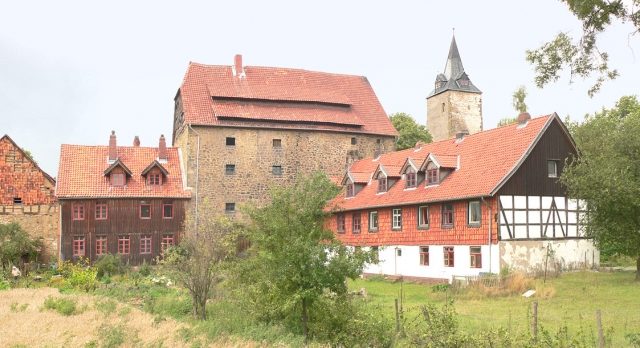
Lutter Castle is located in the municipality of Lutter am Barenberge in Lower Saxony. First mentioned in 1259, the castle was originally a moated castle and served as an agricultural domain since the Thirty Years' War. Since 1980, it has been owned by the Lutter commune, whose members inhabit, manage, and structurally maintain it.
Architectural Description+
The 4-hectare former castle grounds are now horseshoe-shaped, enclosed by farm buildings that form a large inner courtyard. Only a tall keep and a four-story Gothic palas remain from the castle's medieval period. The keep has a side length of 8.5 m. The walls are approximately 1.5 m thick. Originally, the tower was free-standing and was only enclosed by a three-story building in the 17th century. The respective domain tenant resided in this spacious official residence. The palas building, presumably erected in 1318, with two bricked-up Gothic windows, features walls up to 2 m thick. In the Middle Ages, it was a representative building for festivities and official acts. The large hall rooms on each floor, which occupy the entire level, bear witness to this period. Later, it was used as a brewery.
The other farm buildings of the castle courtyard, such as barns, riding hall, day laborer's house, and administrator's house, were rebuilt or constructed in the 18th and 19th centuries. At that time, the impression of a former moated castle also disappeared due to the leveling of the surrounding moat. Furthermore, the ramparts were also removed. Parts of the fortifications were also demolished for the construction of farm buildings. Originally, two drawbridges led to the grounds. Remains of the moat and rampart are still preserved in the west of the complex, where a double rampart system existed.
The castle was first mentioned in documents in 1259, but was probably built around the year 1000 as a moated castle. At that time, Bishop Johann of Hildesheim acquired the castle from the knight Ekbert of Lutter. For a long time, the knightly family of Lutter, who can be traced from 1189 until their extinction in 1403, were the feudal lords of the castle. The family is said to have been very fond of feuds and to have plundered in the neighborhood. In 1270, the castle complex, now in episcopal possession, was refortified. It served as an official residence and a border castle. In 1279, it was besieged by Hildesheim Bishop Siegfried II and Duke Otto the Strict of Brunswick. From 1307, Duke Heinrich the Wondrous of Brunswick was the castle owner. His heirs sold the complex to the Diocese of Hildesheim in 1323, where it remained for over 300 years. During this time, several noble families became pledge holders, the last of whom, the von Schwicheldt, acted as robber knights. For this reason, the castle was taken from them again in 1427 after 24 years of feudal possession. During the Hildesheim Diocesan Feud in 1523, Lutter Castle finally fell to the Duchy of Brunswick, after having previously been a constant bone of contention between Brunswick and the Prince-Bishopric of Hildesheim.
During the Thirty Years' War, the heavily fortified castle served the Danes as a defensive structure. After their military defeat in the Battle of Lutter, the castle was occupied by Count Tilly's troops. Thereafter, the complex was an agricultural state domain for centuries. In 1964, the domain was dissolved, and the lands were sold. Since then, the buildings have been left to decay. The listed 15th-century shepherd's farm and individual smaller buildings were demolished. The municipality of Lutter did not take over the castle grounds due to the enormous renovation costs. For a few years, the grounds were owned by a construction company that wanted to invest but went bankrupt.
Current Use+
Since 1980, the castle has been owned by the Lutter commune, officially operating as Lutter-Gruppe GbR. It is a group of originally 20–30, and in 2009 about 10 people. The members live together as a commune without hierarchical structures on an anarchist basis.
The new residents, who reject hierarchical structures and wage labor, made the former castle their home and workplace. They established smaller businesses on the premises. Almost annually, they renovate and restore the historic building fabric in larger campaigns in accordance with monument protection. Traditional methods are applied, and historical building materials are used. A complete renovation is not possible due to limited financial resources. In contrast to many other restored historical complexes, the original character has been preserved here.
Economic facilities of the current residents in the former castle complex include:
- Whole grain bakery
- Carpentry and joinery
- Seminar and holiday house
- Historical building materials
- Cidery
Take Mobile History with you
You are reading this text for free. Premium adds what matters on the road: descriptions read aloud, sites found through your camera, whole regions taken offline.
- Every description, including the ~17,700 Premium sites
- Audio guide: have descriptions read to you on location
- AR finder: see sites through your camera, with distance and bearing
- Unlimited saved sites
14 days free, then from €2.99 a month. Cancel anytime.
Source: Wikipedia · Licence: CC BY-SA 4.0 · Image: http://commons.wikimedia.org/wiki/File:Burg_Lutter.jpg?uselang=de
This description draws on the facts documented in the linked Wikipedia article; Wikipedia content is licensed under CC BY-SA 4.0. Wording and editing: Mobile History.
Location: 51.9864, 10.2706