Museum
CastleKrefeld-Linn
Linn Castle
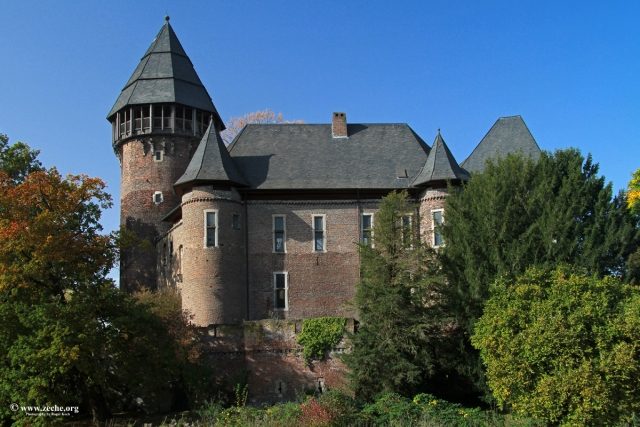
Linn Castle is a moated castle in Krefeld, North Rhine-Westphalia, in the Linn district. It is located about five kilometers east of the city center.
Middle Ages
The castle dates back to a residential and defensive tower of the noble lords Otto and his brother Gerlachus von Lynn, which was built in the 12th century from tuff and pebbles at this location, measuring approximately 8.5 x 14.5 m. As early as around the year 1000, there was a motte at this site, an artificial mound surrounded by a moat with a wooden watchtower protected by palisades. The first expansion consisted of a now no longer preserved shield wall made of tuff on the north side of the castle hill.
Otto von Linn sold the Allodium de Linne in 1188 for 100 marks to the Archbishop of Cologne, Philipp I von Heinsberg, but retained the castle as a fief before he himself, as a young man, participated in the Third Crusade. Inspired by Byzantine fortress architecture, Otto further expanded the castle after his return with the proceeds from Cologne. The old shield wall was initially closed into a ring in four construction phases with a modern brick wall. After its completion, the weak shield wall was removed, and the ring wall was supplemented in two further construction phases to its current hexagonal shape. The first three sections form exactly half of the planned hexagonal ring wall and were built quite quickly one after another between 1195 and 1200. Later, an exactly mirror-symmetrical hexagon was supposed to result. For unknown reasons, the second half of the ring wall was not built as precisely. Already the fourth construction phase was executed smaller than planned around 1202, which influenced the shape and size of the rest of the wall in the last two construction phases. Then the construction work stalled. The last two sections were only completed around 1230 and 1250. On the one hand, the removal of the old shield wall delayed the new construction, and on the other hand, Otto von Linn died around 1219. His son Gerhard von Linn completed the building, but he probably did not have the same idea of a castle as his father. At the end of the 13th century, he had the wall raised by another 3 meters.
At the beginning of the 14th century, the expansion into a territorial defensive complex began. The castle now belonged to the County of Cleves. Heinrich von Strünkede was the bailiff of Mechthild von Cleves at the castle. Robber baronage was practiced, among other things, against Krefeld, which belonged to the County of Moers. This ended when the united Cologne and Cleves troops stormed the castle. The feudal sovereignty of Electoral Cologne was now contractually guaranteed. Thus, Linn Castle resembled many double castles, which consisted of a residential-defensive building as the main castle and an agriculturally used outer bailey. Both were surrounded by a moat.
Modern Era
Renaissance
In 1477, the castle was besieged by Hermann von Hessen during the Cologne Diocesan Feud. A year later, the old moat was filled in to erect an additional outer ring wall. A new moat was then laid out in front of it. During the Thirty Years' War, the space between the inner and outer castle walls was filled in to give the castle a strong outer ring that could withstand bombardment with powder-loaded cannons. From the resulting area, the castle could then also be defended with such guns.
Continuously expanded and reinforced several times, Linn Castle became one of the largest moated castles in the Lower Rhine region. At the beginning of the 17th century, the castle and town of Linn were combined into a unified fortification with five bastions by earth walls and moats. According to current knowledge, the expansion took place in at least two stages. The first outer defensive system was built by 1581, after which it gradually fell into disrepair. Only around 1620 was the old system replaced by a new, much stronger one with five bastions. The defensive capability of the complex was proven by Linn Castle during the siege by Hesse-Kassel, which lasted for more than four weeks. In the end, however, the castle was conquered and further expanded and reinforced by the conquerors between 1643 and 1645.
The largest part of the castle complex still preserved today dates originally from the 13th century; only the south wing and the low outer defensive wall belong to the 15th and 16th centuries.
18th Century
During the War of the Spanish Succession, the castle was completely destroyed. Already in August 1702, the French occupation of the castle was besieged by imperial troops and finally driven out. The bombardment set the castle ablaze. In 1704 it burned again, and in 1715 lightning then set the upper castle courtyard on fire. The restoration of the completely burned-out castle was abandoned by the responsible Linn bailiff, not least because it had lost its strategic importance. Since 1728, the castle was considered uninhabitable. A guard was stationed, who performed his duty in a house specially built for this purpose at the access to the castle, as the castle no longer offered suitable premises for a guardroom. Only the keep was still used as a prison. Its name "Butterturm" (from "Büttel" - bailiff/jailer) also dates from this time.
Between 1707 and 1708, the buildings erected in the outer bailey in 1488 as a bakery and brewery were expanded into the Kellnerei, the official residence of the Electoral Cologne bailiff. Around 1740, Elector Clemens August had the Kellnerei converted into a hunting lodge. However, Clemens August only stayed there very rarely.
In 1794, immediately after the occupation of the Rhineland, the French declared the properties of the enemy governments to be the property of the French state. The castle and lands were sold. The hunting lodge was inhabited at that time by the Linn chief cellarer von Otten.
19th Century
In electoral possession since the 12th century, the castle, together with the hunting lodge, the historic tithe barn, and the extensive surrounding area, was acquired in 1806 by the Krefeld silk manufacturer Isaak de Greiff. Isaak de Greiff used the castle as a summer residence and in the winter months as a hunting lodge. One of his sons, Johann Philipp de Greiff, inherited the estate and soon after settled there with his family. His daughter Marianne Rhodius, née de Greiff, grew up here with her sister Emma and lived in the hunting lodge herself until her death in 1902. Marianne Rhodius was a niece of Cornelius de Greiff, to whom she owed most of her fortune. Her cousin Maria Schelleckes inherited the castle.
20th Century
As co-heir and co-administrator of Marianne Rhodius's estate, Justizrat Gustav Schelleckes moved into the hunting lodge at Linn Castle after the First World War. In 1924, he then sold the castle ruins, together with the hunting lodge and all other associated properties, to the city of Krefeld for 506,000 marks. However, he himself continued to live in the hunting lodge until his death in 1928.
The purchase of the properties by the city of Krefeld fell during the term of office of the then mayor, Dr. Johannes Johansen, who was very committed to the acquisition.
After the Second World War, the now overgrown and wild castle was finally restored and furnished with contemporary furniture. Today it offers an authentic picture of a medieval castle with a keep, battlements, moat, towers, castle dungeon, chapel, palas, and an intact outer bailey.
For over 260 years, Linn Castle had no roof truss. In the course of the restoration after the Second World War, the planks and floorboards of the individual floors were restored, but the upper floors could initially only be provisionally secured against the weather with a flat roof. In the 1980s, a renovation of the roof finally became increasingly urgent. With state funds and donations, the castle was re-roofed with a new roof, as it can be seen today. The new roof is a compromise between history and expediency. The original roof was not as steep as it is today, but a hundred percent reconstruction would not have been possible, as there are hardly any records of it. The roof truss was made with modern methods; a replica of the original construction is hardly affordable today. The roof of the keep was also raised to serve as an observation tower with a good panoramic view over Linn and the castle park.
Castle Chapel+
In the basement of the chapel tower at the gatehouse is the Gothic castle chapel from the 14th century, which opens with a large pointed arch to the palas hall. The chapel consists of a rectangular bay and a five-sided closed altar area built into the chapel tower. The chapel is illuminated by two lancet windows. Possibly, another chapel was located on the upper floor of the battery tower.
Park+
The castle is surrounded by the largely preserved medieval complex of the former Electoral Cologne town of Linn with extensive parklands, which also include part of the moats and bastions belonging to the former fortifications. The park concept was designed in the 19th century by Maximilian Friedrich Weyhe. The clients were the brothers Cornelius and Phillip de Greiff. In 1830, Weyhe presented his design. It envisioned extensive parklands in the English style around the castle's fortifications, with the castle ruins as a romantic centerpiece. However, Weyhe's plan was never fully executed.
In 2004/2005, the park of Linn Castle was included as an outstanding example in the Road of Garden Art between the Rhine and Meuse.
Museum Center Linn Castle+
The castle was renovated until 1926 and expanded into a state museum. In 1930, the hunting lodge was added. The castle and hunting lodge, together with the Archaeological Museum (formerly the Lower Rhine Landscape Museum) located in the immediate vicinity of the castle, form the Linn Castle Museum Center. The Museum Center comprises Linn Castle, the hunting lodge in the outer bailey, the Archaeological Museum, and the Geismühle as an external branch.
Today, the hunting lodge houses several furnished Krefeld bourgeois rooms from the 18th and 19th centuries. A completely furnished Lower Rhine farmhouse kitchen and a collection of mechanical historical musical instruments, which are demonstrated every Sunday, complement the museum's offerings.
Flax Market+
Every year on the Pentecost weekend, the regionally renowned Flax Market takes place on the park grounds around the castle and in the adjacent old town of Linn. The medieval craft market is the largest craft market in Germany. Over 300 craftsmen offer their goods and allow visitors to watch them at work. Medieval games, costumes, music, and of course the castle as a backdrop contribute to the medieval atmosphere.
Take Mobile History with you
You are reading this text for free. Premium adds what matters on the road: descriptions read aloud, sites found through your camera, whole regions taken offline.
- Every description, including the ~17,700 Premium sites
- Audio guide: have descriptions read to you on location
- AR finder: see sites through your camera, with distance and bearing
- Unlimited saved sites
14 days free, then from €2.99 a month. Cancel anytime.
Source: Wikipedia · Licence: CC BY-SA 4.0 · Image: http://www.zeche.org/
This description draws on the facts documented in the linked Wikipedia article; Wikipedia content is licensed under CC BY-SA 4.0. Wording and editing: Mobile History.
Location: 51.3329, 6.6346