To be privately owned
Restaurant
CastleOberstenfeld
Lichtenberg Castle
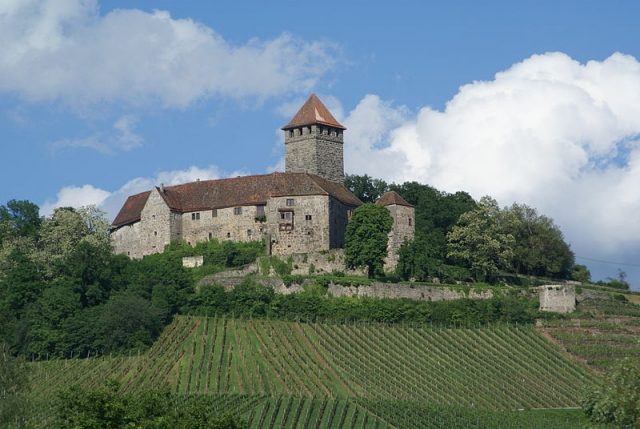
Lichtenberg Castle is a hilltop castle in the municipality of Oberstenfeld, above the community of Oberstenfeld in Baden-Württemberg. The castle was first documented in 1197 and is considered one of Germany's oldest Staufer castles. It is inhabited and houses a restaurant that is only open on special occasions. The castle is considered a landmark of the Bottwartal region.
The first documented mention was as early as 1197. In the 13th century, the Lichtenbergs ruled a small territory around Großbottwar. The owners became high dignitaries in the service of the church. From 1302 to 1314, Sibotho was Bishop of Speyer. Hermann was Chancellor of Louis the Bavarian and from 1333 to 1335 Bishop of Würzburg. In 1407, the family died out.
In 1357, Lichtenberg Castle and its dominion were sold to Count Eberhard the Quarrelsome. In 1361, Württemberg pledged the castle and village as a fief to the Crown of Bohemia. The feudal lordship existed until 1805. In 1483, the Weiler family received the castle as a sub-fief, and it remains in their possession to this day.
Current Significance+
The castle courtyard, tower, and chapel are publicly accessible on Sundays from April to November; the palas is also accessible in the absence of the lord of the castle. By arrangement, weddings and other celebrations can be held at the castle. A wedding ceremony in the chapel is also possible. The vineyard at its feet also belongs to the castle.
The never-destroyed hilltop castle dates from around 1200. The late Romanesque palas and the chapel (1220 to 1230) feature wall paintings from their construction period and around 1350; the gatehouse is Gothic. The current appearance mainly dates from the 15th century, as the Weiler family had a major renovation carried out at that time.
The castle was damaged by artillery fire in 1945 towards the end of World War II and thoroughly renovated in 1956.
Layout+
A keep, approximately 30 meters high and now covered with a roof, dominates the small complex on the attack side. The castle is entered via what is now a stone bridge and a gatehouse, which is flanked by a gatehouse. The high entrance to the keep is at a height of about 8 m. Through a gate barbican, one reaches the inner gate of the complex, above which is the chapel with beautiful exposed wall paintings, the oldest of which date from the 13th century. The narrow castle courtyard is bordered by the palas on the valley side and can be reached via a wooden bridge. To the north runs the curtain wall with a clock tower and the battlement to a rectangular low tower positioned diagonally to the northeast. The bell tower houses two bells by Johann Georg Rohr (1704) and his son Johann Daniel Rohr (1731).
Take Mobile History with you
You are reading this text for free. Premium adds what matters on the road: descriptions read aloud, sites found through your camera, whole regions taken offline.
- Every description, including the ~17,700 Premium sites
- Audio guide: have descriptions read to you on location
- AR finder: see sites through your camera, with distance and bearing
- Unlimited saved sites
14 days free, then from €2.99 a month. Cancel anytime.
Source: Wikipedia · Licence: CC BY-SA 4.0 · Image: http://de.wikipedia.org/wiki/Datei:BurgLichtenberg_Oberstenfeld_v_Lembach.JPG
This description draws on the facts documented in the linked Wikipedia article; Wikipedia content is licensed under CC BY-SA 4.0. Wording and editing: Mobile History.
Location: 49.0138, 9.3265