To be privately owned
CastleKreuzau
Kreuzau Castle
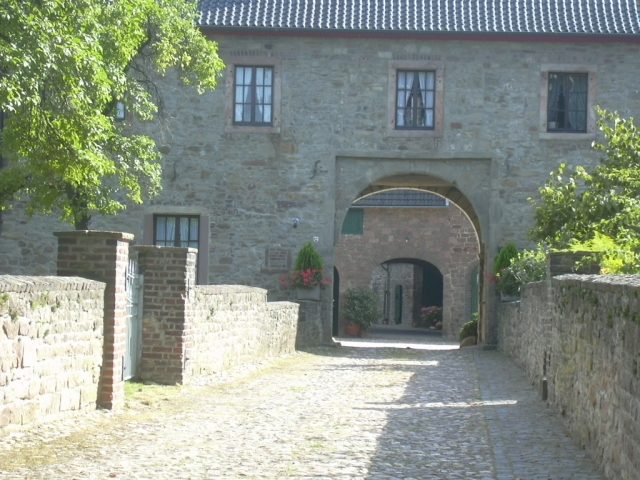
Kreuzau Castle is located in Kreuzau above the Rur in the district of Düren, North Rhine-Westphalia.
The moated castle was built not far from the crossing of an old Roman road over the Rur. It is possible that a house already stood on the site of the castle in Roman times.
The knight Dietrich Schinnemann, a powerful vassal of the Duke of Jülich, appears to have been a member of the von Ouwe family, who are known as the castle lords. He was the knight who, in the second half of the 13th century, called for rebellion against Duke Wilhelm I of Jülich because the latter, with his authoritarian government, restricted the rights of the knighthood. However, Dietrich Schinnemann lost this feud after initial successes, and his castle Freialdenhoven was razed.
In 1384, the Duke of Jülich allowed his vassal Dietrich Schinnemann to sell the castle in Kreuzau with all rights to the Collegiate Church of St. John the Evangelist, which was then still in Nideggen and later in Jülich, for 2000 gold guilders.
After the Schinnemanns, the von Walrave family from Cologne became owners of the estate until the end of the 16th century. Through marriage, the von Raesfeld family became owners. At the instigation of the German Order of Knights, Kreuzau Castle was judicially appraised in 1653. The estate was valued at around 4600 thalers. In 1658, the owners moved out of Kreuzau.
Surprisingly, on February 23, 1668, Lieutenant Colonel Dietrich Adolf von Torck personally presented the Kreuzau aldermen with a deed of gift, by which his relative Anna Stephana von Raesfeld, who was the abbess of Bocholtz Abbey, transferred the right of inheritance to the castle to him.
Von Torck took possession in July 1668. He then leased the castle. The feudal lords in Jülich did not agree with this. They demanded the castle back. Von Torck then had the entire main castle in Kreuzau destroyed. The officer proceeded so thoroughly that a reconstruction of this part of the castle did not seem worthwhile.
On the evening of October 10, von Torck attacked the castle together with three armed men. The dean and the collegiate cellarer were slightly wounded. Now the chapter in Jülich lost its temper and sued the officer, who now also judicially claimed the castle. However, when he learned the amount of the court costs he would incur, he gave up.
The Jülich Abbey was not to enjoy possession of Kreuzau Castle for long. The eldest son of Dietrich Adolf von Torck, Kaspar Jadokus, initiated a lawsuit concerning the castle at the court in Düsseldorf, which was decided in his favor in 1701. However, the tenant appointed by the Jülich Abbey, Herbert Müller, was allowed to continue managing the estate. The castle remained in the possession of the von Torck family until 1883. At that time, the family died out with Maria Franziska Wilhelmina.
She bequeathed the property to her distant relative Wilhelm Jungbluth. After his death in 1889, his brother Joseph Jungbluth inherited the estate, which he sold to Heinrich Arthur Hoesch in 1903. In 1931, Wilhelm Schmitz acquired the castle. After the death of the Schmitz couple in the air raid on Düren on November 16, 1944, the two daughters Dr. Trude Weis-Pfennig and Christel Jacobs inherited the property jointly. Kreuzau Castle is now used for agriculture.
Kreuzau Castle is now a rectangular, partly still enclosed by dry moats, farmstead made of quarry stone. The residential building dates from the 17th to 18th century. The farm buildings have been variously redesigned using the old walls. Allegedly, the northern aisle of the parish church of St. Heribert was built on the foundations of the main castle destroyed by Lieutenant Colonel von Torck in 1906 and 1907.
During the Second World War, the castle was damaged, subsequently demolished down to the first floor, and only reconstructed in its present form in the early 1970s.
Take Mobile History with you
You are reading this text for free. Premium adds what matters on the road: descriptions read aloud, sites found through your camera, whole regions taken offline.
- Every description, including the ~17,700 Premium sites
- Audio guide: have descriptions read to you on location
- AR finder: see sites through your camera, with distance and bearing
- Unlimited saved sites
14 days free, then from €2.99 a month. Cancel anytime.
Source: Wikipedia · Licence: CC BY-SA 4.0 · Image: http://de.wikipedia.org/wiki/Datei:Burgkreuzau.JPG
This description draws on the facts documented in the linked Wikipedia article; Wikipedia content is licensed under CC BY-SA 4.0. Wording and editing: Mobile History.
Location: 50.7487, 6.4853