The Castle can be visited
CastleKrautheim
Krautheim Caste
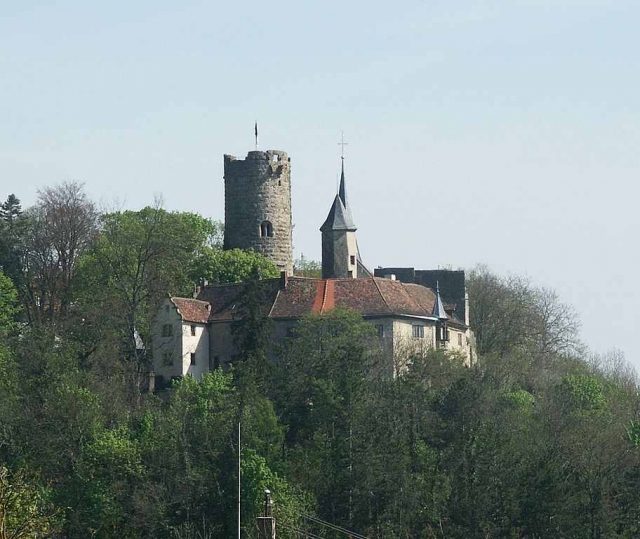
Krautheim Castle was built in 1213 by Wolfrad I von Krautheim on a mountain spur above Krautheim. Today, of the extensive complex, the keep, curtain wall, parts of the palas, and a High Gothic chapel with a lordly gallery are still preserved. After changing rulers, the complex is now owned by the state of Baden-Württemberg.
The spur castle is located in the center of the core town of Krautheim on a mountain spur at the northernmost point of the Jagst in the Hohenlohe district in Baden-Württemberg, at an altitude of approximately 330 m above sea level. It is strategically located 6 km west of Dörzbach and 11 km east of Schöntal, near old trade routes that led from Worms on the Rhine to Mergentheim and from Wimpfen on the Neckar to Rothenburg ob der Tauber. The Jagst forms the border between Baden and Württemberg here.
In Krautheim, there was already a refuge castle in the early Middle Ages. Archaeological excavations revealed a section wall with a ditch in the eastern part of the city (today's Altkrautheim). This was a wooden-earth wall, as built by the Celts and Alamanni.
The history of the current castle dates back to the 12th century. At this time, the local nobility began to move their seats from the valleys to strategically more favorable mountains. It is assumed that the construction of the complex began around 1172 by a Godefridus, who is mentioned as a cleric in Krautheim in a Würzburg document from that year. It is certain that the keep represents the oldest part of the castle. It was built from large tuff stone blocks in the style of a Staufer castle. The access to this tower was 10.5 m above the ground. Initially, the tower probably had a retractable wooden staircase, before it was connected to the palas by a bridge in a later construction period.
Towards the end of the 12th century, the castle complex was significantly expanded. The three brothers Wolfrat, Crato (Kraft), and Konrad von Krautheim had a high curtain wall, the palas, and a neck ditch in front of the wall on the mountain side built. At this time, there were two accesses to the castle. One was at the neck ditch. Here, a drawbridge led into the interior of the complex. On the west side, a steep mountain path led from the valley to the castle. Around 1230, the chapel was rebuilt. For this, the entrance to the castle had to be relocated. The formerly small chapel was extended by the gate hall and the choir was pushed into the eastern palas. In the years from 1240 to 1242, the Staufer imperial regalia (imperial crown, scepter, and imperial sword) were probably kept in Krautheim.
In the 14th century, the castle complex and the city came into the possession of the Archdiocese of Mainz, where it remained until secularization in 1802.
The castle gained literary fame through Götz von Berlichingen. In 1516, he shouted his opinion to the Elector of Mainz's bailiff Max Stumpf, who was in the castle, with the expletive "He should lick my ass". The Götz memorial stone now commemorates this event at the original spot. Goethe later included the quote in his famous play "Götz von Berlichingen", in which, however, historical accuracy is by no means preserved. The complex was destroyed in the Peasants' War in 1525. From 1612, it was extended in the style of a palace by the Archbishop of Mainz, Johann Schweikhard von Kronberg.
In 1889, during restoration work, the current entrance to the castle was broken through the shield wall.
Take Mobile History with you
You are reading this text for free. Premium adds what matters on the road: descriptions read aloud, sites found through your camera, whole regions taken offline.
- Every description, including the ~17,700 Premium sites
- Audio guide: have descriptions read to you on location
- AR finder: see sites through your camera, with distance and bearing
- Unlimited saved sites
14 days free, then from €2.99 a month. Cancel anytime.
Source: Wikipedia · Licence: CC BY-SA 4.0 · Image: https://commons.wikimedia.org/wiki/File:Burg_Krautheim_300405.jpg
This description draws on the facts documented in the linked Wikipedia article; Wikipedia content is licensed under CC BY-SA 4.0. Wording and editing: Mobile History.
Location: 49.3866, 9.6351