The Castle can be visited
CastleHavixbeck
Hülshoff Castle
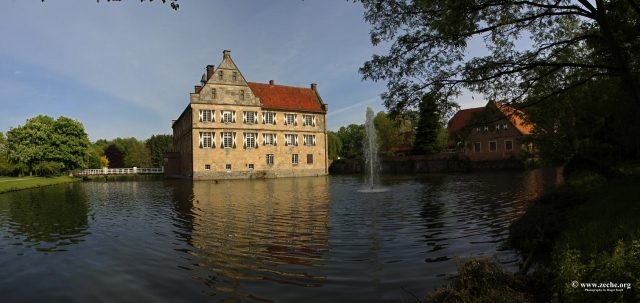
Hülshoff Castle is a typical Münsterland moated castle, its name derived from the term "Hülse" (also Hülshoff, Holst, English holly) for the holly tree. It is located between Havixbeck and the Münster suburb of Roxel and has been part of the municipality of Havixbeck since 1975. The castle has been the ancestral seat of the Barons Droste zu Hülshoff since 1417 and the birthplace of the poet Annette von Droste-Hülshoff.
Architectural Description+
Hülshoff Castle still presents itself today as a closed Renaissance complex, whose high three-tiered gables are unadorned. The moated castle stands on two islands connected by a bridge. In the 17th and 18th centuries, the complex was renovated, rebuilt, and expanded in Baroque forms, using Baumberg sandstone together with brick masonry. The Gärtnersturm (Gardener's Tower), built in 1628, has displayed a rider relief since the 19th century, originally placed elsewhere, depicting Heinrich I von Droste-Hülshoff (1500–1570), who was involved in the conquest of the city of Münster from the Anabaptists.
Building History+
The complex was first mentioned in a document in the 11th century as the Oberhof "Zum Hülshoff". Since 1417, the Lords of Deckenbrock have been known as its owners. Johann IV von Droste, who, like other Erbmänner (hereditary men) in Münster, worked and lived there, and was the owner of the Oberhof Deckenbrock, first bought a parcel of land from Hülshove in 1414, which is now the northern part of the castle park. In 1417, he also bought the house Tor Kulen, already mentioned in documents in 1347, and the Oberhof Hülshoff from his distant relative Jutta von Schonebeck. According to the documents, there was only a house with thick walls on an island in what was then a smaller house pond. The current outer bailey had a moat in the southern area, where the access was located at that time. The family initially used the castle as a country estate, especially during the summer months.
It was only Heinrich I (1500–1570) who, due to the experiences of the Anabaptist period and the Erbmänner dispute, moved his permanent residence to Hülshoff. Between 1540 and 1545, he built or extended the main house with the western wing and fortified the castle. He had the pond enlarged by a canal. The complex was further fortified in 1580 by his son, the mayor of Münster Bernhard II von Droste zu Hülshoff (1542–1624). He erected enclosing walls, the (demolished in the 19th century) Old Dog Tower (its original weather vane with the Droste-Travelmann coat of arms is now on the New Dog Tower) and a Renaissance bay window (demolished in the 18th century). His son Heinrich II (1597–1666) had to strengthen the fortifications again due to repeated sieges and looting in the Spanish-Dutch and Thirty Years' Wars. In 1628, he raised and paved the current Lindenallee, the present main access to the castle.
The interior of the manor house was rebuilt at the end of the 18th century by the governor of Münster, General Heinrich-Johann von Droste zu Hülshoff (1735–1798), during which the windows also received their current form. His nephew Clemens-August II von Droste zu Hülshoff, father of the poet Annette von Droste-Hülshoff, had the swampy area to the south drained. For this purpose, he had the branch ditches dug from the eastern and western towers of the outer bailey to the house pond. The almost silted-up moat between the two towers was deepened.
The last major changes occurred in the 19th century. In 1868, the New Dog Tower was built at the expense of the ornithologist Ferdinand von Droste zu Hülshoff (1841–1874). The castle chapel in neo-Gothic style was added by his brother, the district administrator of Münster Heinrich von Droste zu Hülshoff (1827–1887).
It was not until the 1970s that the outer bailey received such wide moats through Jutta von Droste zu Hülshoff that one can speak of an island location.
Current Use+
Hülshoff Castle and its park can be visited for an entrance fee. There are guided tours of the interiors, which primarily commemorate the poet Annette von Droste-Hülshoff. The castle cellar and, in summer, the courtyard are managed by the castle restaurant. Hülshoff Castle is also known for its large and well-maintained park. The landscaped park is divided into various sections. Numerous perennials can be admired in the summer months. In May, the "Gartenträume" (Garden Dreams) festival takes place annually on the park grounds, and in November, the "Winterträume" (Winter Dreams) festival. Hülshoff Castle is a stop on the 100 Castles Route. The cycle path connects the castles in Münsterland on 4 circular routes.
Birthplace of the Poet+
Annette von Droste-Hülshoff was born at Hülshoff Castle in 1797 and spent her childhood and youth here.
"You ancestral home with your towers,
Lulled by the quiet pond,
Where in the storms of my life
I have so often fallen and triumphed, –
You broad, leaf-vaulted halls,
That saw me young and joyful,
Where my sighs eternally wander
And the traces of my feet remain."
– Annette von Droste-Hülshoff
With the help of the Annette von Droste zu Hülshoff Foundation, officially recognized in 2012, the birthplace is permanently preserved for public use and offers a domicile for literary events, exhibitions, and research projects.
Take Mobile History with you
You are reading this text for free. Premium adds what matters on the road: descriptions read aloud, sites found through your camera, whole regions taken offline.
- Every description, including the ~17,700 Premium sites
- Audio guide: have descriptions read to you on location
- AR finder: see sites through your camera, with distance and bearing
- Unlimited saved sites
14 days free, then from €2.99 a month. Cancel anytime.
Source: Wikipedia · Licence: CC BY-SA 4.0 · Image: http://www.zeche.org/
This description draws on the facts documented in the linked Wikipedia article; Wikipedia content is licensed under CC BY-SA 4.0. Wording and editing: Mobile History.
Location: 51.9716, 7.5038