To be privately owned
CastleHohensolms
Hohensolms Castle
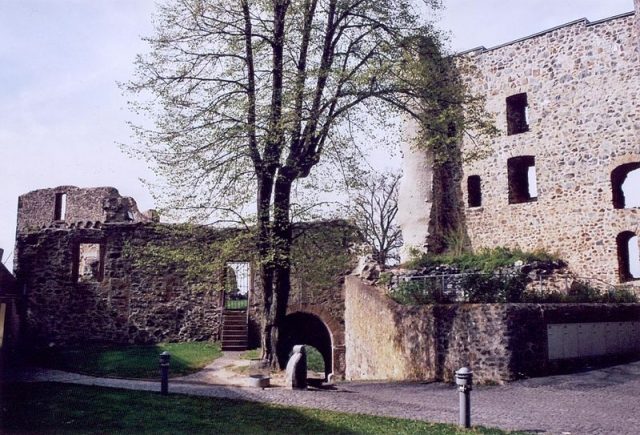
Hohensolms Castle - also known as Neu-Hohensolms, is located on the "Ramsberg" at an elevation of approximately 440 m above sea level in the eponymous district of the municipality of Hohenahr in the Lahn-Dill district in Hesse.
The hill castle was built around 1350 by the Counts of Solms. It replaced the Alt-Hohensolms Castle, which was destroyed in 1349 by the Imperial City of Wetzlar and was located about 2 kilometers further south.
During conflicts with the Imperial City of Wetzlar, the castle was partially destroyed in 1356 and 1363.
With the death of Count Johann III of Solms – Burgsolms (1405 – 1415), this line of the Counts of Solms died out. The castle and lordship passed to Count Bernhard II of Solms-Braunfels (1409 – 1459).
Through a renewed division in 1420, the castle and lordship passed to the Lords of Solms – Lich. Count Reinhard I of Solms – Lich (1544 – 1562) had the castle expanded into a palatial residence around the middle of the 16th century.
In 1579, the Counts of Solms – Lich divided into the lines Lich, Hohensolms, and Butzbach. The complex became the residence of the Counts of Solms – Hohensolms. With the extinction of the Solms – Hohensolms line in 1600, the complex passed in equal parts to Solms – Lich and Solms – Butzbach.
During the Thirty Years' War, the complex was destroyed and only partially rebuilt. While the Counts of Solms – Butzbach restored their part, the Counts of Solms – Lich allowed their part to fall into disrepair.
The complex served as a residence until 1718. In that year, Count Friedrich Wilhelm of Solms – Hohensolms (1707 – 1744) moved his residence to Lich to take over the inheritance of the deceased Count Hermann Adolf Moritz of Solms – Lich (1650 – 1718). This led to the formation of the Solms-Hohensolms-Lich line. Subsequently, the complex was only irregularly used as a widow's residence or summer residence.
From 1924 until its dissolution in 1936, the Christdeutsche Jugend (Christian German Youth) took over the complex as a federal home. From 1943 – 1946, refugees were housed in the buildings. Since 1952, the Protestant Church in Hesse and Nassau has maintained various facilities – predominantly for youth work – in the complex (even though, curiously, the castle is located in the territory of the Protestant Church in the Rhineland).
Take Mobile History with you
You are reading this text for free. Premium adds what matters on the road: descriptions read aloud, sites found through your camera, whole regions taken offline.
- Every description, including the ~17,700 Premium sites
- Audio guide: have descriptions read to you on location
- AR finder: see sites through your camera, with distance and bearing
- Unlimited saved sites
14 days free, then from €2.99 a month. Cancel anytime.
Source: Wikipedia · Licence: CC BY-SA 4.0
This description draws on the facts documented in the linked Wikipedia article; Wikipedia content is licensed under CC BY-SA 4.0. Wording and editing: Mobile History.
Location: 50.6547, 8.5142