To be privately owned
CastleWeinzierl am Walde-Nöhagen
Hartenstein Castle
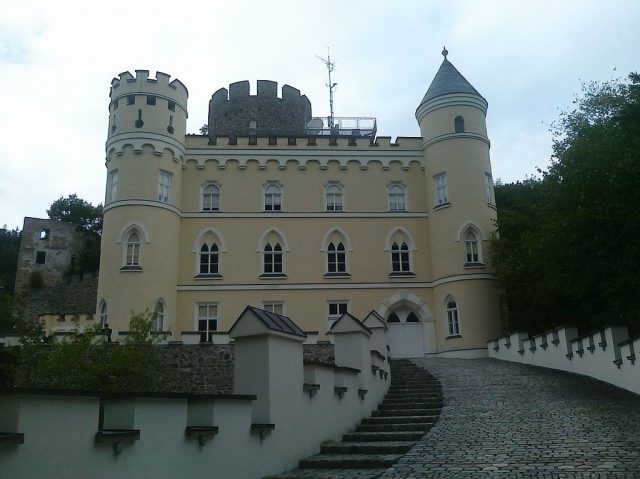
Hartenstein Castle in Austria is located in the small Kremstal valley, in the rugged granite landscape of the Waldviertel, about 15 km west of the city of Krems in the municipality of Weinzierl am Walde in Lower Austria.
The founding of the Hartenstein dominion and the associated construction of a residence is shrouded in the mists of history. The castle was probably built by a possible descendant of the Kuenringer, Heinricus de Hertinsteine, who was mentioned in a document in 1187. Hartenstein was also owned by the Lords of Kaja and Kamegg. They owned the castle until 1270, when it fell to the brothers Hertnit and Leutold von Stadekke. In 1300, Heinrich von Wallsee acquired the complex. The powerful Wallseer family, originating from Swabia, frequently appeared in the Waldviertel as successors to the Kuenringer. They owned numerous lordships such as Spitz, Senftenberg, Gföhl, and Dürnstein. They had Hartenstein administered by burgraves. When they gave up several lordships in the Waldviertel in the second half of the 14th century, Hartenstein came into the possession of the Lords of Maissau from 1380 to 1411. In 1416, Christoph von Rappach acquired the castle. From 1430, it belonged to Hans and Leopold von Neidegg, the owners of Burgschleinitz, Ranna, and Albrechtsberg. In 1445, Jörg Scheck vom Walde bought it. Now the owners changed quite frequently.
In the second half of the 17th century, the castle lords and rulers preferred more comfortable residences, left the castle, and abandoned it to decay. Yet, in 1645, it withstood a brief siege by the Swedes, who, however, blew up the "Nasn," an outwork. In 1666, the later infamously known finance minister Georg Ludwig Graf Sinzendorf bought the dominion with 117 subjects. After his death in 1682, Prince Paul Esterhazy acquired the castle. In 1726, Emperor Charles VI enfeoffed Baron Philipp Ferdinand von Gudenus with Hartenstein, in whose family it remained until 1927. Between 1780 and 1799, Johann Heinrich Reichsfreiherr von Gudenus used the still usable material such as doors and window frames for the construction of his hunting lodge Els. At the beginning of the 19th century, the two towers served as granaries. In 1892, the physician Otto Pospischil leased the complex and established a cold-water sanatorium in the outer bailey, which was rebuilt in the historicizing "castle style" in 1892/96. The main castle had long since become a ruin. An attempt to revive the sanatorium by the physician Erich Buchmeier after the Second World War was unsuccessful. In 1993, Peter Kotauczek and his company BEKO Hartenstein took over.
Surroundings+
Below Hartenstein Castle is the Gudenus Cave, washed out of the bank and inhabited by Neanderthals in the Stone Age, where Lower Austria's earliest settlement traces, almost 100,000 years old, were discovered, such as hand axes and other tools.
Take Mobile History with you
You are reading this text for free. Premium adds what matters on the road: descriptions read aloud, sites found through your camera, whole regions taken offline.
- Every description, including the ~17,700 Premium sites
- Audio guide: have descriptions read to you on location
- AR finder: see sites through your camera, with distance and bearing
- Unlimited saved sites
14 days free, then from €2.99 a month. Cancel anytime.
Source: Wikipedia · Licence: CC BY-SA 4.0 · Image: http://commons.wikimedia.org/wiki/File:Burg_Hartenstein_Niederoesterreich_Hauptansicht.jpg
This description draws on the facts documented in the linked Wikipedia article; Wikipedia content is licensed under CC BY-SA 4.0. Wording and editing: Mobile History.
Location: 48.4461, 15.3968