The Castle can be visited
CastleHardegg - Pleissing
Hardegg Castle
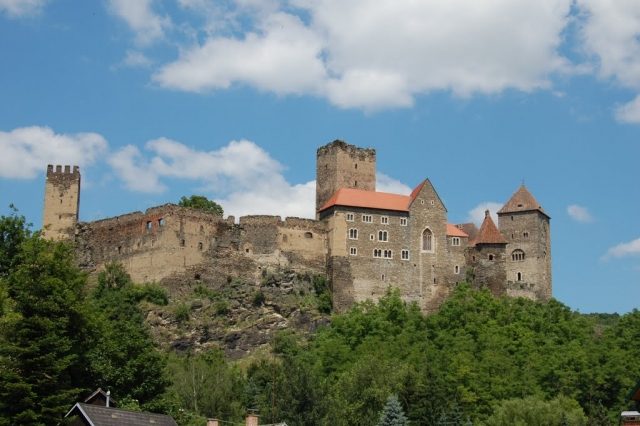
Hardegg Castle is a castle in Lower Austria. It is located in the town of Hardegg in the Thaya Valley.
Hardegg was first mentioned in 1145 in a document by Elisabeth von Schleunz, with Otto de Hardeck cited as a witness to the donation. However, a small defensive structure already existed before that. The first owners were the Counts of Plain and Hardegg. After this lineage died out, the castle had various owners, such as the Magdeburg-Hardeggs. Under them, the castle was significantly expanded until it became one of the largest in the country. A tower, a palas, and a chapel were built. It served as the administrative center of the County of Hardegg, which is traceable from 1294. Towards the end of the 15th century, the County of Hardegg was even immediate to the Empire. The power of the castle lords was based on numerous knightly retinues in the surrounding villages; the main towns of the county administered from Hardegg were Pulkau and Retz, founded between 1280/1305. After the death of the childless Michael, Imperial Count of Hardegg, Burgrave of Magdeburg, the castle passed into the possession of the Habsburgs, who in 1499 passed it on to the heirs of the Magdeburgs, the brothers Prüschenk, Barons of Stettenberg, Hereditary Cupbearers above the Enns, Seneschals in Styria. At the same time, both were appointed Imperial Counts of Hardegg and in Machland. In 1501, Ulrich von Hardegg acquired the County of Glatz from his later brothers-in-law Albrecht, Karl, and Georg von Münsterberg, and thus also the title of Count of Glatz. In 1502, Heinrich and Sigmund received the silver coinage right.
In the mid-17th century, the castle again changed owners and finally came into the possession of the Khevenhüller-Metsch family. Since then, it was hardly inhabited and increasingly fell into disrepair. During the fire of the town of Hardegg in 1764, residents were allowed to use stones and wood from the castle to rebuild their houses.
From 1878, Johann-Carl Prince Khevenhüller-Metsch, who was also known as a fellow combatant of Emperor Maximilian of Mexico against the troops of the republican Mexican government, had the fortress rebuilt and a family crypt installed. The plans were provided by Carl Gangolf Kayser, who was imperial "court architect" in Mexico from 1864 to 1867. A museum was established in the castle in honor of Emperor Maximilian.
Surroundings+
Neighboring castles and palaces include Riegersburg Castle, Kaja Castle, Fronsburg Castle, and in the Czech Republic, the ruins of Nový Hrádek (Neuhäusel).
Take Mobile History with you
You are reading this text for free. Premium adds what matters on the road: descriptions read aloud, sites found through your camera, whole regions taken offline.
- Every description, including the ~17,700 Premium sites
- Audio guide: have descriptions read to you on location
- AR finder: see sites through your camera, with distance and bearing
- Unlimited saved sites
14 days free, then from €2.99 a month. Cancel anytime.
Source: Wikipedia · Licence: CC BY-SA 4.0 · Image: Maciek Wegrzyn
This description draws on the facts documented in the linked Wikipedia article; Wikipedia content is licensed under CC BY-SA 4.0. Wording and editing: Mobile History.
Location: 48.8536, 15.8569