Home for people with handicap
CastleHainchen
Hainchen Castle
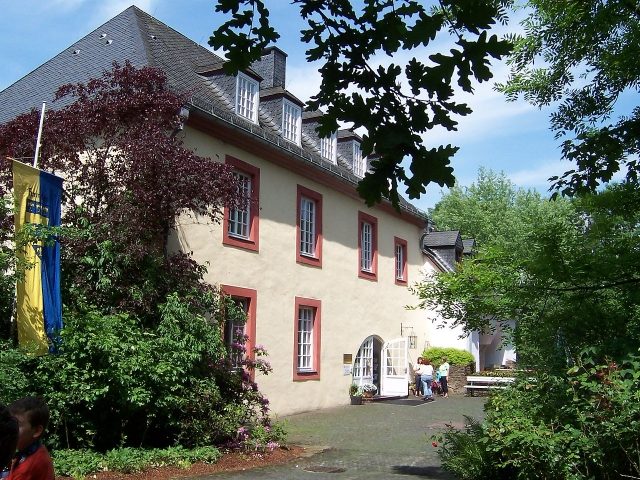
Hainchen Castle is the only moated hilltop castle in Westphalia and is located on the outskirts of the Hainchen district of the city of Netphen in Siegerland (North Rhine-Westphalia).
The castle has existed since at least 1290, the year in which it was first mentioned in a document. At that time, it was owned by the von Hain family, an old noble family in and around Nassau. In 1239, Count Heinrich II the Rich of Nassau, at the request of his vassal Friedrich vom Hain, transferred the revenues of the Netphen parish to the Premonstratensian convent of Keppel near Hilchenbach, which Friedrich had built on his property.
The castle was completely surrounded by two moats. The castle consists of four corner towers, a barrel-vaulted medieval cellar and a vaulted ground floor from 1537.
The castle was sold by its owners in 1313 to Count Heinrich I of Nassau-Siegen.
In 1355, the castle was handed over to the knight Konrad von Bicken from Herborn as a Nassau castle fief.
His descendant Philipp von Bicken then acquired the entire estate, castle and valley of Hain, as a fief in 1443.
The castle was expanded under Philipp von Bicken. The northeast side of the main building received a chapel as an annex. At the beginning of the 16th century, the Lords of Bicken took the moated castle as their residence and fortified it with walls and bulwarks. Since the then liege lord Johann V (Nassau) feared that the Bicken family could become too powerful, the possibility of stationing Nassau troops in the castle was agreed upon for all time in 1511.
One of Philipp von Bicken's sons was Johann Adam von Bicken (* May 27, 1564, † January 11, 1604 in Aschaffenburg), born at Hainchen Castle, who was Archbishop and Elector of Mainz and thus Archchancellor of the Holy Roman Empire from 1601 to 1604. The brothers Johann and Eberhart von Bicken had a magnificent tomb erected for themselves in the parish church of St. Cäcilia in the neighboring village of Irmgarteichen, which is still preserved and can be visited today.
In the 18th century, the von Bicken family was impoverished. They sold Hainchen Castle in 1711 to the Prince of Nassau-Siegen. After further changes of ownership, the moated castle came into the possession of Prince Wilhelm IV, Prince of Orange, on July 7, 1747.
After Hainchen passed into Prussian state ownership, the castle gradually fell into disrepair in the 19th century. In 1864, the last two of the original four main towers were demolished, and the rubble from the building was used to build the country road from Hainchen to Rittershausen in Hesse. Later, from the beginning of the 20th century, the castle remains served as residential and commercial buildings for a Prussian chief forestry office. After the St. Josef Children's Home was bombed out in World War II, it was temporarily housed in the vacant castle rooms in 1945. The establishment of a construction workshop by Berlin Professor Otto Sticht failed in the 1960s due to differing views on the nature and manner of restoration and insufficient investment capital.
Since the 1970s, the castle has been managed by the Siegerländer Burgenverein, which promoted the preservation of Hainchen moated castle and the reconstruction of the castle complex. After the completed reconstruction work, which began with the laying of the foundation stone on February 21, 1976, the moated castle was handed over to its current purpose on January 15, 1977, with a ceremony. Meanwhile, the castle, managed by the Lebenshilfe Institute, serves as a recreation facility for disabled and elderly people in need of care. The approximately 33,000 m² park serves as a cultural meeting place. Inside the castle, the rooms were furnished according to historical specifications during the reconstruction. Here, for example, the oak door from 1557 bears witness to bygone days as the oldest relic, but the castle cellars and the groin vault of the "old kitchen" still fulfill this function.
Take Mobile History with you
You are reading this text for free. Premium adds what matters on the road: descriptions read aloud, sites found through your camera, whole regions taken offline.
- Every description, including the ~17,700 Premium sites
- Audio guide: have descriptions read to you on location
- AR finder: see sites through your camera, with distance and bearing
- Unlimited saved sites
14 days free, then from €2.99 a month. Cancel anytime.
Source: Wikipedia · Licence: CC BY-SA 4.0
This description draws on the facts documented in the linked Wikipedia article; Wikipedia content is licensed under CC BY-SA 4.0. Wording and editing: Mobile History.
Location: 50.8541, 8.2178