To be privately owned
CastleSondershausen-Großfurra
Großfurra Castle
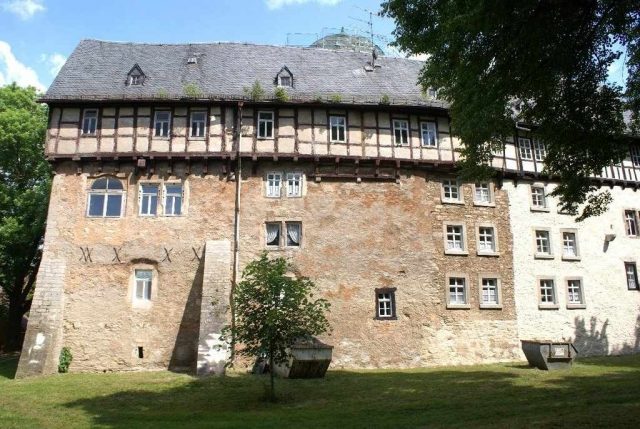
Furra Castle, also known as Großfurra, or colloquially as Schloss, originated from a moated castle in the middle of the present-day district of Großfurra in the town of Sondershausen in the Kyffhäuser district in Thuringia.
The Fulda monastery was already established in Furra in the 9th century. The moated castle was built in the 11th century by the Thuringian Landgraves and first mentioned in 1198 as being in the possession of the knightly family of Furra. With this castle, the inhabitants controlled the Wipper valley west of Sondershausen. The Lords of Furra became vassals of the Margraves of Meissen in 1249 and are mentioned as Hohnstein vassals in 1276.
After the Furra family died out in 1332, the castle was enfeoffed to various noble families and was divided into the eastern wing, the Vogtland, and the western wing, the noble fief.
From 1425 onwards, the von Wurmb family gradually acquired the castle parts from the various noble families and directed the history of the castle and its lands for over 500 years.
Between 1525 and 1526, the von Wurmb family was driven from the castle by rebellious peasants during the Peasants' War. After its suppression, they regained possession. The former protective castle increasingly became a coercive castle against the peasants; it was subsequently rebuilt several times, survived the plague, numerous wars, and remained almost undamaged until the end of the Second World War in 1945.
Due to American artillery shelling of Großfurra in April 1945, the keep of the castle also sustained hits. Under the subsequent Soviet occupation from July 1945, the von Wurmb family was dispossessed without compensation and expelled. The building, colloquially known as Schloss, was plundered, then became public property and was used as a school, kindergarten, and for housing refugees. The valuable library was lost. The expropriation also affected the extensive estate buildings and land. The 500-meter-long castle wall was demolished, and the stones were used for the foundations of new buildings. The Wurmb burial chapel with crypt and coffins became a Catholic church and thus survived the turmoil of the time.
After the fall of communism in 1990, the now dilapidated building stood empty, as the necessary major renovation measures were too costly. The tower had a long crack, roofs, walls, and windows were defective.
After the buildings were purchased by Helmut Pohl, a merchant from Göttingen born in Bavaria, the buildings were extensively renovated and restored from 1996 to 2004 under monument protection premises, and today they serve as his home and company headquarters.
Layout+
The original castle complex was a moated castle surrounded by a rampart, with a two-winged, massive core building, one two-story and one three-story with a half-timbered superstructure. The round, 20-meter-high keep with a diameter of 10 meters and a domed roof is integrated into the building.
The former castle park is a pleasure garden laid out in the 17th century, which was transformed into a landscape garden in the mid-19th century. In 1945 and thereafter, parts of the park were built upon, and the stock of beautiful old trees was thinned by felling.
Take Mobile History with you
You are reading this text for free. Premium adds what matters on the road: descriptions read aloud, sites found through your camera, whole regions taken offline.
- Every description, including the ~17,700 Premium sites
- Audio guide: have descriptions read to you on location
- AR finder: see sites through your camera, with distance and bearing
- Unlimited saved sites
14 days free, then from €2.99 a month. Cancel anytime.
Source: Wikipedia · Licence: CC BY-SA 4.0 · Image: Roland Neubert, Halle (Saale)
This description draws on the facts documented in the linked Wikipedia article; Wikipedia content is licensed under CC BY-SA 4.0. Wording and editing: Mobile History.
Location: 51.3923, 10.7977