To be privately owned
CastleKressbronn-Gießen
Gießen Castle
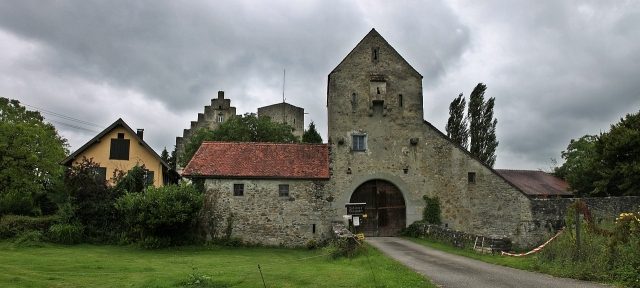
Gießen Castle is a high medieval castle complex in the Gießen district of Kressbronn in the Baden-Württemberg Lake Constance district in Germany.
The lowland castle is located north of the Kressbronn district of Betznau and east of Gießenbrücke. It served to secure the Argen crossing, which possibly already existed in Roman times, as settlements and Roman roads have been proven in the immediate vicinity of the castle.
The castle, built as a motte-and-bailey castle, was a fortified moated castle in the Middle Ages, whose moat was constantly supplied with water by a canal from Laimnau. The well-preserved castle complex is now privately owned and therefore cannot be visited.
This fortified medieval moated castle received its present form in 1482. The gate tower and current access to the courtyard dates from the late 16th century. It has five tower rooms and a tower terrace.
The motte-and-bailey castle was probably already at this location before 1250, and was first mentioned in a document from 1357. It became the administrative center of the estates in the hinterland of Lake Constance in the lower Argental, acquired by the Lindau Heilig-Geist-Spital between 1388 and 1405.
The first documented owners of Gießen Castle came from the knightly family of the Lords of Wolfurt, who had great influence in Southern Germany and Switzerland since the 13th century and produced warriors as well as abbots and nuns.
The Wolfurts were not on good terms with the Counts of Montfort. They preferred to maintain contacts with the city of Lindau and monasteries outside the Montfort sphere of influence.
On July 3, 1405, the Lindau Heilig-Geist-Spital bought Gießen Castle, including the farmyard, mill, other individual farms, serfs, court, interest income, wine and grain tithes and other rights from the knight Ulrich von Wolfurt and his nephew Wolf von Wolfurt for 3,000 Rhenish guilders, as the three children of the deceased Rudolf von Wolfurt were unable to maintain the inherited property.
Gießen Castle with its possessions and rights was soon after united with the village of Laimnau, the Elmenau property and the Ulrichskapelle to form the Spitalische Niedergericht Gießen and Laimnau. In accordance with its importance, the castle was not occupied by a steward, but by a bailiff.
Between 1482 and 1486, the castle was fortified with a moat and rampart – against all protests from Count Ulrich von Montfort of Tettnang. In 1521, the residential building was enlarged, in 1529 the tower clock was commissioned, and since 1531 spring water flowed from a well.
During the Thirty Years' War, the Swedish General Wrangel occupied Gießen Castle on May 8, 1647, after an unsuccessful conquest of Lindau. In the middle of the 18th century, major construction measures began at the castle: a new tower clock was installed in 1768, the ring moat was re-excavated, in 1774 the inner castle wall was demolished and the inner moat was filled in, and in 1788 the old drawbridge was replaced by a stone arched bridge.
After the reorganization of Europe by Napoleon, Gießen Castle became unprofitable for the Lindau Hospital and was to be sold. Its parceled lands found buyers only with difficulty. The castle itself was auctioned in May 1810 for 14,020 guilders to the Electoral Trier Chamberlain Carl Anselm von Horben zu Ringenberg from Augsburg. However, he could not pay, so the castle passed into the possession of the bailiff Josef Köberlin von Mitten (Wasserburg) on September 26 of the same year for a payment of 13,000 guilders.
For the following 175 years, Gießen Castle remained a farm. The owners changed repeatedly. In 1868, Father Augustin Fischer, cabinet secretary to the Austrian Archduke Maximilian, acquired the complex, and from 1877 to 1974 it was owned by two farming families. Even today, the former moated castle of Gießen with its outbuildings is privately owned.
Franz Innozenz Nachbaur+
Innozenz Nachbaur was born on March 25, 1830, as the son of the farmer Fidel Nachbaur and his wife Genoveva, née Götz, at Gießen Castle. He only later adopted the name Franz. Nachbaur became a famous tenor singer - he lent his voice to all Wagner operas.
Take Mobile History with you
You are reading this text for free. Premium adds what matters on the road: descriptions read aloud, sites found through your camera, whole regions taken offline.
- Every description, including the ~17,700 Premium sites
- Audio guide: have descriptions read to you on location
- AR finder: see sites through your camera, with distance and bearing
- Unlimited saved sites
14 days free, then from €2.99 a month. Cancel anytime.
Source: Wikipedia · Licence: CC BY-SA 4.0 · Image: Norbert Kaiser
This description draws on the facts documented in the linked Wikipedia article; Wikipedia content is licensed under CC BY-SA 4.0. Wording and editing: Mobile History.
Location: 47.6265, 9.5991