Cultural Events
CastleArnsberg-Neheim-Hüsten
Freseken Castle
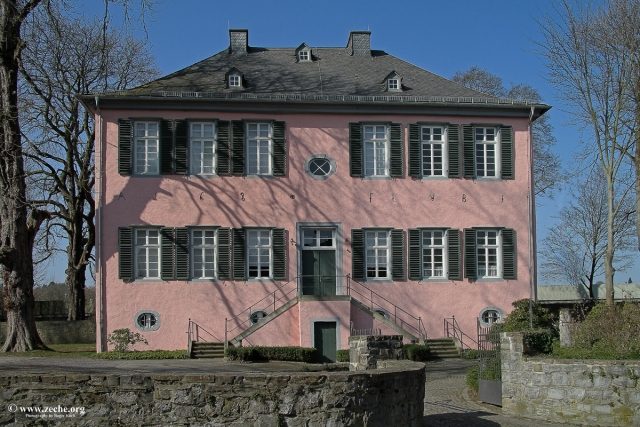
The Fresekenhof is a former Burgmannenhaus (knight's house) in Neheim, originally dating from the 14th century and rebuilt in the 17th century.
The building originally dates from the 1360s. Against the backdrop of warlike conflicts between the County of Arnsberg and the County of Mark, the fortifications of Neheim Castle were strengthened at that time. Among other things, the Fresekenhof was built on the city wall. Together with the Schüngelschen Burghaus to the north, the building secured the city gate facing west. Even on the current building, remnants of the city wall still clearly show its former defensive character.
After the County of Arnsberg passed to the Archbishopric of Cologne, the sovereign Friedrich III granted the house, along with land ownership, to the Burgmann Wilhelm Freyseken on August 28, 1377. He came from the knightly family of Nihem. Later, the family was called Freseken.
The building remained in family ownership until the 16th century. The new owner was Captain Israel, one of the co-founders of the St. Johann Baptist shooting fraternity of 1607. In 1633, the Fresekenhof was destroyed by Swedish-Hessian troops.
The next owner was Ferdinand Lothar von Bönnighausen, a colonel in the service of the Electorate of Cologne and the illegitimate son of Field Marshal Lothar Dietrich von Bönninghausen. The new owner had the building rebuilt in 1688 on the foundations and using the preserved vault of the previous building. For the next three generations, the property remained in the Bönnighausen family.
In 1699, it passed into the possession of the chamberlain and court councilor Friedrich von Wrede-Lohe. He was followed in 1718 by Major General Stephan Christian von Folleville. After his death, his widow lived in the Fresekenhof before she was murdered in 1749.
Clemens Lothar von Fürstenberg zu Herdringen acquired the building in 1766. This included 208 Morgen of land and hunting rights. After 1807, the house served as a widow's residence. It was also rented out as a court seat between 1802 and 1892. In 1820, the residential building was redesigned in the classical style. After the court moved out, the Fresekenhof was the seat of a state forestry office until 1918. After the Second World War, it housed refugee families until 1955, later a private museum and storage rooms.
Efforts by Baron von Fürstenberg to find a new use, such as a hotel or museum, were thwarted by the construction of the Bundesautobahn 46 directly behind the Fresekenhof. In 1980, the Arnsberg city council decided to purchase the building and establish a community center.
Today
Today, the city of Arnsberg uses the fireplace room in the building for smaller receptions and as a wedding room for civil marriages. Other users include the local shooting fraternity, the hunters' association, and the Neheim-Hüsten local heritage association. There is also a permanent exhibition about Franz Stock.
The bird shooting for the shooting festival takes place in the courtyard of the Burghaus Freseken.
Take Mobile History with you
You are reading this text for free. Premium adds what matters on the road: descriptions read aloud, sites found through your camera, whole regions taken offline.
- Every description, including the ~17,700 Premium sites
- Audio guide: have descriptions read to you on location
- AR finder: see sites through your camera, with distance and bearing
- Unlimited saved sites
14 days free, then from €2.99 a month. Cancel anytime.
Source: Wikipedia · Licence: CC BY-SA 4.0 · Image: http://www.zeche.org/
This description draws on the facts documented in the linked Wikipedia article; Wikipedia content is licensed under CC BY-SA 4.0. Wording and editing: Mobile History.
Location: 51.4553, 7.9551