Museum
Restaurant
CastleFalkenstein
Falkenstein Castle
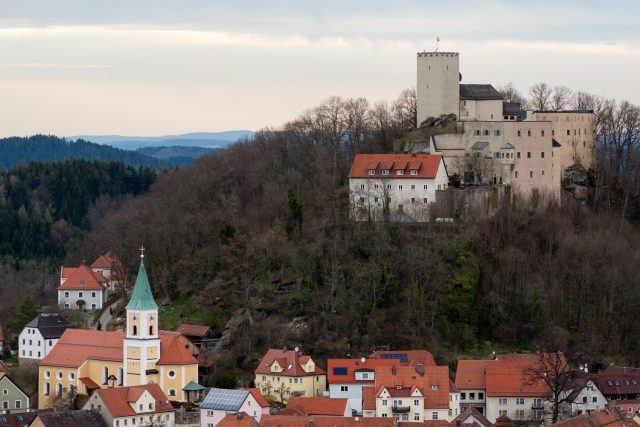
Falkenstein Castle is a hilltop castle above the climatic health resort of Markt Falkenstein in the Upper Palatinate district of Cham. The castle is located on a granite rock at an altitude of 626 meters above sea level and about 60 meters above the valley floor of the Perlbach. In good visibility, the view from the tower extends to the Großer Arber in the east and to the foothills of the Alps.
The towering granite cone was fortified in 1074 as a protective and defensive castle by the Prince-Bishopric of Regensburg under Bishop Tuto. Together with the castles of Wörth and Donaustauf, it secured the eastern area of the Prince-Bishopric of Regensburg. The first written record dates back to the years 1129 to 1130, when a Rudolf von Valchenstein and an Otto von Valchenstein appear in the documents. These may have been members of the Neuburg-Falkenstein family. In 1150, the keep was built. Towards the end of the 12th century, the castle passed to the Counts of Bogen. When this family died out with Count Adalbert V in 1242, the Wittelsbachs inherited the property. The ownership was not clear, because when Konrad II von Hohenfels got into a dispute with his neighbors in Brennberg in 1232, he returned the castle to Bishop Siegfried of Regensburg as part of a settlement. Thus, the Bishops of Regensburg always remained owners of the castle and lordship. A few years later, the Bishop of Regensburg returned the lordship of Falkenstein to the Hohenfels family. The castle then remained in the hands of the Hohenfels family for a longer period, but they became involved in ever new feuds with their neighbors. After the imposition of the Imperial Ban, Heinrich von Hohenfels - Falkenstein was forced in 1323 to sell the castle to King Ludwig IV the Bavarian. However, King Ludwig did not have the money to pay the purchase price, so he borrowed it from Landgrave Ulrich von Leuchtenberg. Since he could not repay the amount, the king ceded the castle and lordship to the Landgrave in 1327. In 1514, Duke Wilhelm IV gifted the castle to the Stauffers of Ehrenfels. Thereafter, the owners changed as follows:
- Preysing (1550 - 1565)
- Seyboldsdorf (1565 - 1590)
- Nothafft zu Wernberg (1590 - 1607)
- Khuen von Belasy (1607-1625)
- Maxlrain (1625 - 1664)
- Haslang zu Haslankreit (1629 - 1664)
- Maximilian von Törring (from 1664)
In the 17th century, the castle was reshaped with late Renaissance elements, such as the arcaded walkways on the ground and upper floors. The castle chapel, built onto the castle, dates back to Count Törring (from 1664). In 1829, the castle went for 150,000 fl. to the princely house of Thurn und Taxis. Due to its limited use, the complex fell into such disrepair in the 19th and 20th centuries that in 1967, the market town of Falkenstein had to acquire the dilapidated castle for a symbolic price of one Mark to save it from final decay. In 1978, the renovation work was completed. Since then, the restored castle has served as a 'House of the Guest' with gastronomy and a Hunting and Wildlife Museum, which is based on the collection of hunting trophies of the Hamburg notary Hans-Werner Schacht (1907-1981). Annual castle courtyard plays take place in the inner courtyard of the castle.
Architectural Description+
The complex consists of a 40 x 40 meter outer and main castle, the latter being divided into upper and lower castle. The rubble-stone ring wall of the outer bailey is mostly preserved only as a retaining wall and connects in the northwest to the so-called "Weiberwehr" (women's defense). The narrow courtyard is an elongated pentagon of approx. 45 x 29 meters, which is entered from the strategically angled and vaulted gate passage. Above the gate is the alliance coat of arms of the von Belasy/Nothafft families. The outer walls of the lower castle, up to 1.50 meters wide, belong to the oldest building fabric of the castle complex, which is rather to be dated to the 13th century. The square five-story keep, with dimensions of 8.5 x 8.5 meters, rises steeply from the rock in the west. The castle chapel is a hall building with a barrel vault with lunettes resting on consoles, featuring post-Gothic decorative ribs, a small square west tower with an octagonal top and onion dome, and a choir rounded at the bottom and closed on three sides at the top.
Surroundings+
The surrounding castle park is considered the second largest nature and rock park in Bavaria and is a nature reserve. The very rare, light-reflecting luminous moss can also be found there. The Klause, the Froschmaul, Steinernes Gässchen, Hohler Stein, and Himmelsleiter are highlights of a hike through the castle park.
Trivia+
When the Hussites threatened Falkenstein around 1430, the Zwinger (outer bailey) was defended by brave women, and the surrounding battlement was subsequently named "Weiberwehr" (women's defense).
Take Mobile History with you
You are reading this text for free. Premium adds what matters on the road: descriptions read aloud, sites found through your camera, whole regions taken offline.
- Every description, including the ~17,700 Premium sites
- Audio guide: have descriptions read to you on location
- AR finder: see sites through your camera, with distance and bearing
- Unlimited saved sites
14 days free, then from €2.99 a month. Cancel anytime.
Source: Wikipedia · Licence: CC BY-SA 4.0
This description draws on the facts documented in the linked Wikipedia article; Wikipedia content is licensed under CC BY-SA 4.0. Wording and editing: Mobile History.
Location: 49.0992, 12.4843