Cultural Events
CastleErkelenz
Erkelenz Castle
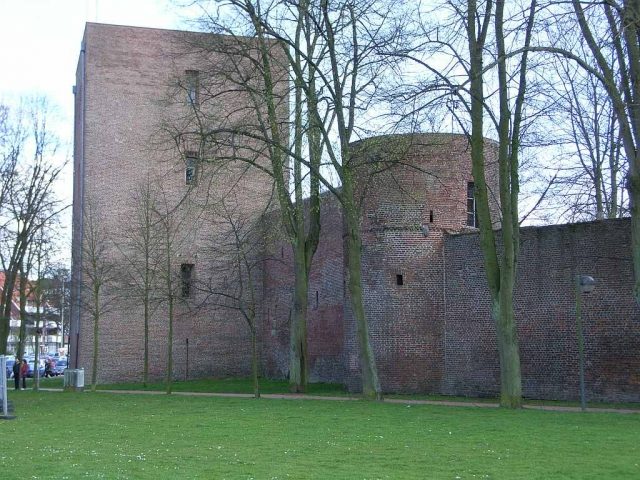
Although the castle is only mentioned in documents in 1349, the city presumably already had a lighter rampart when it was granted city rights in 1326, which had begun in the 11th century. In addition, the castle was obviously incorporated into the city wall, so it must have been present when city rights were granted in 1326. It is also hardly conceivable that an unfortified place was elevated to a city.
The castle was only accessible from the city. Rainald IV, Duke of Gelre († 1423), had planned when building the castle tower in 1423 to create an access point for himself and his men also facing the field, without being dependent on the opening and closing of the city gates. However, his successor Arnold von Egmond had to commit to the citizenry to wall up the already started access point again and never to open it again. The castle was the seat of the bailiffs, a garrison, and an armory.
The simple brick tower, which before its restoration, having fallen into ruin, was popularly called the Witch's Tower, measures 13 meters in side length on a square plan, 23 meters in height facing the field, and has 3.50-meter thick masonry at the bottom. From the elevated castle courtyard, it features, above a basement that served as a torture chamber, three upper floors, each with a window in every cardinal direction, small light windows in the spiral staircase, and a latrine bay window over two upper floors. The adjacent castle wall with loopholes is 11 meters high on the field side and equipped on the castle side with a covered battlement over pointed arch arcades.
On the city side, the castle also had smaller towers and a drawbridge over a moat. The lower part of such a tower can still be seen here. Next to it is the so-called Wolfsturm (Wolf's Tower), rather a rectangular tower stump, which was the castle dungeon, above ground on the city side but without doors or windows, into which prisoners were lowered ("holed") from the castle courtyard through a round hole in the center of the ceiling. The tower was so named because the howling and lamenting of the prisoners there reminded one of wolves. Concluding the building complex, one of formerly 14 defensive towers in the castle and city wall is still present.
Take Mobile History with you
You are reading this text for free. Premium adds what matters on the road: descriptions read aloud, sites found through your camera, whole regions taken offline.
- Every description, including the ~17,700 Premium sites
- Audio guide: have descriptions read to you on location
- AR finder: see sites through your camera, with distance and bearing
- Unlimited saved sites
14 days free, then from €2.99 a month. Cancel anytime.
Source: Wikipedia · Licence: CC BY-SA 4.0
This description draws on the facts documented in the linked Wikipedia article; Wikipedia content is licensed under CC BY-SA 4.0. Wording and editing: Mobile History.
Location: 51.0819, 6.3157